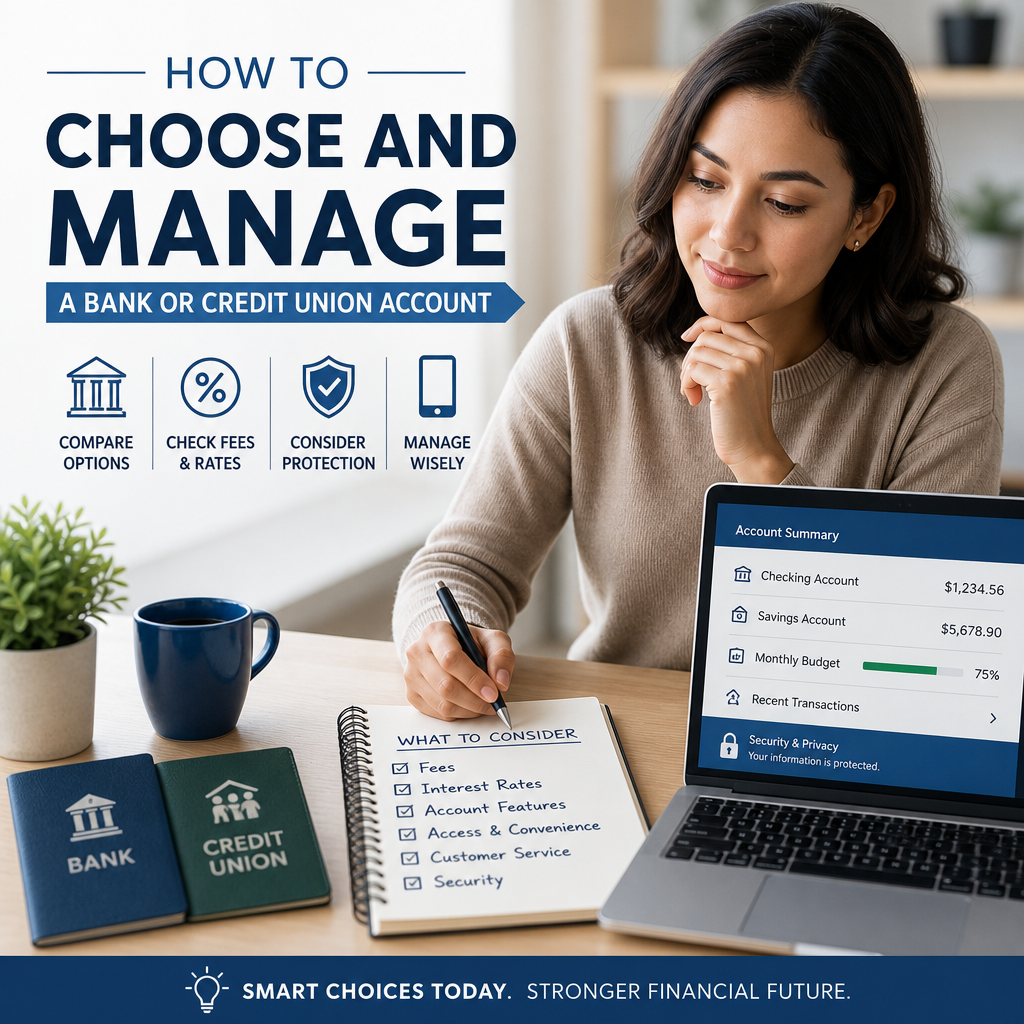
How to Choose and Manage a Bank or Credit Union Account
Choosing the right bank or credit union account can help you save money, avoid fees, and make everyday finances easier to manage. This guide shows you what to compare and how to keep your account working for you.
By: Mary Mitchell on August 3, 2026
Anúncios
Opening a bank or credit union account is one of the first steps toward building financial stability. The right account can make everyday money management easier, help you avoid unnecessary fees, and give you tools for saving, spending, and planning ahead. The wrong one, on the other hand, can quietly drain your balance through maintenance charges, overdraft fees, and inconvenient service.
Whether you’re opening your first account or thinking about switching institutions, it helps to understand how different accounts work and what to look for before you sign up. In this guide, you’ll learn how to compare options, choose the best fit for your needs, and manage your account with confidence.
Anúncios
Understanding the Basics of a Bank or Credit Union Account
A bank or credit union account is a place to store money safely while giving you access to everyday financial services. Most people use at least one checking account, and many also keep savings accounts for emergencies or future goals.
Common account types
Here are the most common accounts you’ll encounter:
Anúncios
Checking accounts: Designed for daily spending, bill payments, debit card purchases, and direct deposit.
Savings accounts: Intended for money you don’t need to spend immediately.
Money market accounts: Often combine features of checking and savings, sometimes with check-writing or debit access.
Certificates of deposit (CDs): Hold money for a fixed term in exchange for a set interest rate.
Banks and credit unions offer many of the same account types, but they may differ in fees, rates, membership rules, and customer service.
Bank vs. credit union
A bank is a for-profit financial institution, while a credit union is a member-owned cooperative. That difference can affect your experience:
Banks often have larger branch networks, more ATM access, and broader digital tools.
Credit unions may offer lower fees, better rates, and a more community-focused approach.
Membership requirements apply to most credit unions, but they are often easier to meet than people expect.
The best choice depends on your priorities: convenience, fee structure, rates, service, or access to physical branches.
How to Choose the Right Bank or Credit Union Account
Choosing a bank or credit union account starts with understanding how you use money now and how you want to manage it in the future. A college student, a freelancer, a family, and a retiree may all need different features.
1. Start with your financial habits
Ask yourself a few practical questions:
Do you write checks or mostly use debit and digital payments?
Do you keep a low balance or maintain a cushion?
Do you need access to branches and in-person help?
Do you travel often or need a wide ATM network?
Are you trying to save more automatically?
Your answers will guide you toward the right mix of checking, savings, and digital features.
2. Compare fees carefully
Fees matter more than many people realize. A small monthly charge can add up fast, especially if your balance is low.
Look for:
Monthly maintenance fees
Overdraft and NSF fees
ATM fees
Wire transfer fees
Paper statement fees
Excess withdrawal fees on savings accounts
Cashier’s check or stop payment fees
Some accounts waive fees if you meet conditions such as:
Setting up direct deposit
Maintaining a minimum balance
Using your debit card a certain number of times each month
Enrolling in e-statements
If an account sounds attractive but has several fee triggers, read the fine print before opening it.
3. Review interest rates and APY
For savings accounts, money market accounts, and CDs, the annual percentage yield (APY) tells you how much interest you can earn over a year, including compounding. Higher APY can help your savings grow faster, especially when you keep money in the account long term.
That said, don’t choose an account based on APY alone. A high rate is less helpful if:
The account charges monthly fees
The institution has poor digital tools
Your money is hard to access when needed
The account requires a large minimum balance
4. Check digital and mobile banking tools
Most people manage money online now, so a strong mobile app and website are essential. Look for features such as:
Mobile check deposit
Bill pay
Balance alerts
Spending summaries
Automatic transfers
Person-to-person payments
Card controls and freeze/unfreeze options
Good digital tools make it easier to track spending, avoid overdrafts, and stay organized.
5. Consider ATM and branch access
If you use cash often or prefer in-person service, branch and ATM access matters. Check whether the institution has:
Branches near your home, work, or school
A large fee-free ATM network
Shared branching access, especially common with credit unions
Out-of-network ATM fees and reimbursement policies
If you travel frequently, a nationwide ATM network may be more important than having a branch nearby.
6. Evaluate customer service and reputation
A bank or credit union can look great on paper but still be frustrating to use. Research customer service before you open an account.
Useful signs of quality service include:
Responsive phone and chat support
Clear account disclosures
Easy-to-understand fee schedules
Helpful local branch staff
Strong app ratings and user reviews
You can also check whether the institution is insured and in good standing with its regulator.
7. Look at minimum opening deposits and balance requirements
Some accounts require a minimum deposit to open. Others may require you to keep a certain balance to avoid fees or earn interest.
If you’re starting with limited funds, choose an account with:
A low or no minimum opening deposit
No monthly maintenance fee
No minimum balance requirement
Flexible overdraft protection options
A simple account structure can save frustration and help you build healthy habits.
Choosing the Best Account for Your Goals
Different goals call for different account types. A good bank or credit union account should match your stage of life and your financial priorities.
For everyday spending
A checking account is usually the foundation. Look for:
Low fees
Easy bill pay
Debit card access
ATM convenience
Mobile alerts for low balances
If your paycheck is direct deposited, make sure the account supports it smoothly.
For saving and emergency funds
A savings account is ideal for money you want to keep separate from everyday spending. For an emergency fund, choose an account that offers:
Easy transfers from checking
No monthly fee
Reasonable APY
Fast access when needed
Some people keep a separate savings account for emergencies, vacations, or large purchases like car repairs.
For students or first-time account holders
If you’re new to banking, simplicity is key. Look for:
No monthly fees
Low opening deposit
Strong mobile banking
Educational resources
Easy overdraft protection settings
A basic checking and savings combo can be enough to start.
For families
Families often benefit from accounts that support:
Joint ownership
Automatic savings transfers
Shared budgeting tools
Teen or child accounts
Bill payment and recurring transfer features
This setup can help parents teach money skills while keeping expenses organized.
How to Open a Bank or Credit Union Account
Once you’ve narrowed your choices, opening an account is usually straightforward.
What you’ll typically need
Most institutions ask for:
Government-issued photo ID
Social Security number or taxpayer identification number
Date of birth
Contact information
Physical address
Opening deposit, if required
If you’re opening a credit union account, you may also need to prove eligibility for membership.
Steps to open the account
Compare account details and choose the best fit.
Gather your documents.
Apply online or visit a branch.
Review the account agreement and fee schedule.
Fund the account with your opening deposit.
Set up online banking, alerts, and direct deposit if needed.
Take time to read the disclosures before you agree. The account opening process is also a good moment to ask questions about overdraft coverage, mobile deposits, and transfer limits.
How to Manage a Bank or Credit Union Account Effectively
Opening the account is only the beginning. Good account management protects your money and helps you stay in control.
Track your balance regularly
One of the easiest ways to avoid overdrafts is to check your balance often. Don’t rely only on the number shown on the app’s home screen, especially if recent purchases haven’t cleared yet.
Try to:
Review transactions weekly
Keep a small buffer in checking
Watch for pending charges
Reconcile your records with the bank or credit union app
Set up alerts
Account alerts can warn you before small problems become big ones. Useful alerts include:
Low balance notifications
Large withdrawal alerts
Direct deposit confirmations
Bill due reminders
Card-not-present transaction alerts
These notifications can help you catch fraud, avoid overdrafts, and stay on top of bills.
Automate savings and bill payments
Automation is one of the simplest ways to manage money better. You can set up:
Recurring transfers to savings
Automatic bill pay for fixed expenses
Round-up savings programs
Direct deposit splits between checking and savings
For example, if you get paid every two weeks, you might automatically move a small amount into savings on payday. That habit can build a cushion without requiring constant effort.
Protect yourself from overdrafts
Overdrafts happen when your account doesn’t have enough money to cover a transaction. Depending on the institution, the fee can be expensive.
To reduce the risk:
Keep a spending buffer
Turn on balance alerts
Link savings as overdraft protection if available
Ask whether the account allows debit card and ATM overdraft coverage separately
Track recurring subscriptions that may be easy to forget
It can also help to understand the institution’s overdraft policy before you need it.
Watch for fraud and unauthorized activity
Security is a major part of account management. Review transactions regularly and report suspicious activity right away.
Protect your account by:
Using strong, unique passwords
Enabling two-factor authentication
Avoiding public Wi-Fi for sensitive banking tasks
Shredding paper statements
Using card lock features when available
Reporting lost or stolen cards immediately
If you see unfamiliar transactions, contact the institution as soon as possible.
Reassess your account from time to time
Your needs change, and your account should change with them. A student account that worked well in college may not be ideal after you start a full-time job. Likewise, a family may outgrow a basic checking account.
Review your account every year or so and ask:
Am I paying unnecessary fees?
Do I have the right features?
Is the mobile app working well for me?
Could another bank or credit union offer better value?
A periodic review can save money and reduce stress.
Mistakes to Avoid When Choosing a Bank or Credit Union Account
Even a solid account can become a poor fit if you overlook the details.
Common mistakes include:
Choosing an account only because it has a bonus offer
Ignoring monthly maintenance fees
Forgetting to check ATM access
Missing minimum balance requirements
Overlooking overdraft policies
Failing to review the mobile app
Not understanding credit union membership rules
Promotional offers may be appealing, but long-term value usually matters more than a short-term incentive.
Practical Example: Choosing the Right Account
Imagine two people shopping for a new bank or credit union account.
Maria works remotely, gets paid by direct deposit, rarely uses cash, and wants strong mobile tools. She may prefer a checking account with no monthly fee, a solid app, and a high-APY savings account with automatic transfers.
James works in a job that pays cash tips and needs easy branch access. He may prefer a credit union with low fees, shared branching, and nearby ATM access.
Both are choosing based on how they actually use money, not just the headline features. That’s the key to finding the right account.
Frequently Asked Questions
What is the difference between a bank account and a credit union account?
A bank account is held at a for-profit financial institution, while a credit union account is offered by a member-owned cooperative. Credit unions often have lower fees and better rates, while banks may offer more branches, ATMs, and technology options. The best choice depends on your goals, location, and service preferences.
What fees should I look out for before opening an account?
The most important fees to review are monthly maintenance fees, overdraft fees, ATM fees, minimum balance charges, and paper statement fees. Also check for savings account withdrawal limits, wire transfer fees, and account closure fees. A low-fee account can save you much more over time than a flashy promotional offer.
How much money do I need to open a bank or credit union account?
It depends on the institution. Some accounts require no minimum opening deposit, while others may ask for a small starting amount. If your budget is tight, look for accounts with no opening deposit requirement and no monthly fee so you can keep more of your money available.
Is my money safe in a bank or credit union account?
Deposits at banks are generally insured by the FDIC, and deposits at most credit unions are insured by the NCUA. This insurance protects eligible deposits up to the applicable limits. Always confirm that the institution is insured before opening an account.
How can I avoid overdraft fees?
You can reduce overdraft fees by tracking your balance, setting up low-balance alerts, keeping a small buffer in checking, and linking a savings account for overdraft protection if available. It also helps to review recurring payments and subscriptions so you don’t get surprised by automatic withdrawals.
Choosing and managing a bank or credit union account is about more than finding a place to store money. The right account can help you reduce fees, simplify bill payment, build savings, and protect yourself from fraud and overdrafts. The key is to match the account to your habits, goals, and need for convenience.
Before opening an account, compare fees, APYs, ATM access, mobile tools, and customer service. If you’re deciding between a bank and a credit union, think about whether you value branch convenience, lower costs, or a more personalized service experience. Once your account is open, manage it actively by checking balances, setting alerts, automating transfers, and reviewing transactions regularly.
A little attention goes a long way. With the right account and a few smart habits, you can make everyday banking easier and set yourself up for stronger financial health over time. Start by comparing your current account to a better option, and make the switch if it clearly supports your needs.
Mary S, CFP®, is a Certified Financial Planner with over 12 years of experience in personal finance, retirement planning, and wealth management. She writes educational content that helps readers understand financial concepts and make informed decisions based on reliable information.