Mutual Funds and ETFs: Similarities and Key Differences
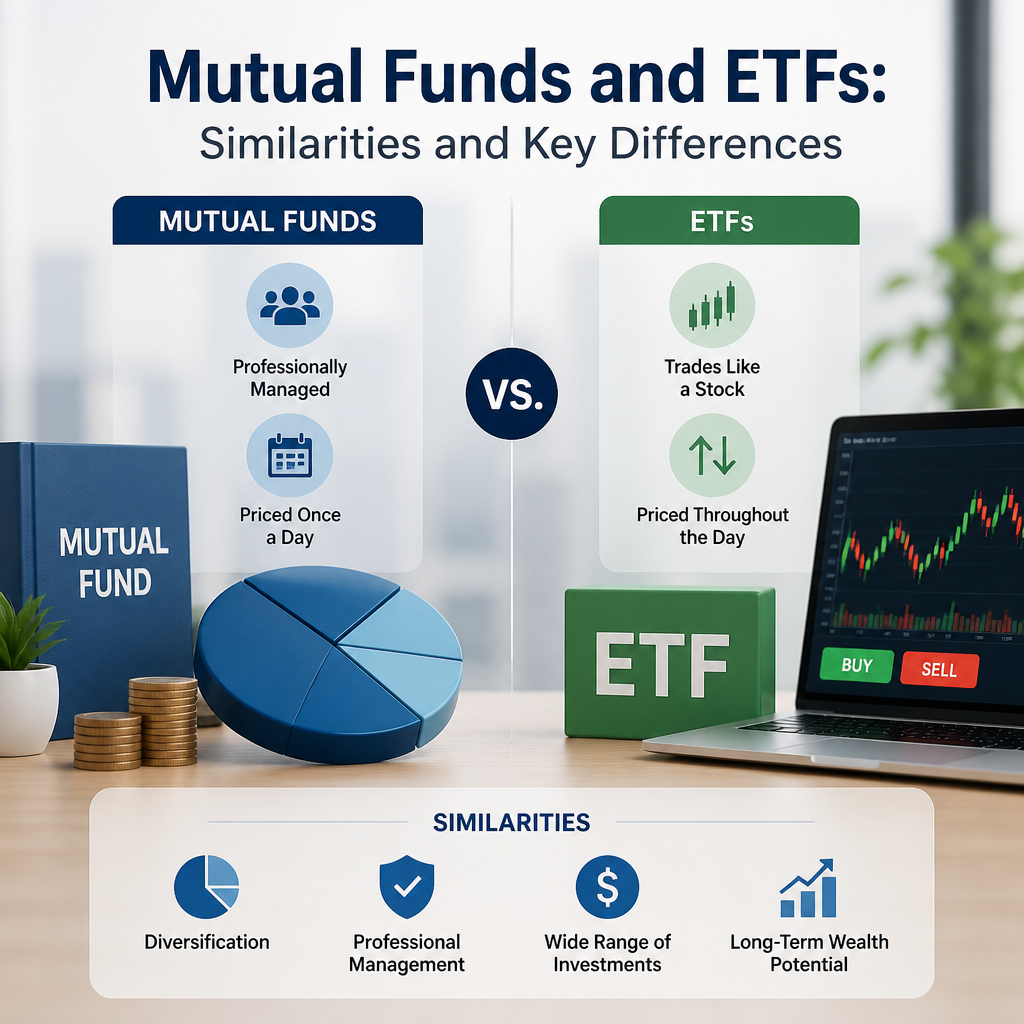
Mutual funds and ETFs both make it easy to build a diversified portfolio without choosing individual securities one by one. But while they share the same basic goal, their trading, pricing, and tax treatment can lead to very different results for investors.
By: Mary Mitchell on August 3, 2026
Anúncios
If you’re building a diversified portfolio, you’ll almost certainly encounter mutual funds and ETFs. Both are popular ways to invest in a broad mix of stocks, bonds, or other assets without having to pick every security yourself. They share a lot in common, but the way they trade, cost, and fit into a financial plan can be very different.
Understanding mutual funds and ETFs can help you choose the right option for your goals, risk tolerance, and investing style. Whether you’re saving for retirement, investing in a taxable account, or just getting started, knowing the differences can save money, reduce confusion, and improve your long-term results.
Anúncios
What Are Mutual Funds and ETFs?
At a basic level, both mutual funds and exchange-traded funds, or ETFs, are pooled investment vehicles. That means many investors combine their money into one fund, and a professional manager or index strategy uses that pool to buy a diversified set of holdings.
Mutual Funds
A mutual fund collects money from investors and uses it to buy a portfolio of assets. Those assets may include:
Anúncios
Stocks
Bonds
Cash equivalents
A mix of asset classes
Mutual funds can be actively managed, meaning a portfolio manager makes decisions about which securities to buy and sell. They can also be passively managed, such as index mutual funds that aim to track a market benchmark.
ETFs
An ETF is also a pooled investment fund, but it trades on an exchange like a stock. Investors buy and sell ETF shares throughout the trading day at market prices. Like mutual funds, ETFs can be active or passive, but many are designed to track an index.
The Biggest Similarities Between Mutual Funds and ETFs
Even though they work differently, mutual funds and ETFs overlap in several important ways.
Both Offer Diversification
Instead of buying one or two individual stocks, you can own dozens, hundreds, or even thousands of securities through a single fund. That diversification can help reduce the impact of any one company’s poor performance.
Both Can Be Actively or Passively Managed
You’ll find:
Actively managed mutual funds
Index mutual funds
Actively managed ETFs
Index ETFs
This means the fund structure does not determine the strategy by itself. A fund may be designed to beat the market, or it may simply aim to match it.
Both Can Fit Long-Term Goals
Investors commonly use either option for:
Retirement accounts
College savings
Taxable brokerage accounts
Core portfolio diversification
For many people, the right choice depends less on the fund type and more on the underlying strategy, fees, and tax consequences.
The Most Important Differences Between Mutual Funds and ETFs
This is where things get interesting. The structure of mutual funds and ETFs affects how you buy them, how they’re priced, and how they may be taxed.
Trading and Pricing
Mutual Funds Trade Once Per Day
Mutual fund shares are priced at the end of the trading day, after the market closes. When you place an order, you usually don’t know the exact price until the fund calculates its net asset value, or NAV.
This can be useful if you prefer a simple, hands-off approach. But it also means you can’t react intraday the way you can with a stock or ETF.
ETFs Trade Throughout the Day
ETFs trade on exchanges during market hours. You can place:
Market orders
Limit orders
Stop orders, depending on your broker
This gives investors more flexibility, but it also introduces bid-ask spreads and price changes throughout the day.
Buying Minimums and Investment Amounts
Mutual Funds May Have Minimum Investments
Some mutual funds require a minimum initial investment, which can be a barrier for new investors. However, many funds offered in workplace retirement plans or through brokerage platforms now have low or no minimums.
ETFs Let You Buy by the Share
With ETFs, you generally buy whole shares unless your broker supports fractional shares. That can make ETFs feel less flexible at first, especially if the share price is high.
Expense Ratios and Fees
Cost matters, especially over long periods. Both fund types charge ongoing fees, usually expressed as an expense ratio.
Mutual Funds Can Be More Expensive
Actively managed mutual funds often have higher expense ratios because they rely on research teams and portfolio managers. Some also charge sales loads or other fees, though many low-cost mutual funds are available.
ETFs Often Have Lower Expense Ratios
Many ETFs, especially index ETFs, are known for low expense ratios. That said, not all ETFs are cheap. Actively managed ETFs or specialized sector funds can carry higher costs.
Tax Efficiency
Tax treatment is one of the key reasons many investors compare mutual funds and ETFs closely.
ETFs Are Often More Tax Efficient
Because of how ETF shares are created and redeemed, many ETFs distribute fewer capital gains than comparable mutual funds. That can make them attractive in taxable brokerage accounts.
Mutual Funds May Distribute Capital Gains More Often
Mutual fund managers may need to sell holdings to meet redemptions or rebalance the portfolio, which can trigger taxable capital gains distributions for shareholders.
That does not mean mutual funds are a bad choice. In tax-advantaged accounts like 401(k)s and IRAs, tax efficiency may matter less.
Automatic Investing and Dollar-Cost Averaging
Mutual Funds Make Automation Easy
Mutual funds are often well suited to automatic investing because you can contribute a set dollar amount each month. This makes it easier to build a habit and practice dollar-cost averaging.
ETFs Are Improving, But Can Be Less Seamless
Some brokers now allow recurring ETF purchases and fractional shares. Still, mutual funds usually offer a smoother experience for investors who want to invest a fixed amount on a schedule.
When Mutual Funds May Be a Better Fit
Mutual funds can make sense if you value simplicity and automation.
Good Reasons to Choose Mutual Funds
Consider mutual funds if you:
Want to invest a fixed dollar amount regularly
Prefer one end-of-day price rather than intraday trading
Are using an employer retirement plan
Want hands-off portfolio management
Don’t want to worry about bid-ask spreads
Example
Suppose you contribute $200 every two weeks to a retirement account. A mutual fund can automatically invest that exact amount without requiring you to calculate how many shares to buy.
When ETFs May Be a Better Fit
ETFs are often appealing to investors who want flexibility and lower costs.
Good Reasons to Choose ETFs
ETFs may work well if you:
Want to trade during market hours
Prefer low expense ratios
Are investing in a taxable account
Want broad market index exposure
Like the ability to use limit orders
Example
If you’re building a taxable brokerage portfolio and plan to hold investments for years, an ETF may help reduce taxable distributions compared with some mutual funds.
Active vs. Passive: Don’t Confuse the Wrapper With the Strategy
A common mistake is assuming mutual funds are active and ETFs are passive. That’s not true.
Passive Funds
Passive funds track an index, such as:
The S&P 500
Total U.S. stock market indexes
International developed market indexes
Bond market benchmarks
Passive funds may come in either mutual fund or ETF form.
Active Funds
Active managers try to outperform a benchmark by selecting securities they believe are undervalued or better positioned.
You can find active strategies in both mutual fund and ETF formats.
Why This Matters
When comparing mutual funds and ETFs, focus on:
The strategy
The cost
The tax impact
The fund manager’s track record, if applicable
The underlying holdings
The fund structure matters, but it’s only one part of the decision.
Common Myths About Mutual Funds and ETFs
Misconceptions can make investing feel more complicated than it is.
Myth 1: ETFs Are Always Cheaper
Not always. Many ETFs are low-cost, but some have higher expense ratios than index mutual funds. Always compare the actual fees.
Myth 2: Mutual Funds Are Outdated
Mutual funds remain useful, especially in retirement plans and automatic investment setups. For many investors, they’re still a practical choice.
Myth 3: ETFs Are Automatically Better for Taxes
ETFs are often more tax efficient, but the difference depends on the fund strategy and the account type. In a tax-deferred account, tax efficiency may be less important.
Myth 4: You Need to Be an Advanced Investor to Use ETFs
Not at all. A simple ETF that tracks a broad market index can be one of the easiest ways to invest.
How to Choose Between Mutual Funds and ETFs
There is no universal winner. The best choice depends on your situation.
Ask These Questions
Before investing, consider:
Am I investing in a taxable or retirement account?
Do I want to contribute a fixed dollar amount regularly?
Do I care about intraday trading?
How important are fees?
Am I choosing an active or passive strategy?
Does my brokerage support fractional ETF shares?
A Simple Decision Framework
Use this quick guide:
Choose mutual funds if you want automatic dollar investing and simple end-of-day pricing.
Choose ETFs if you want trading flexibility and potentially greater tax efficiency.
Compare the actual fund, not just the structure.
Keep the focus on your long-term plan, not short-term trading.
Real-World Investing Scenarios
Here are a few practical examples of how mutual funds and ETFs might fit different investors.
New Investor in a 401(k)
A new employee contributing to a workplace retirement plan may find mutual funds easier because the plan often offers them by default and allows automatic payroll contributions.
Taxable Brokerage Investor
An investor building a taxable portfolio for the long term might lean toward ETFs to help manage tax efficiency and keep expenses low.
Hands-Off Retirement Saver
Someone who wants to set up recurring contributions and ignore the account for years may prefer mutual funds, especially if the plan offers a broad index fund with low fees.
Tips for Evaluating Any Fund
No matter which structure you choose, focus on the fundamentals.
Review These Key Details
Look at:
Expense ratio
Investment objective
Underlying holdings
Historical performance, with context
Trading costs and spreads
Minimum investment
Tax implications
Pay Attention to the Prospectus
The fund’s prospectus and official fact sheet can tell you a lot about:
Strategy
Risks
Fees
Portfolio turnover
Distributions
Reading these documents helps you avoid surprises.
Frequently Asked Questions
1. Are mutual funds and ETFs the same thing?
No. They are similar because both are pooled investments that can provide diversification, but they differ in how they trade, how they’re priced, and sometimes how they’re taxed. Mutual funds are priced once a day at NAV, while ETFs trade throughout the day on an exchange.
2. Is an ETF always cheaper than a mutual fund?
No. Many ETFs have low expense ratios, but some mutual funds are also very affordable, especially index mutual funds. You should compare expense ratios, trading costs, and any account-level fees before deciding.
3. Which is better for beginners: mutual funds or ETFs?
It depends on the beginner’s habits and account type. Mutual funds can be easier for automatic investing with a fixed dollar amount. ETFs can be a good choice if you want low-cost index exposure and are comfortable buying shares on an exchange.
4. Are ETFs more tax efficient than mutual funds?
Often, yes, but not always. ETFs commonly generate fewer taxable capital gains distributions because of their structure. Still, tax efficiency depends on the specific fund and the type of account you use.
5. Can I hold both mutual funds and ETFs in the same portfolio?
Absolutely. Many investors use both. For example, someone might hold mutual funds in a retirement plan and ETFs in a taxable brokerage account. The best mix depends on your goals, account types, and investing preferences.
Mutual funds and ETFs both give investors an efficient way to diversify without having to build a portfolio one security at a time. They share many benefits, including professional management, broad market exposure, and flexibility across different investing goals. But they also differ in important ways that can affect convenience, taxes, fees, and the overall investing experience.
Mutual funds are often a strong fit for automatic investing and retirement plans, especially when you want to contribute a set dollar amount on a regular schedule. ETFs, on the other hand, may appeal to investors who value intraday trading, lower expenses, and potential tax advantages in taxable accounts. The best choice is not about which one is universally “better.” It’s about which one fits your strategy, account type, and behavior as an investor.
If you remember one thing, let it be this: don’t choose based on labels alone. Compare the underlying fund, understand the costs, and keep your long-term plan front and center. That approach will serve you far better than chasing trends.
Mary S, CFP®, is a Certified Financial Planner with over 12 years of experience in personal finance, retirement planning, and wealth management. She writes educational content that helps readers understand financial concepts and make informed decisions based on reliable information.