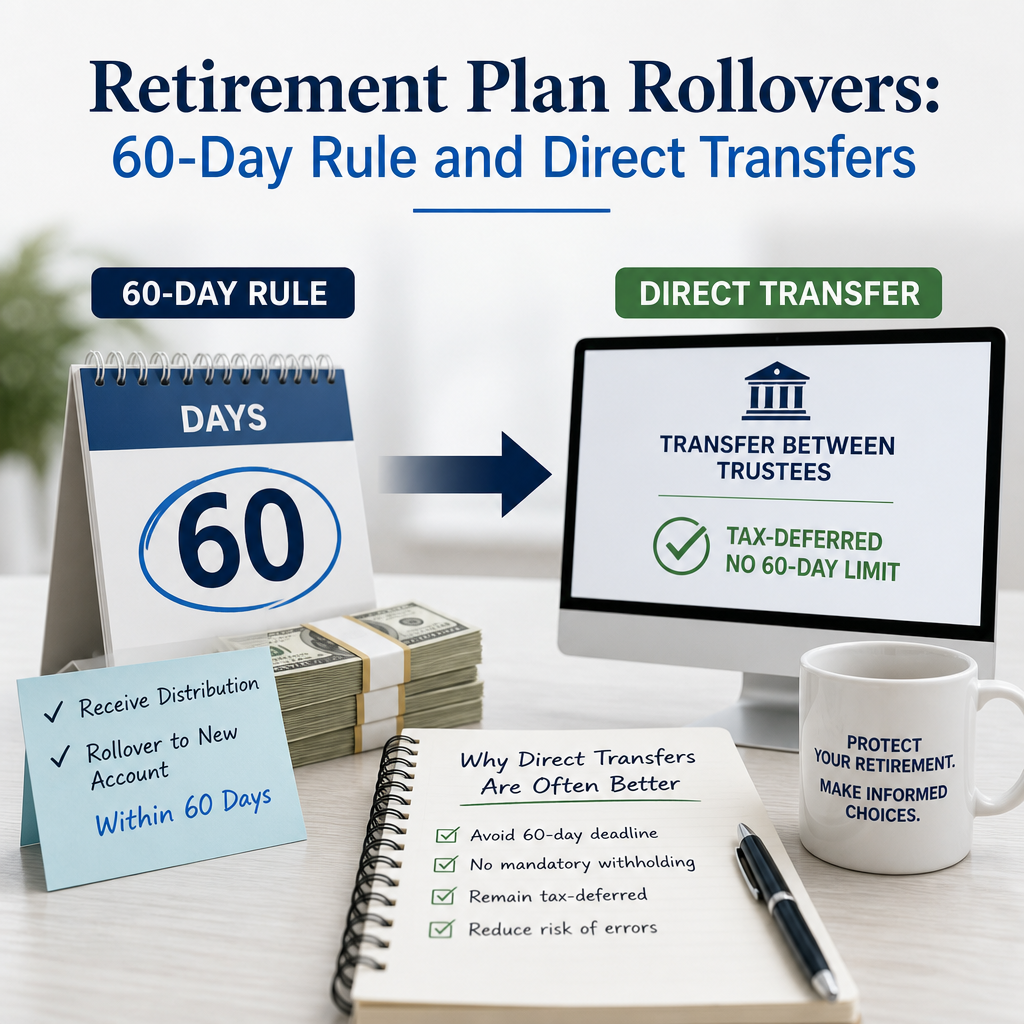
Retirement Plan Rollovers: 60-Day Rule and Direct Transfers
Retirement plan rollovers can help you move savings without losing tax advantages, but the method you choose matters. Learn how the 60-day rule works and why direct transfers are often the safer, simpler option.
By: Mary Mitchell on August 3, 2026
Anúncios
Changing jobs, retiring, or consolidating old accounts often leads to one important decision: what to do with an employer-sponsored retirement plan. For many savers, retirement plan rollovers offer a way to keep money growing tax-advantaged while simplifying account management. But the rules matter—especially when comparing the 60-day rollover rule with direct transfers.
If you move retirement funds the wrong way, you can trigger taxes, penalties, or withholding issues that are avoidable with a little planning. Understanding the difference between an indirect rollover and a direct transfer can help you protect your savings and make a cleaner transition.
Anúncios
What Are Retirement Plan Rollovers?
A retirement plan rollover is the movement of money from one retirement account to another, usually without creating a taxable event. Common examples include moving funds from:
A 401(k) to an IRA
A 403(b) to another qualified retirement account
A traditional IRA to another traditional IRA
A workplace plan to a new employer’s retirement plan, if allowed
The main goal is usually the same: preserve the tax-deferred status of the money and keep it invested for retirement.
Anúncios
Retirement plan rollovers are especially common when someone:
Changes jobs
Retires
Wants more investment choices
Needs simpler account consolidation
Wants to reduce fees or improve account control
The key is choosing the right type of rollover. That is where the 60-day rule and direct transfers come in.
The 60-Day Rule Explained
The 60-day rule applies to indirect rollovers, meaning the money is paid to you first rather than moving directly between institutions.
How it works
In an indirect rollover:
Your retirement plan sends the distribution to you.
You have 60 days from the date you receive the money to deposit it into another eligible retirement account.
If you complete the rollover on time, the distribution is generally not taxable.
This sounds straightforward, but there are important complications.
Why the 60-day rule can be risky
When funds are paid to you, the plan administrator may be required to withhold taxes. For example, employer plan distributions often include mandatory federal withholding. That means you may receive less than the full balance.
To complete a full rollover, you usually need to replace the withheld amount from other money in your possession. If you don’t, the withheld portion may be treated as a taxable distribution.
Other risks include:
Missing the 60-day deadline
Depositing the funds into the wrong type of account
Rolling over money more than once within the allowed period
Forgetting that the clock starts when you receive the funds, not when you deposit them
When the 60-day rule might be used
Some people use the 60-day rollover rule when they need temporary access to funds or are waiting to open another account. However, it is generally less forgiving than a direct transfer and should be handled carefully.
In most cases, a direct transfer is simpler and safer.
Direct Transfers: A Cleaner Way to Move Retirement Money
A direct transfer moves money from one eligible retirement account to another without the funds ever being paid to you personally. You may also hear this called a trustee-to-trustee transfer.
How direct transfers work
With a direct transfer:
The old custodian or plan sends the money directly to the new custodian or plan.
You do not receive the money.
The transfer usually does not trigger withholding.
The move is typically easier to document and track.
For example, if you roll over a 401(k) from a former employer into an IRA, the safest approach is often to request a direct rollover to the IRA custodian. The funds go straight from plan to plan.
Benefits of direct transfers
Direct transfers are often preferred because they:
Reduce the risk of missing deadlines
Avoid mandatory withholding in many cases
Minimize paperwork problems
Make it easier to move the full balance
Lower the chance of accidental taxation
For most savers, direct transfers are the most straightforward method for retirement plan rollovers.
60-Day Rollovers vs. Direct Transfers: Key Differences
Understanding the difference between these two methods can save time and money.
Feature
60-Day Rollover
Direct Transfer
Money paid to you first
Yes
No
Deadline concerns
Yes, strict 60-day window
No 60-day receipt window
Withholding issues
Often yes
Usually no
Risk of mistakes
Higher
Lower
Ease of tracking
More complex
Simpler
Preferred by many savers
No
Yes
Which option is better?
In most cases, a direct transfer is better because it reduces risk and administrative headaches. The 60-day rule can still be useful, but only if you understand the timing and tax consequences.
Common Mistakes to Avoid in Retirement Plan Rollovers
Even a small error can complicate an otherwise simple rollover. Here are some of the most common mistakes people make.
Missing the 60-day deadline
This is one of the biggest problems with indirect rollovers. If the funds are not deposited into a qualifying account within 60 days, the IRS may treat the distribution as taxable.
Forgetting about withholding
If taxes are withheld from a distribution, you usually must come up with other funds to complete the full rollover amount. Many people assume they only need to roll over what they received, which may leave part of the distribution taxable.
Rolling over to the wrong account type
Not every retirement account accepts every type of rollover. For example:
Traditional retirement funds usually move into traditional IRAs or qualified employer plans
Roth funds must generally move into Roth accounts
Some employer plans have specific rules and limitations
Taking possession of the funds unnecessarily
If you can do a direct transfer, it is usually safer than receiving a check or deposit into your personal account. Once the money is in your hands, you must manage deadlines, deposits, and possible withholding.
Ignoring plan-specific rules
Employer plans can have their own distribution procedures. Always check whether your current plan, new plan, or IRA custodian has special paperwork, deadlines, or acceptance requirements.
Special Considerations for 401(k), IRA, and Employer Plan Rollovers
Not all retirement plan rollovers are handled the same way.
Rolling over a 401(k) to an IRA
This is one of the most common rollovers. An IRA may offer:
More investment options
Easier consolidation
Flexible beneficiary planning
A direct rollover from a 401(k) to an IRA is often the cleanest approach.
Moving funds between IRAs
IRA-to-IRA transfers can often be completed as direct transfers, which are usually not subject to the same pitfalls as the 60-day rule. Still, make sure the transfer is correctly coded and documented.
Rolling over to a new employer’s plan
Some employers allow incoming rollovers from previous plans or IRAs, but not all do. New plans may also have restrictions on the types of funds they accept.
Roth conversions vs. rollovers
A Roth conversion is different from a rollover. A rollover usually preserves the tax treatment of the money. A conversion generally moves pre-tax money into a Roth account and may create taxable income. If you are unsure which applies to your situation, review the transaction carefully before initiating it.
Practical Example: Choosing the Safer Route
Imagine you leave a job with $80,000 in a 401(k). You want to move it into an IRA.
Option 1: Indirect rollover
The plan sends you a distribution check. The plan withholds part of the amount for taxes. You have 60 days to deposit the full eligible amount into the IRA, including replacing any withheld funds from your own savings.
If you miss the deadline or fail to replace withholding, part of the distribution may become taxable.
Option 2: Direct transfer
You ask the 401(k) provider to send the funds directly to the IRA custodian. The money never lands in your personal checking account, and the transfer is completed without the same deadline pressure.
For most people, the direct route is simpler, cleaner, and less stressful.
Steps to Complete Retirement Plan Rollovers Successfully
Whether you are working with a 401(k), IRA, or other retirement plan, a little organization goes a long way.
1. Confirm where the money is going
Decide whether the money will go to:
A traditional IRA
A Roth IRA
A new employer’s plan
Another eligible retirement account
2. Request the right type of transfer
Ask for a direct transfer whenever possible. If you are using the 60-day rule, make sure you understand the exact deadline and any withholding requirements.
3. Keep records
Save:
Plan statements
Transfer forms
Confirmation letters
Check copies
Bank deposit records
Good records help if you ever need to verify the transaction.
4. Watch the timing
If you receive the funds directly, mark the 60-day deadline immediately. Do not wait until the last week.
5. Verify receipt with the receiving institution
Confirm that the new custodian or plan has received and properly coded the funds. A deposit alone is not always enough if the transaction is labeled incorrectly.
Tax and Penalty Concerns to Keep in Mind
The tax treatment of retirement plan rollovers depends on how the transfer is completed and what type of account is involved.
In general:
A properly completed rollover may be tax-free
A missed deadline can make the distribution taxable
Early distributions may also be subject to additional penalties if the money is not rolled over correctly
Withholding does not eliminate your tax obligation if the rollover is incomplete
Because retirement distributions can affect both federal and state taxes, it is wise to review the consequences before moving money.
When to Get Help
You may want to speak with a tax professional or financial advisor if:
You are moving a large balance
The account includes both pre-tax and after-tax money
You are unsure whether the receiving plan accepts your rollover
You received a distribution check and are close to the 60-day deadline
You are considering a Roth conversion instead of a rollover
You have multiple retirement accounts and want to consolidate strategically
Professional guidance can help you avoid an expensive mistake.
Frequently Asked Questions
1. What is the difference between a rollover and a direct transfer?
A rollover can include money paid to you first, which then must be deposited into another retirement account within the allowed timeframe. A direct transfer moves the funds directly between financial institutions, so you never take possession of the money.
2. Does the 60-day rule apply to all retirement account transfers?
No. The 60-day rule applies to indirect rollovers, where you receive the distribution personally. Direct transfers typically do not use the 60-day clock because the funds move directly between custodians or plans.
3. Can I roll over a 401(k) into an IRA without paying taxes?
Often, yes, if the rollover is completed properly. A direct transfer is usually the safest way to avoid taxes and withholding issues. If you use the 60-day rule, you must meet the deadline and replace any withheld amount if needed.
4. What happens if I miss the 60-day rollover deadline?
If you miss the deadline, the distribution may be treated as taxable income. Depending on your age and the type of account, you may also face an early withdrawal penalty. In some cases, there may be limited relief options, but you should not rely on them.
5. Is a direct transfer always better than a 60-day rollover?
Not always, but it is usually the better option. Direct transfers reduce risk, avoid deadline pressure, and typically simplify the process. The 60-day rollover can still work, but it requires careful attention to timing and tax rules.
Retirement plan rollovers can be a smart way to protect your savings, simplify your finances, and keep your money working for your future. But the method you choose matters. The 60-day rule gives you a narrow window to redeposit funds after receiving them, and that creates real risk if you miss a deadline or overlook withholding. Direct transfers, on the other hand, usually provide a smoother path because the money moves directly between institutions without landing in your personal account.
If you are planning a rollover, the safest first step is to confirm the account types involved and request a direct transfer whenever possible. Keep detailed records, understand the tax consequences, and do not assume every retirement plan follows the same process. A careful approach can help you avoid unnecessary taxes, preserve more of your balance, and make the transition from one account to another far less stressful. When in doubt, review the rules before moving money—not after.
Mary S, CFP®, is a Certified Financial Planner with over 12 years of experience in personal finance, retirement planning, and wealth management. She writes educational content that helps readers understand financial concepts and make informed decisions based on reliable information.