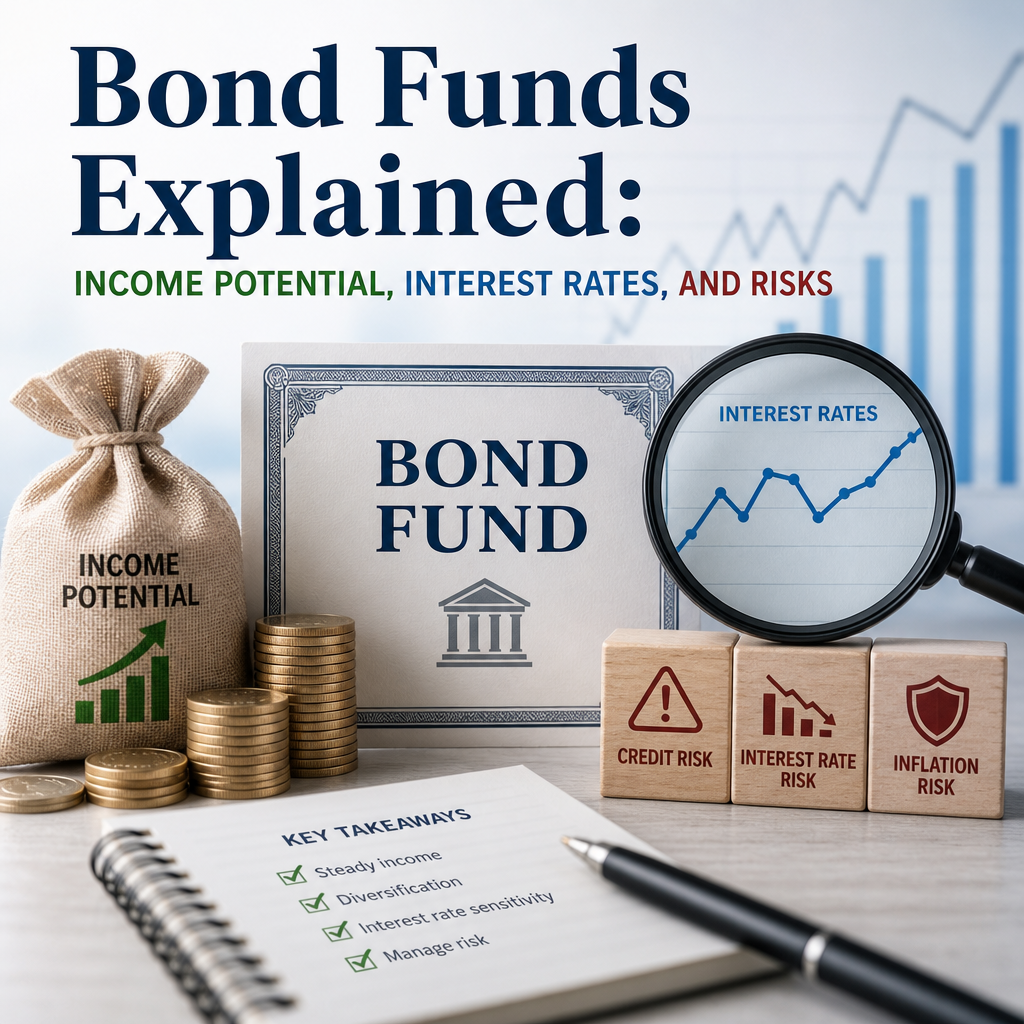
Bond Funds Explained: Income Potential, Interest Rates, and Risks
Bond funds can be a simple way to earn regular income and diversify your portfolio, but their returns and prices are closely tied to interest rates. Before investing, it’s important to understand how bond funds work and the risks that can affect both income and principal.
By: Mary Mitchell on August 3, 2026
Anúncios
Bond funds are one of the most common ways investors seek steady income without buying individual bonds one by one. They can offer diversification, professional management, and easier access to the bond market than building a portfolio from scratch. But like any investment, bond funds come with trade-offs. If you’re trying to understand how bond funds generate income, why interest rates matter so much, and what risks to watch for, this guide breaks it down in plain English.
Whether you’re saving for retirement, balancing a stock-heavy portfolio, or simply looking for a more conservative investment option, it helps to know how bond funds really work before you buy.
Anúncios
What Are Bond Funds?
A bond fund is a mutual fund or exchange-traded fund (ETF) that invests in a basket of bonds. Instead of owning a single Treasury, municipal bond, or corporate bond, you own shares in a fund that holds many different fixed-income securities.
How bond funds differ from individual bonds
Individual bonds have a maturity date. If you hold them to maturity and the issuer doesn’t default, you generally know when you’ll get your principal back.
Anúncios
Bond funds work differently:
They usually do not have a maturity date.
The fund’s portfolio changes over time as bonds are bought and sold.
The share price can rise or fall daily.
Income payments may vary based on the bonds held in the fund.
That makes bond funds more flexible, but also less predictable than owning a single bond.
Common types of bond funds
You’ll see many varieties, including:
Treasury bond funds – invest in U.S. government securities
Municipal bond funds – invest in bonds issued by states and local governments
Corporate bond funds – hold bonds issued by companies
Short-term bond funds – focus on bonds with shorter maturities
Intermediate-term bond funds – aim for a balance of income and interest-rate sensitivity
Long-term bond funds – usually offer higher yields, but greater price volatility
High-yield bond funds – invest in lower-rated bonds with higher income potential and more risk
How Bond Funds Generate Income
The main appeal of bond funds is income. They collect interest payments from the underlying bonds and pass that income to shareholders, usually in the form of monthly dividends.
Sources of bond fund income
A bond fund’s income typically comes from:
Coupon payments from the bonds in the portfolio
Trading gains or losses when bonds are sold before maturity
Occasional capital gains distributions if the fund realizes profits
The yield you see advertised for a bond fund reflects the income potential, but it is not a guarantee. Fund yields change as holdings change, and they can move up or down with the broader interest-rate environment.
Why income can vary
Bond funds do not lock in income the way a single bond does. The fund manager may buy new bonds at different rates as old bonds mature or are sold. If market interest rates rise, newer bonds in the fund may pay more. If rates fall, the fund may replace older bonds with lower-yielding ones.
This is why bond funds can be useful for ongoing income, but not ideal if you need a fixed, unchanging payment stream.
Why Interest Rates Matter So Much
Interest rates are one of the biggest drivers of bond fund performance. When rates change, bond prices usually move in the opposite direction.
The basic relationship
Here’s the simple version:
When interest rates rise, bond prices usually fall
When interest rates fall, bond prices usually rise
This happens because existing bonds become more or less attractive compared with newly issued bonds. If new bonds are paying higher rates, older bonds with lower coupons are less desirable, so their market prices drop.
What this means for bond funds
Because bond funds hold bonds that are constantly priced in the market, rising rates can temporarily push down the fund’s share price. If you plan to sell during that period, you may realize a loss. If you stay invested, the fund may eventually benefit from reinvesting in higher-yielding bonds.
That’s an important difference between:
Income: the cash a bond fund pays out
Total return: income plus price changes
A bond fund can still produce income even if its share price falls. But the total return may be lower than expected.
Duration: the key interest-rate risk measure
Duration measures how sensitive a bond fund is to interest rate changes. In general:
Shorter duration = less sensitivity
Longer duration = more sensitivity
For example, a long-term bond fund usually experiences larger price swings when rates move than a short-term bond fund. If you are worried about rising rates, shorter-duration funds may be easier to hold through volatility.
The Main Risks of Bond Funds
Bond funds are often viewed as safer than stock funds, but “safer” does not mean risk-free. Understanding the major risks can help you choose the right fund for your goals.
1. Interest-rate risk
As discussed, rising rates can reduce the market value of bonds held by the fund. This is one of the most important risks for bond fund investors, especially in longer-duration funds.
2. Credit risk
Credit risk is the chance that a bond issuer will fail to make interest or principal payments. This is more relevant in corporate bond funds and high-yield funds than in Treasury funds.
A few points to keep in mind:
U.S. Treasury bond funds carry very low credit risk because they invest in government securities.
Municipal and corporate bond funds have varying degrees of credit risk.
High-yield bond funds generally take more credit risk in exchange for higher income.
3. Inflation risk
Even if a bond fund pays steady income, inflation can erode that income’s purchasing power. If prices rise faster than your fund’s yield, your real return may be weaker than it looks on paper.
4. Liquidity risk
Some bond funds invest in securities that are harder to trade, especially during periods of market stress. If the fund can’t sell bonds easily, prices may become more volatile.
5. Reinvestment risk
When bonds mature or are sold, the fund must reinvest that cash. If prevailing rates are lower than before, the fund may have to buy lower-yielding bonds, which can reduce future income.
Types of Bond Funds and What They’re Best For
Not all bond funds serve the same purpose. The “best” one depends on your timeline, risk tolerance, and income goals.
Treasury bond funds
These funds are often used by conservative investors who want high-quality government-backed holdings. They may be a good fit for investors who prioritize credit safety over higher yield.
Municipal bond funds
Municipal bond funds can be attractive for investors in higher tax brackets because some income may be exempt from federal taxes, and sometimes state taxes as well. Tax treatment varies, so it’s smart to understand how the fund fits your situation.
Corporate bond funds
These funds usually offer more income than government bond funds, but they also introduce more credit risk. They can be useful for investors seeking a middle ground between safety and yield.
Short-term bond funds
These funds generally have lower interest-rate sensitivity and may be a better choice when you want stability and quicker access to your money.
High-yield bond funds
Also called junk bond funds, these carry more credit risk because they invest in lower-rated issuers. They may be appropriate for investors who understand the trade-off between higher yield and greater volatility.
How to Evaluate a Bond Fund Before Buying
Choosing a bond fund isn’t just about chasing the highest yield. A smart evaluation looks at the fund’s structure, risk profile, and role in your portfolio.
Key factors to review
1. Yield and distribution history
Look at the fund’s current yield, but don’t rely on it alone. Check whether the distributions have been stable over time and whether they reflect income or occasional capital gains.
2. Duration
Longer duration means more exposure to interest-rate swings. Match duration to your tolerance for volatility.
3. Credit quality
Review the credit ratings of the underlying holdings. Funds with lower-rated bonds may offer higher income, but they can also suffer more in a downturn.
4. Expense ratio
Fees matter because they reduce net returns. Lower-cost funds can make a meaningful difference over time.
5. Portfolio diversification
A well-diversified fund spreads risk across many issuers, sectors, and maturities. Concentrated funds can be more vulnerable if a specific sector struggles.
6. Tax treatment
Some bond funds create taxable income even if you reinvest the distributions. Municipal funds may offer tax advantages, but the benefits depend on your tax bracket and where you live.
Practical Examples of Bond Fund Use
Bond funds can play different roles depending on your financial plan.
Example 1: A retiree seeking income
A retiree may use a mix of short- and intermediate-term bond funds to help generate monthly cash flow while trying to reduce volatility compared with stocks.
Example 2: A long-term investor balancing risk
A younger investor with a stock-heavy portfolio may use bond funds to diversify and reduce portfolio swings. In this case, bond funds act as a stabilizer rather than a primary income source.
Example 3: A saver planning for a near-term goal
Someone preparing for a home purchase in two to three years may prefer a short-term bond fund over a long-term one because it may be less exposed to interest-rate risk.
These examples show why there is no single “best” bond fund. The right choice depends on what the money is for.
Are Bond Funds Better Than Individual Bonds?
The answer depends on your goals.
Bond funds may be better if you want:
Diversification across many bonds
Easier investing with smaller amounts
Professional management
Regular income distributions
Simpler access to different bond sectors
Individual bonds may be better if you want:
A known maturity date
More control over timing and cash flow
The ability to hold a bond to maturity
Predictable principal return, assuming no default
For many investors, bond funds offer a more practical and flexible entry point into fixed income. But if you need certainty about when you’ll get your principal back, individual bonds may be a better fit.
How Bond Funds Fit Into a Portfolio
Bond funds often serve as the conservative side of a diversified portfolio. They can help offset stock volatility and provide income that may be reinvested or used for living expenses.
A common approach is to use bond funds to:
Reduce overall portfolio risk
Smooth returns during stock market declines
Create income
Add diversification across asset classes
That said, the right allocation depends on your age, time horizon, and risk tolerance. A financial plan that works for one investor may not suit another.
Frequently Asked Questions
1. Are bond funds safe?
Bond funds are generally less volatile than stock funds, but they are not risk-free. Their value can fall when interest rates rise, when credit conditions weaken, or when underlying bonds lose value. Safety depends on the fund’s holdings, duration, and credit quality.
2. Can you lose money in a bond fund?
Yes. Although bond funds are designed to produce income and stability, the share price can decline. If you sell after a drop, you may realize a loss. Even if you hold the fund, total return can be negative in a rising-rate or credit-stress environment.
3. What is the difference between bond yield and bond fund return?
Yield refers to the income generated by the fund’s holdings. Return includes both income and changes in the fund’s share price. A fund can have a attractive yield but still deliver poor total return if bond prices fall.
4. How do rising interest rates affect bond funds?
Rising interest rates usually cause bond prices to fall, especially for funds with longer durations. Short-term funds tend to be less sensitive. Over time, higher rates may also allow the fund to reinvest in bonds with better yields.
5. Which bond fund is best for beginners?
Many beginners start with a broad, low-cost short- or intermediate-term bond fund because it offers diversification and less volatility than long-duration or high-yield funds. The best choice still depends on your time horizon, tax situation, and risk tolerance.
Bond funds can be a valuable part of an investment strategy, especially if you want income, diversification, and professional management without the complexity of buying individual bonds. They can help stabilize a portfolio and provide regular distributions, but they also carry meaningful risks. Interest-rate changes, credit quality, inflation, and fund duration all influence performance.
The key is to match the bond fund to your goal. If you want lower volatility, short-term or high-quality funds may make sense. If you want higher income and are comfortable with more risk, a corporate or high-yield fund may fit better. If tax efficiency matters, municipal bond funds may deserve a closer look.
Before investing, review the fund’s duration, credit quality, fees, and tax treatment. Most importantly, make sure the fund supports your broader financial plan instead of simply chasing yield. A well-chosen bond fund can do more than generate income—it can add balance, resilience, and flexibility to your portfolio.
Mary S, CFP®, is a Certified Financial Planner with over 12 years of experience in personal finance, retirement planning, and wealth management. She writes educational content that helps readers understand financial concepts and make informed decisions based on reliable information.