How Teachers Can Find Evidence-Based Classroom Practices
Teachers are surrounded by advice, but not every strategy is backed by real results. This guide shows how teachers can find evidence-based classroom practices and use them with confidence to support student learning.
By: Jennifer Collins on August 3, 2026
Anúncios
Teachers face endless advice about what works in the classroom. Some ideas come from colleagues, some from social media, and some from professional development sessions that sound promising but never quite deliver. In that mix, it can be hard to tell which strategies are actually effective. That is why learning how teachers can find evidence-based classroom practices matters so much.
Anúncios
Evidence-based teaching helps educators move beyond trends and guesswork. It gives teachers a way to choose strategies supported by research, classroom data, and professional judgment. When used well, it can improve student engagement, support learning, and make instructional time more intentional.
This guide explains how to evaluate classroom strategies, where to find reliable research, and how to apply evidence-based practices in practical ways that fit real classrooms.
What Evidence-Based Classroom Practices Really Mean
Evidence-based classroom practices are teaching methods that have been shown to improve student outcomes through credible research and repeated use in real educational settings. They are not just popular ideas or well-meaning suggestions.
Anúncios
A practice becomes more trustworthy when it is:
Supported by strong research studies
Tested across different student groups or settings
Aligned with learning goals
Practical enough to use in day-to-day teaching
Monitored for results over time
It is important to distinguish between evidence-based, research-informed, and research-based. These terms are related, but not identical.
Evidence-based vs. research-based vs. promising ideas
Evidence-based: Backed by high-quality research and proven outcomes.
Research-based: Informed by research, but not always supported by strong evidence across many settings.
Promising or emerging: Worth exploring, but not yet well established.
Teachers do not need to ignore new ideas. However, they should evaluate them carefully before making them part of regular practice.
Why Teachers Should Use Evidence-Based Practices
Choosing evidence-based strategies helps teachers make better instructional decisions. It also supports consistency, especially when schools are trying to improve reading, behavior, math performance, or student participation.
Some key benefits include:
More reliable student learning gains
Better use of planning time
Stronger support for diverse learners
Clearer goals for intervention and instruction
Less reliance on trial and error
Evidence-based classroom practices are especially useful when teachers need to support students with learning differences, English learners, or students who need extra help. In those cases, a strategy with proven results is more valuable than a trend that only works in theory.
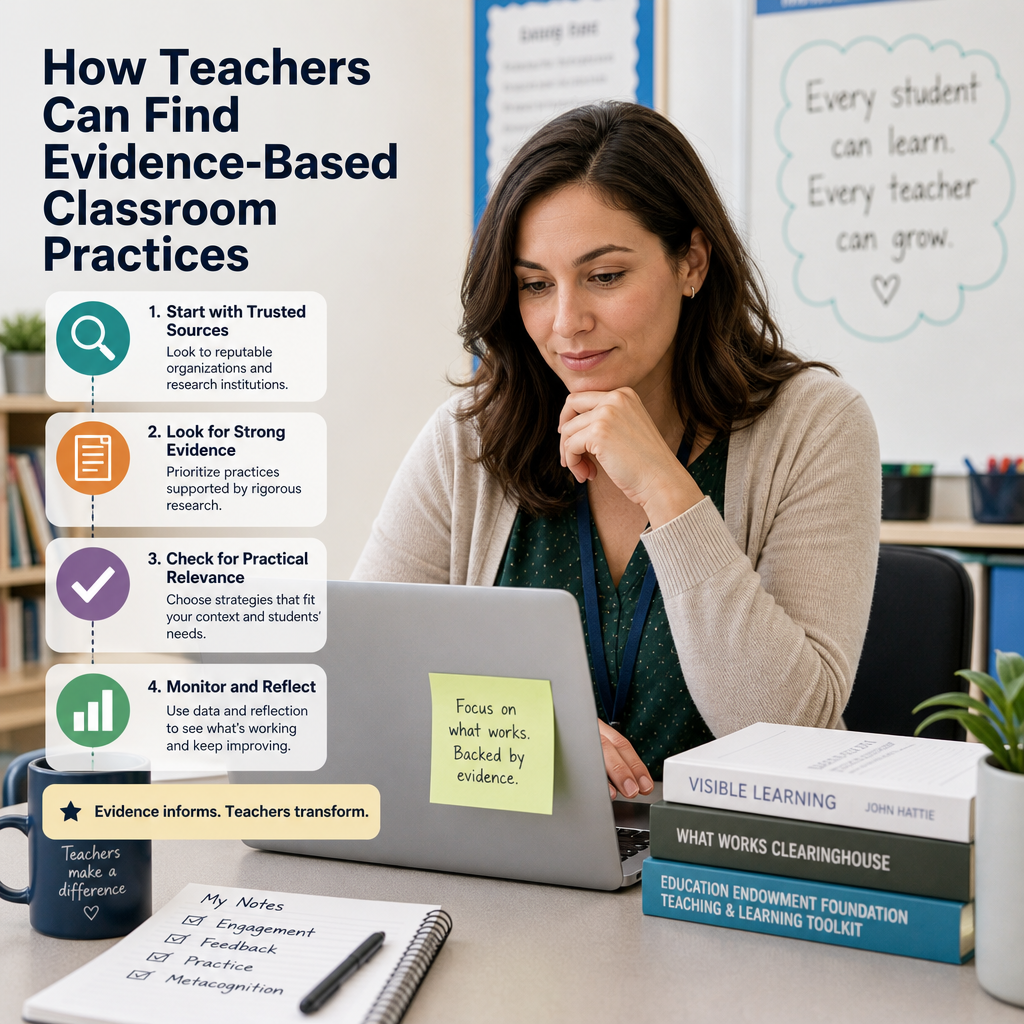
How Teachers Can Find Evidence-Based Classroom Practices
The process does not have to feel overwhelming. Teachers can use a few practical steps to separate solid strategies from weak ones.
1. Start with a specific classroom problem
Before looking for solutions, define the problem clearly. Vague concerns lead to vague answers.
Instead of asking:
“How can I improve reading?”
Ask:
“How can I improve reading fluency for third graders who read below grade level?”
“How can I reduce off-task behavior during independent work?”
“How can I increase participation during whole-group discussion?”
A precise question makes it easier to find relevant research and evidence-based classroom practices that fit the actual need.
2. Use trustworthy research sources
Not every blog post or teaching account is a reliable source. Teachers should look for evidence from respected organizations, peer-reviewed journals, and government education sites.
Good places to start include:
What Works Clearinghouse
Institute of Education Sciences
Regional educational laboratories
University research centers
Professional associations with research summaries
These sources often summarize findings in plain language, making them more useful for busy educators.
3. Look for multiple studies, not just one success story
A single study can be helpful, but it should not be the only reason to adopt a strategy. Strong evidence usually comes from several studies that point in the same direction.
When reviewing a classroom practice, ask:
Has it been tested more than once?
Were the participants similar to my students?
Did the results hold up in different settings?
Was the study conducted by independent researchers?
This step helps teachers avoid being influenced by isolated examples that may not generalize well.
4. Check the quality of the evidence
Not all research carries the same weight. Some studies are more reliable than others.
Look for signs of stronger evidence:
Clear research methods
Comparison groups or control groups
Replicated results
Measured student outcomes
Transparent reporting of limitations
Teachers do not need to become researchers, but they should know how to spot the difference between a strong study and a weak one.
5. Match the strategy to your students and context
Even a well-supported practice may not work exactly the same way in every classroom. Student age, subject area, school schedule, and class size all matter.
For example:
A reading intervention may be effective for early elementary students but less relevant for secondary learners.
A behavior strategy may work well in one classroom but need adjustment for another group.
A discussion routine may support social studies but need modification for science labs.
Evidence-based classroom practices work best when teachers adapt them thoughtfully without losing the core instructional principle.
6. Start small and gather your own evidence
Teachers can test a practice on a small scale before fully adopting it. This reduces risk and makes it easier to see whether the approach is working.
A simple implementation cycle might look like this:
Choose one strategy.
Define what success will look like.
Use the strategy consistently for a set period.
Collect student data or observations.
Review the results.
Decide whether to continue, adjust, or replace it.
Local classroom evidence matters. A strategy supported by research should still be monitored in your own setting.
Reliable Places to Find Evidence-Based Classroom Practices
Teachers need sources that are easy to trust and practical to use. Below are several places to look for evidence-based classroom practices.
Government and public research databases
Government-supported education research databases often provide summaries, intervention guides, and practice recommendations.
Examples include:
What Works Clearinghouse
Institute of Education Sciences
National Center for Education Statistics for broader context and educational data
These sources are useful because they focus on evidence review rather than marketing.
University research centers
Many universities maintain education labs or literacy and learning centers that publish useful guides. These can be especially helpful for topics such as reading instruction, special education, and classroom management.
Professional associations
Organizations for reading, math, special education, and classroom leadership often publish guidance for educators. Their materials may include research summaries, instructional frameworks, and implementation tips.
Peer-reviewed journals
For teachers who want to dig deeper, peer-reviewed journals offer detailed research. These articles can be technical, but they are often the best source for understanding how a strategy was tested.
How to Evaluate Whether a Practice Is Worth Trying
A teacher does not need to become a research statistician to judge a classroom practice. A simple checklist can help.
Ask these questions
What problem does this strategy address?
Is there evidence that it improves student learning?
Has it been tested with students similar to mine?
Is the strategy practical in my classroom?
What materials, time, or training does it require?
How will I know if it is working?
If a practice sounds impressive but cannot answer these questions clearly, it may not be ready for regular use.
Watch for red flags
Be cautious if a strategy is promoted mainly through:
Emotional testimonials
Before-and-after stories without data
Commercial claims that promise quick results
Buzzwords without clear instructional steps
Advice that cannot explain why it works
Anecdotes can be helpful starting points, but they should not replace evidence.
Practical Examples of Evidence-Based Classroom Practices
Evidence-based teaching is easier to use when it becomes concrete. Here are a few examples of practices that many educators explore through research.
Explicit instruction
Explicit instruction means the teacher clearly models a skill, guides practice, and checks for understanding. This approach is often useful for foundational academic skills, vocabulary, and procedures.
A teacher might:
Explain a concept directly
Model the task step by step
Use guided practice
Provide immediate feedback
Transition students to independent work
Formative assessment
Formative assessment helps teachers check learning during instruction rather than waiting until the end of a unit. It can include exit tickets, quick quizzes, whiteboard responses, or observation notes.
This helps teachers:
Spot misunderstandings early
Adjust instruction quickly
Group students strategically
Focus on what students still need
Retrieval practice
Retrieval practice asks students to recall information from memory. It strengthens learning more effectively than simply rereading material.
Teachers might use:
Short quiz questions
Brain dumps
Flashcards
Practice prompts at the start of class
Structured classroom routines
Predictable routines can improve time management and reduce confusion. This is especially helpful for transitions, independent work, and small-group instruction.
Examples include:
A clear entry routine
Defined steps for turning in work
Signals for attention
Consistent group roles
Positive behavior supports
Evidence-based behavior practices focus on teaching expected behaviors, reinforcing them, and creating a consistent environment. These approaches can support student self-regulation and classroom climate.
Making Evidence-Based Practices Work in Real Classrooms
Finding evidence is only the first step. Implementation matters just as much.
Keep the core idea intact
When adapting a strategy, preserve the part that made it effective. For example, if a routine depends on frequent feedback, removing that feedback may weaken the results.
Don’t adopt too many changes at once
Teachers often feel pressure to try everything. But too many new practices at once can create confusion and reduce fidelity.
Try this instead:
Choose one priority area
Introduce one practice at a time
Monitor results
Build from there
Use professional learning strategically
Professional development is more useful when it focuses on implementation, not just theory. Teachers benefit from coaching, modeling, and time to reflect on what happens in their own classrooms.
Collaborate with colleagues
Grade-level teams, department groups, and instructional coaches can help teachers compare results and share observations. Collaboration makes it easier to refine strategies and avoid reinventing the wheel.
A Simple Process Teachers Can Follow
If you want a practical roadmap, use this five-step process:
Identify the need
Define the learning or behavior challenge clearly.
Search for evidence
Use trusted research sources and look for repeated findings.
Evaluate fit
Consider your students, subject, and classroom conditions.
Implement carefully
Try the practice with clear steps and consistent routines.
Review results
Look at student work, behavior patterns, or assessment data.
This process keeps decision-making focused and manageable.
Frequently Asked Questions
What makes a classroom practice evidence-based?
A classroom practice is evidence-based when research shows it improves student outcomes in credible, repeated studies. The best practices are supported by high-quality evidence, not just teacher testimonials or popularity. Teachers should also consider whether the strategy fits their students and subject area.
Where can teachers find reliable research on teaching strategies?
Teachers can use trusted sources such as the What Works Clearinghouse, the Institute of Education Sciences, university research centers, and peer-reviewed journals. These sources often provide summaries that help educators understand the evidence without reading every original study.
How can teachers tell if a strategy is just a trend?
A trend often relies on marketing, social media buzz, or isolated success stories. Evidence-based strategies have a stronger foundation: multiple studies, clear methods, and measurable outcomes. If a practice sounds exciting but lacks research support, it may be a trend rather than a dependable instructional tool.
Do evidence-based practices work for every classroom?
Not automatically. A strategy can be well supported and still require adjustment based on grade level, subject, class size, or student needs. Teachers should look at the research, try the practice thoughtfully, and monitor whether it works in their specific setting.
How can teachers test a new practice without disrupting the class?
Start small. Introduce one strategy, define what success looks like, and collect simple evidence such as student work, observation notes, or brief assessments. If the practice helps, expand it gradually. If not, adjust it or try a different approach.
Finding evidence-based classroom practices does not require perfect expertise or a research degree. It requires a clear question, trustworthy sources, thoughtful evaluation, and a willingness to test ideas in real teaching conditions. When teachers use evidence to guide decisions, they are more likely to choose strategies that support learning, strengthen classroom management, and make instruction more effective.
The best approach is not to chase every new idea. It is to build a reliable system for judging what works, why it works, and whether it fits your students. Over time, that habit leads to more confident teaching and better outcomes for learners.
If you are looking for a place to start, focus on one challenge in your classroom, search for credible research, and try one strategy with a simple plan for measuring results. Small, evidence-based changes often lead to meaningful progress.
Jennifer, M.Ed., holds a degree in Higher Education Administration, with
a focus on U.S. college financial aid, admissions policy, and student
support systems. She researches and writes about scholarships, federal
aid programs, and the college planning process to help students and
families make informed, well-supported decisions.