How Federal Data Track Public Schools and Districts in the U.S.
Anúncios
Understanding how federal data track public schools and districts across the United States is essential for parents, educators, policymakers, journalists, and community members who want to make informed decisions. These datasets help answer basic questions: How many schools are in a district? How are students enrolled? What services and programs are available? Which schools serve which grade levels? Federal education data create a shared picture of the nation’s public school system, making it easier to compare schools and districts in consistent ways.
At the center of this system are official data collections managed by the U.S. Department of Education and its research and statistics arm, the National Center for Education Statistics (NCES). These records do more than count schools. They help define school boundaries, district relationships, enrollment patterns, staffing, and other key characteristics that shape education policy and public understanding.
Anúncios
Why Federal School Data Matter
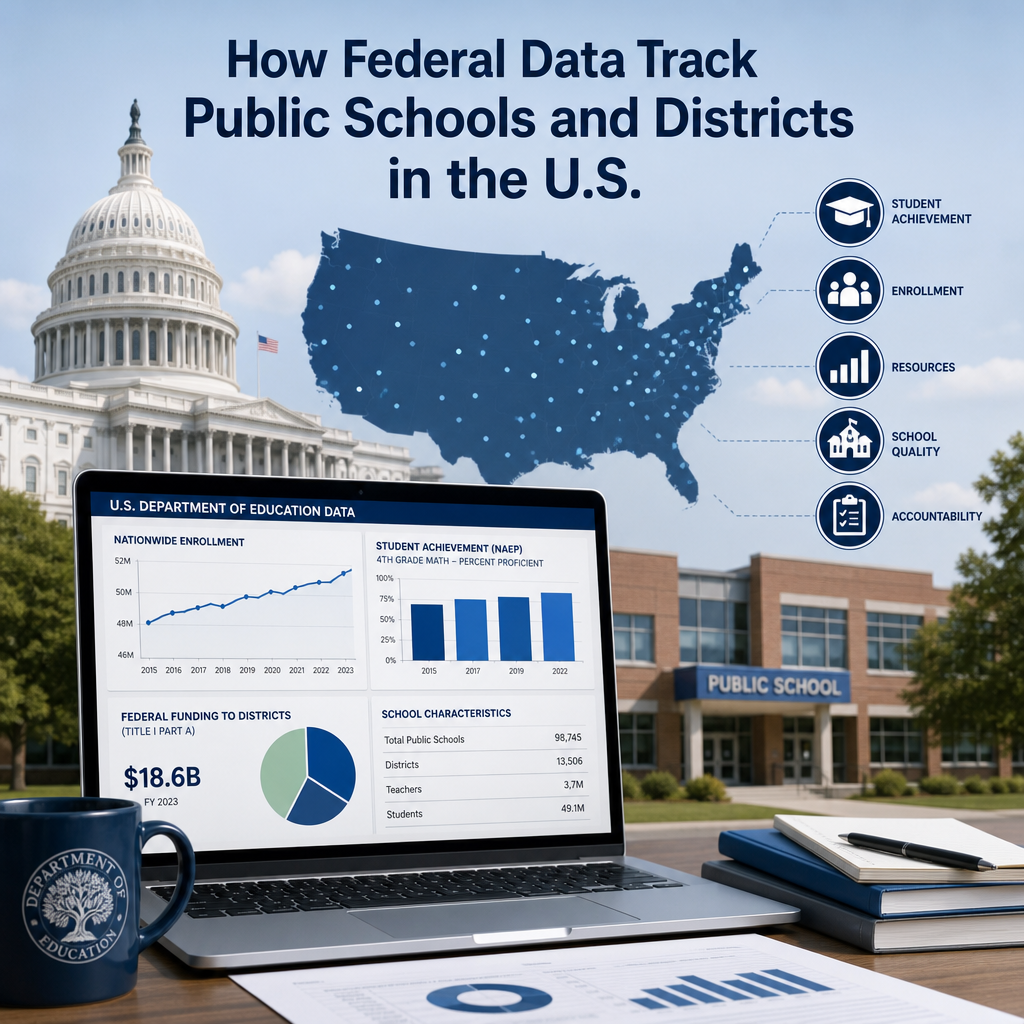
Public school data are not just for researchers. They influence everyday decisions and long-term planning.
Federal data help:
Anúncios
- Identify schools and districts accurately
- Track enrollment trends over time
- Compare district size, staffing, and grade spans
- Support accountability, funding, and civil rights monitoring
- Provide a consistent national reference point
Because states use different reporting systems, federal education data create standard definitions that make national comparisons possible. That consistency matters when someone wants to compare a rural district in Iowa with a suburban district in Virginia or understand how a charter school fits into a local education landscape.
How Federal Data Track Public Schools and Districts Across the United States
Federal education agencies track public schools and districts through a combination of administrative records, survey collections, and standardized identifiers. The goal is to build a reliable national framework that describes every public school and district in the country.
The role of NCES
The National Center for Education Statistics is the primary federal source for school and district data. NCES collects, organizes, and publishes information through systems such as:
- The Common Core of Data (CCD)
- The Private School Universe Survey
- The Integrated Postsecondary Education Data System for higher education
- Geographic and boundary-related datasets
For public elementary and secondary education, the CCD is the most important source. It covers public schools, local education agencies, and many related characteristics such as enrollment, staff, and school locale.
Unique identifiers for schools and districts
One of the most important tools in federal school tracking is the use of unique identification codes. These codes help ensure that a school or district can be recognized consistently across years and datasets.
Common identifiers include:
- NCES school ID numbers
- NCES district ID numbers
- State education agency codes
- Geographic identifiers used with census-based data
These identifiers reduce confusion when school names change, schools consolidate, or districts reorganize. For example, if two schools share similar names in different states, their federal IDs keep them distinct in the data.
The Common Core of Data: The Backbone of Public School Tracking
The Common Core of Data is the main federal database for public school and district information. It includes annual data on nearly all public schools and school districts in the United States and outlying areas.
What the CCD includes
The CCD typically tracks:
- School name and location
- District affiliation
- Grade span
- Enrollment
- Staff counts
- School type and locale
- Charter school status
- Title I status in some collections
- Student membership and demographic information
Because the CCD is updated regularly, it is useful for trend analysis. A district that experiences rapid enrollment growth, for example, can be observed across multiple years rather than as a one-time snapshot.
Why the CCD is useful
The CCD supports a wide range of practical uses:
- Families can look up schools and compare basic characteristics.
- Researchers can study trends in enrollment, staffing, and school organization.
- State and local leaders can benchmark districts against broader national patterns.
- Reporters and advocates can verify facts before making claims about school systems.
The CCD is also widely used in education policy analysis because it offers a stable, public, and nationally standardized source of information.
How Schools and Districts Are Defined in Federal Data
Federal data rely on clear definitions so that every school and district is counted consistently.
What counts as a public school?
In federal data, a public school is generally a school that provides free education and is operated by a public education agency. This includes:
- Traditional public schools
- Charter schools in states that treat them as public schools
- Special education schools operated by public agencies
- Alternative schools under public district or agency control
Not every educational institution is included. For example, private schools are tracked separately, and some specialized programs may not be counted as standalone schools if they do not meet federal reporting criteria.
What counts as a school district?
A school district, also called a local education agency in many federal datasets, is the public entity responsible for providing education services. Districts can be:
- Large city systems
- Suburban districts
- Rural districts
- Charter school agencies in some states
- Specialized agencies serving students with disabilities or other distinct populations
This matters because district boundaries and responsibilities vary widely across the country. Federal data help maintain a common framework even when state systems differ.
The Data Elements That Tell the Story
Federal datasets go beyond simple counts. They include several categories of information that help explain how a school or district functions.
Enrollment and membership
Enrollment data show how many students attend a school or district. Some federal reports also distinguish between:
- Membership
- Full-time equivalent counts
- Grade-specific enrollment
These distinctions are useful when comparing schools with different scheduling models or specialized student populations.
Staffing and personnel
Federal data often include numbers of:
- Teachers
- Principals and administrators
- Instructional support staff
- School-level support personnel
These figures can help observers understand staffing patterns, student-to-teacher ratios, and resource allocation.
Grade span and school level
Federal data identify whether a school is:
- Elementary
- Middle
- High
- Combined or ungraded
- Early childhood or special education focused
This information helps families and policymakers understand what a school serves and how it fits into the local education system.
Locale and geographic context
Schools and districts are also classified by location, such as:
- City
- Suburban
- Town
- Rural
These classifications help researchers compare school systems in different settings and understand how geography affects access, staffing, transportation, and student needs.
How Federal Data Stay Current
Tracking public schools and districts across the United States is a massive job, and federal data depend on regular updates from states and agencies.
Data collection from states
State education agencies submit data to NCES through standardized reporting systems. States already collect a great deal of school information for their own accountability and administrative purposes, and federal collections build on that work.
Annual updates
Many federal datasets are updated annually. That schedule makes it possible to observe changes such as:
- New schools opening
- Schools closing or consolidating
- District mergers or reorganizations
- Shifts in student enrollment
- Changes in staffing or school grade spans
Annual updates are especially important because school systems are not static. A district that looked one way five years ago may look very different today.
Data quality and verification
Federal agencies apply checks to improve consistency and reduce reporting errors. While no large dataset is perfect, these processes help ensure that public records are as accurate and usable as possible.
How Federal Data Support Research and Public Accountability
Federal school and district data are foundational to education research and accountability.
For researchers
Researchers use federal data to study topics such as:
- School choice and charter growth
- Rural education access
- Staffing shortages
- Enrollment shifts
- District consolidation
- Geographic disparities
Because federal datasets are standardized, researchers can compare patterns across states and over time without rebuilding a data system from scratch.
For policymakers
Federal data help policymakers:
- Allocate resources more effectively
- Monitor changes in school capacity
- Assess whether programs are reaching intended populations
- Support civil rights and equity analysis
For example, if a district is serving growing numbers of students but staffing levels are not increasing accordingly, federal data can help reveal that pattern.
For the public
Parents and community members often use federal data to confirm basic facts about a school or district before attending a meeting, making a choice, or reviewing local policy decisions. That transparency strengthens public trust.
Limits of Federal School Data
Even strong datasets have limits, and it helps to understand them.
Data lag
Some federal data are released after the school year ends, so they may not reflect the most recent changes in real time. A school that closes midyear or opens after a reporting cutoff may not appear immediately in a public dataset.
Definitions vary by state
Although federal standards create consistency, states still differ in how they report certain categories. Charter school structures, special programs, and district arrangements may not look identical everywhere.
Some details require local sources
Federal data are best for broad national and cross-state comparisons, but they may not capture every local nuance, such as:
- Boundary changes
- Temporary campus use
- Program-specific service models
- Detailed attendance zones
For that reason, federal records work best when paired with local district information.
How to Use Federal Data Wisely
If you are using federal school and district data, a careful approach will give you better results.
Practical tips
- Check the publication year before drawing conclusions
- Use the school or district ID, not just the name
- Compare multiple years to spot trends
- Verify local details with district websites when necessary
- Read dataset notes and definitions before citing findings
Example: comparing districts
Suppose you want to compare two districts with similar enrollment. Federal data can help you see whether they differ in:
- Grade configuration
- School count
- Rural or urban setting
- Staffing levels
- Charter presence
- Student population size
That comparison can reveal meaningful differences that simple enrollment totals would miss.
Why This System Matters for the Future
As education changes, federal data remain vital. New school models, population shifts, and changing public needs all require reliable information. Whether the topic is school choice, facility planning, staffing shortages, or geographic equity, federal data help ground the conversation in facts.
The strength of the system lies in its consistency. Even though local schools differ widely, federal collections make it possible to see the whole picture. That national perspective is essential for smart policy and informed public discussion.
Frequently Asked Questions
1. What is the main federal source for public school and district data?
The main source is the National Center for Education Statistics, especially the Common Core of Data. It provides standardized information on public schools and districts across the United States.
2. How often are federal school data updated?
Many federal education datasets are updated annually. However, publication timing can vary, and some information may be released after the school year ends.
3. Do federal datasets include charter schools?
Yes, charter schools are included when they meet federal definitions of public schools and are reported by states as part of the public education system.
4. Can I use federal data to compare schools in different states?
Yes. That is one of the main purposes of federal school data. Standard definitions and identifiers make cross-state comparisons more reliable than using local data alone.
5. Are federal school data always complete and current?
They are highly useful, but no dataset is perfect. Some information may lag behind real-world changes, and certain local details may require confirmation from state or district sources.
Official Resources
- National Center for Education Statistics (NCES)
- NCES Common Core of Data
- U.S. Department of Education
- U.S. Census Bureau School District Boundaries Program
- Institute of Education Sciences
Conclusion
Federal education data play a critical role in showing how public schools and districts are organized across the United States. By using standardized identifiers, annual reporting, and nationally consistent definitions, these datasets create a reliable picture of enrollment, staffing, geography, and school structure. That makes them valuable for families, researchers, journalists, and policymakers who need clear, comparable information.
At the same time, it is important to use these records carefully. Federal data are powerful for spotting broad trends and comparing systems across states, but they work best when paired with local context and up-to-date district information. Understanding the strengths and limits of the data helps you make better decisions and ask better questions.
If you want to interpret school systems with confidence, start with the federal sources. They offer one of the clearest ways to see how public schools and districts are tracked nationwide, and they provide a strong foundation for informed analysis, accountability, and community engagement.