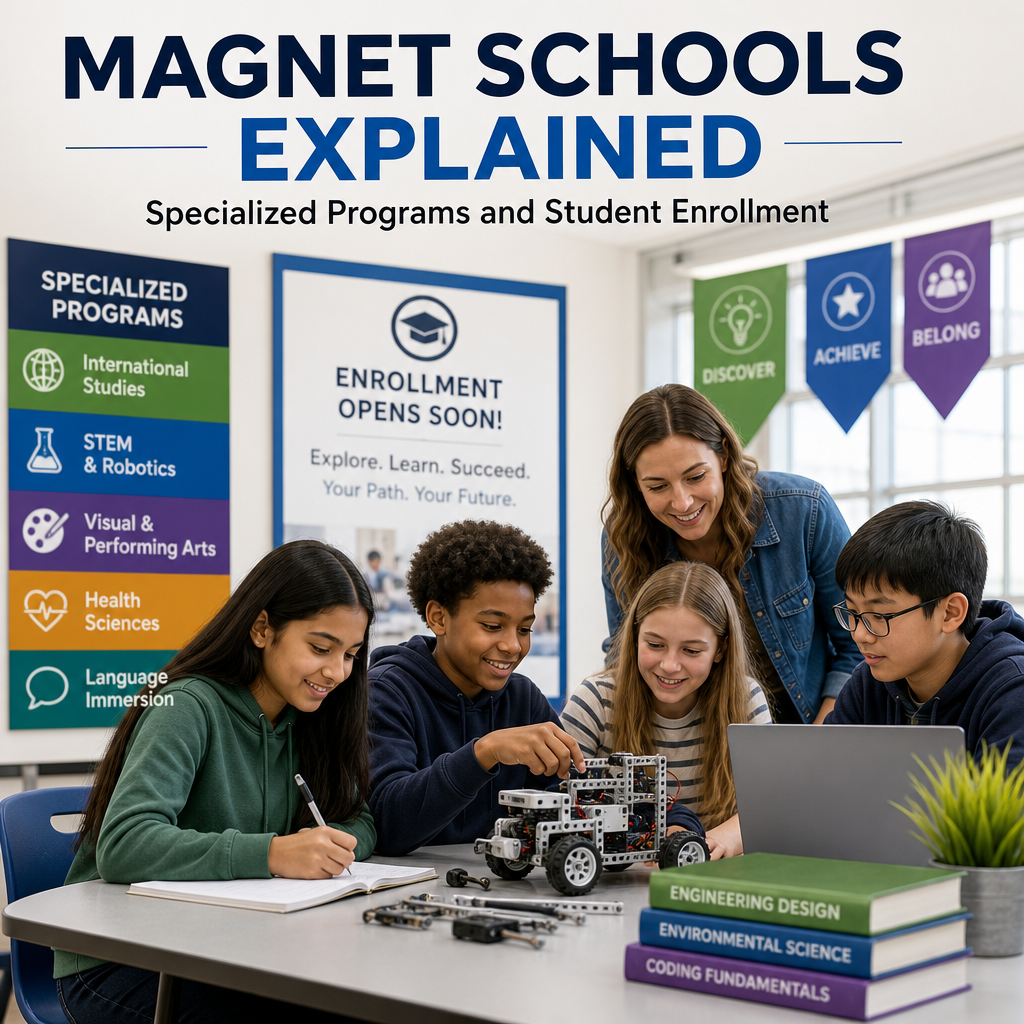
Magnet Schools Explained: Specialized Programs and Student Enrollment
Magnet schools give families a public school option with specialized programs built around a child’s interests, from STEM and the arts to language immersion and career-focused learning. Understanding how magnet schools handle student enrollment can help you find a better fit for your child’s goals and daily school experience.
By: Jennifer Collins on August 3, 2026
Anúncios
Choosing the right school can shape a child’s academic experience, daily routine, and long-term opportunities. For many families, magnet schools offer an appealing option because they combine strong academics with specialized programs designed to match student interests, strengths, and goals. Whether a child is drawn to STEM, the arts, language immersion, or career-focused study, magnet schools can provide a more focused learning environment than a traditional neighborhood assignment.
Anúncios
This guide explains what magnet schools are, how they differ from other public schools, and what families should know about student enrollment. If you’re exploring school options, understanding how magnet schools work can help you make a confident, informed decision.
What Are Magnet Schools?
Magnet schools are public schools that offer specialized curricula or themes to attract students from a wider geographic area. Unlike traditional neighborhood schools, magnet schools are often designed around a particular focus such as:
Science, technology, engineering, and mathematics (STEM)
Performing or visual arts
International baccalaureate (IB)
Language immersion
Montessori or project-based learning
Health sciences
Career and technical education
The word “magnet” refers to the school’s ability to draw students from different neighborhoods, and sometimes even different attendance zones, because of its unique academic offerings.
Anúncios
Magnet schools remain public schools, which means they are generally tuition-free and funded by public dollars. In many districts, they are used to expand educational choice while also supporting diversity and student access.
How Magnet Schools Work
Magnet schools are typically operated by a public school district or a public charter system, though the exact structure varies by location. They may serve elementary, middle, or high school students, and some districts offer magnet programs within a larger school instead of a fully separate campus.
Key Features of Magnet Schools
Magnet schools often include:
A specialized academic theme or instructional model
Admission through an application or lottery process
Transportation options in some districts
Curriculum aligned with the school’s focus
Opportunities for hands-on learning, enrichment, or advanced coursework
A student body drawn from multiple neighborhoods
Because they are public schools, magnet schools usually must follow state education standards and accountability requirements. However, they often have flexibility to go deeper into their chosen theme.
Examples of Specialized Programs
A magnet school focused on STEM may emphasize robotics, computer science, and engineering design. An arts magnet might offer theatre production, dance technique, and studio art in addition to core subjects. A dual-language magnet may teach some subjects in English and some in another language, helping students build bilingual skills over time.
These programs can create a more immersive learning environment and help students explore interests earlier than they might in a standard school setting.
Why Families Choose Magnet Schools
Families consider magnet schools for many reasons. Some want a stronger academic challenge, while others are looking for a school culture that better matches their child’s personality or learning style.
Benefits of Magnet Schools
Some common advantages include:
Specialized learning
Students spend more time in subjects or activities they genuinely enjoy.
More school choice
Magnet schools give families options beyond their assigned neighborhood school.
Engaging curriculum
Many programs emphasize project-based learning, real-world applications, and hands-on experiences.
Peer community
Students often join peers who share similar interests, which can improve motivation and belonging.
Pathway to future opportunities
A strong theme-based program can help students build skills for college, career training, or specialized careers.
For example, a student interested in medicine might thrive in a health sciences magnet that includes anatomy labs, guest speakers, and career exploration. Another student who loves the arts may feel more connected in a school where creativity is part of everyday learning.
How Magnet Schools Differ From Charter and Neighborhood Schools
Magnet schools are often confused with charter schools or traditional public schools, but they are not the same.
Magnet Schools vs. Neighborhood Schools
Neighborhood schools usually serve children based on where they live. Magnet schools, by contrast, typically accept students from a broader area and may not be tied to a single attendance zone.
Neighborhood schools may offer a general curriculum with some enrichment options. Magnet schools usually center their entire identity around a theme or specialized instructional model.
Magnet Schools vs. Charter Schools
Charter schools are public schools too, but they operate under a charter agreement and often have more independent governance. Magnet schools generally remain part of a school district and must follow district policies more closely.
Both can offer school choice, but magnet schools tend to be more directly tied to a district’s mission and public-school system.
Understanding Magnet School Enrollment
The student enrollment process for magnet schools can vary widely depending on the district, grade level, and number of applicants. Some schools are open enrollment, while others are highly competitive.
Common Enrollment Steps
Although procedures differ, magnet school enrollment often includes the following steps:
Research available schools
Review the school’s theme, academic performance, transportation, schedule, and extracurricular offerings.
Check eligibility
Some magnet schools require students to live in the district, while others may accept out-of-district applicants.
Submit an application
Families usually apply during a designated window. This may happen online or through the district office.
Provide supporting documents
Schools may request proof of residency, birth certificate, report cards, test scores, attendance records, or recommendation forms.
Complete screening or audition requirements
Certain magnet programs, such as arts or gifted academies, may involve an audition, portfolio review, interview, or academic screening.
Wait for selection results
If the number of applicants exceeds available seats, admission may be determined by lottery or a point-based system.
Accept the seat
If offered a spot, families usually need to confirm enrollment by a deadline.
Lottery-Based Admission
Many magnet schools use a lottery system to ensure fairness when applications exceed available seats. In some districts, priority may be given to siblings, students from specific neighborhoods, or applicants meeting certain criteria.
If the school has more demand than capacity, a lottery helps distribute opportunities without relying solely on first-come, first-served enrollment.
Deadlines Matter
Because magnet school enrollment often happens months before the school year starts, families should pay close attention to deadlines. Missing an application window can mean waiting another year.
A smart approach is to:
Start researching schools early in the fall
Review district timelines carefully
Gather documents in advance
Attend open houses or information sessions
Ask questions about transportation and program expectations
What to Look For When Choosing a Magnet School
Not every magnet school is the right fit for every child. A strong program on paper may still be a poor match if it doesn’t align with your child’s personality, learning needs, or family schedule.
Important Factors to Consider
When comparing options, think about:
Academic focus: Does the theme support your child’s interests and goals?
Teaching style: Is the school hands-on, rigorous, project-based, or more traditional?
Student support services: Are there resources for special education, English learners, or advanced learners?
Transportation: Is bus service available, and how long is the commute?
School culture: Does the environment feel welcoming and structured?
Schedule and workload: Will the time commitment fit your family’s routine?
Extracurriculars: Are clubs, athletics, performances, or competitions offered?
For example, a family might love a magnet school’s science labs but later realize the daily commute is too long for younger children. Another family may be drawn to an arts program but need to confirm whether the school also offers strong core academics.
Questions to Ask Before Applying
A little preparation can make the enrollment process much easier. Before you apply, consider asking school or district staff:
How are students selected if applications exceed seats?
Is transportation provided for all students?
Are there entrance requirements or auditions?
What happens if my child wants to leave the magnet program later?
Do students take advanced placement, honors, or dual-enrollment courses?
How does the school support students who need extra help?
What kind of homework, projects, or family involvement should we expect?
These questions can help you move beyond the marketing materials and understand the day-to-day reality of the school.
Are Magnet Schools a Good Fit for Every Student?
Magnet schools can be an excellent fit, but they are not automatically the best choice for every child. Some students thrive when they have a focused academic theme and can dive deeply into an area of interest. Others may do better in a smaller neighborhood setting with a predictable routine and fewer transitions.
Students Who May Benefit Most
Magnet schools may work especially well for students who:
Show strong interest in a particular subject
Need more challenge than a standard curriculum offers
Enjoy project-based or experiential learning
Want exposure to peers with similar interests
Benefit from a specialized pathway toward college or a career
Students Who May Need a Different Setting
A different school model may be better if a child:
Struggles with long commutes or early start times
Needs a highly individualized schedule
Prefers a smaller, less specialized environment
Does best with a neighborhood-based peer group
The best choice depends on the child, not the label. A magnet school can be a powerful fit when the school’s structure supports the student’s strengths and goals.
How to Support a Successful Transition
If your child is accepted into a magnet school, a smooth transition can make a big difference.
Practical Ways to Prepare
Visit the campus before school starts
Review the daily schedule together
Talk about the school’s theme and expectations
Set up transportation plans early
Encourage your child to join clubs or activities
Stay in touch with teachers during the first few weeks
Students often adjust more quickly when they understand what to expect. For younger children, simple routines can reduce anxiety. For older students, it helps to explain how the magnet program connects to future goals.
The Long-Term Value of Magnet Schools
A strong magnet school experience can shape more than academic performance. It can help students discover passions, build confidence, and develop discipline in a field they care about. Whether the focus is engineering, art, language, or leadership, these schools often encourage students to think more deeply and apply knowledge in meaningful ways.
For families, magnet schools can also expand access to quality education and provide alternatives within the public school system. That makes them an important part of the school choice conversation in many communities.
Frequently Asked Questions
What is the main purpose of a magnet school?
The main purpose of a magnet school is to offer a specialized educational program that attracts students from a broader area. These schools often focus on themes like STEM, arts, language immersion, or career preparation while remaining public and tuition-free.
Is admission to a magnet school guaranteed?
No, admission is not always guaranteed. Many magnet schools have limited seats and accept students through a lottery, screening process, or application review. Some programs are more competitive than others, so families should apply early and follow all requirements carefully.
Do magnet schools charge tuition?
In most cases, magnet schools do not charge tuition because they are public schools. However, families may still want to ask about fees for uniforms, field trips, instruments, supplies, or special activities, depending on the school’s program.
Can students from outside the district apply?
Sometimes, yes. Some magnet schools accept applicants from outside the district, while others limit enrollment to district residents. Policies vary by state and district, so it’s important to check the specific school’s eligibility rules.
Do magnet schools provide transportation?
Many districts offer transportation for magnet school students, but not all do. Transportation policies can depend on the distance from home to school, district resources, and the number of students enrolled. Always confirm bus routes, pickup locations, and timing before applying.
Magnet schools give families a valuable public-school option built around specialized programs, strong themes, and broader school choice. For many students, that structure creates a more engaging and motivating learning experience. Whether the focus is STEM, the arts, language immersion, or career preparation, magnet schools can connect classroom learning to real interests and future goals.
Still, the best choice depends on fit. Families should look closely at the program focus, admissions process, transportation, school culture, and daily expectations before applying. Understanding the student enrollment process is especially important, since deadlines, lotteries, and documentation requirements can affect access.
If you are exploring schools for your child, start early, ask detailed questions, and compare options with your child’s needs in mind. A thoughtful choice today can lead to a stronger school experience tomorrow.
Jennifer, M.Ed., holds a degree in Higher Education Administration, with
a focus on U.S. college financial aid, admissions policy, and student
support systems. She researches and writes about scholarships, federal
aid programs, and the college planning process to help students and
families make informed, well-supported decisions.