Gallaudet University and Federal Support for Deaf Education
Anúncios
Gallaudet University stands at the center of American deaf education, but its role goes far beyond being a single university. It reflects a long history of federal support for deaf education in the United States and the idea that Deaf people deserve full access to higher learning, leadership opportunities, and a community built around American Sign Language (ASL). For many families, students, educators, and advocates, Gallaudet is both a symbol and a practical example of what inclusive education can look like when policy and access work together.
Understanding Gallaudet University and federal support for deaf education helps explain how the U.S. has approached educational access for Deaf and hard of hearing students over time. It also shows why federal investment remains important today, especially as students navigate school accommodations, language access, and transition to college or careers.
Anúncios
What Makes Gallaudet University Unique?
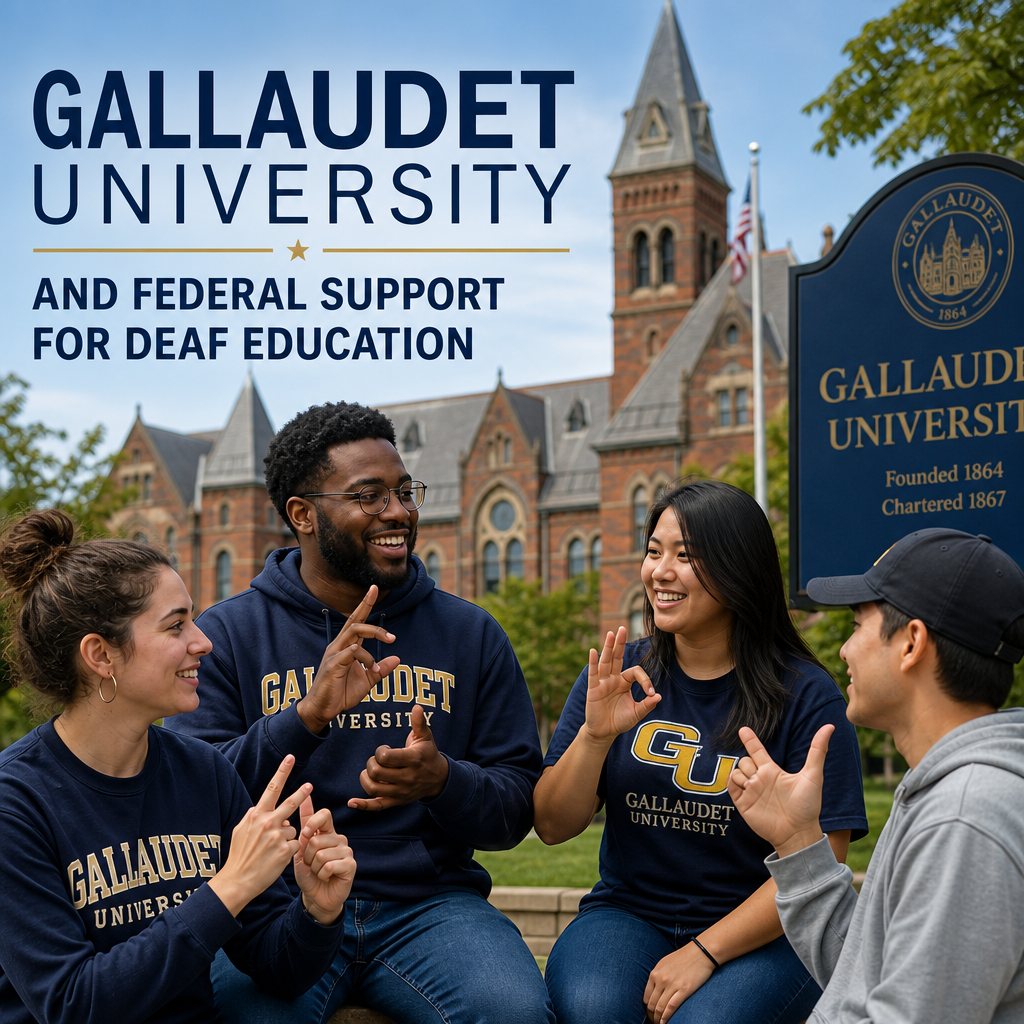
Gallaudet University is the world’s only university designed specifically for Deaf and hard of hearing students. Located in Washington, D.C., it serves undergraduate, graduate, and professional students in an environment where ASL and English are both central to campus life.
That matters because education is not just about course content. It is also about how students access information, participate in class, build relationships, and develop identity. Gallaudet provides a setting where Deaf students do not have to work around their access needs; instead, the institution is built with those needs in mind.
Anúncios
A campus shaped by Deaf culture and language access
At Gallaudet, communication access is not an afterthought. Interpreting, captioning, visual learning tools, and Deaf-centered teaching practices are part of the educational model. This creates a learning environment that can support:
- Direct communication in ASL
- Bilingual education in ASL and English
- Leadership development within Deaf culture
- Peer connections and mentorship
- Academic engagement without constant access barriers
For many students, that kind of environment can be life-changing. It gives them a chance to focus on learning rather than constantly managing communication obstacles.
The History of Federal Support for Deaf Education
Federal support for deaf education did not begin with modern disability laws. It developed over time as the government recognized that educational access required public investment, institutional support, and civil rights protections.
Early federal involvement
The roots of Gallaudet University trace back to the mid-1800s, when public support helped establish a national institution for Deaf education. Over time, that support evolved into a broader federal commitment to education for students with disabilities, including Deaf and hard of hearing learners.
Today, federal support for deaf education takes many forms, such as:
- Direct support for Gallaudet University
- Special education funding for children and youth
- Disability rights laws that require reasonable accommodations
- Research and training grants for educators and interpreters
- Services that support transition, employment, and accessibility
Why federal support matters
Deaf education is not only a local school issue. It involves national standards, funding structures, and rights protections. Federal involvement helps address uneven resources across states and school districts. Without it, access to qualified teachers, interpreters, assistive technology, and specialized programs would vary even more widely.
In practical terms, federal support helps ensure that Deaf students have more than a chance to attend school. It helps create real access to learn, thrive, and succeed.
Gallaudet University as a Federal Institution
One reason Gallaudet University remains so important is that it has a unique relationship with the federal government. It is a private university with a public mission and federal support. That structure reflects its historic role as a national resource for Deaf education.
A national mission
Gallaudet is not simply serving a local community. It has a national role in:
- Educating Deaf and hard of hearing students
- Training future Deaf leaders
- Advancing research related to Deaf studies, language, and access
- Providing a model for accessibility in higher education
Because of that mission, federal support is not just a budget issue. It is part of how the United States recognizes the value of Deaf education and leadership.
A bridge between policy and practice
Gallaudet also helps translate policy into lived experience. Laws and regulations matter, but students need classrooms, professors, interpreters, technology, and support systems that make those rights real. Gallaudet shows what that can look like when access is built into the institution itself.
Federal Laws That Shape Deaf Education
Gallaudet University and federal support for deaf education are closely connected to broader disability and education law. Several key laws shape how Deaf students access services from early childhood through higher education.
Individuals with Disabilities Education Act (IDEA)
IDEA requires public schools to provide students with disabilities a free appropriate public education. For Deaf and hard of hearing students, that may include:
- Interpreting services
- Audiological support
- Speech-language services
- Specialized instruction
- Assistive technology
- Communication access plans
IDEA also emphasizes individualized planning. That is crucial because Deaf students do not all have the same needs. Some use ASL, some use spoken language, and many use a combination of communication methods.
Section 504 of the Rehabilitation Act
Section 504 protects students with disabilities from discrimination in federally funded programs. In schools and colleges, it often supports accommodations such as:
- Captioning
- Note-taking support
- Accessible communication
- Modified testing conditions
- Interpreter services
For Deaf students in higher education, Section 504 is especially important because colleges and universities must remove barriers to access.
Americans with Disabilities Act (ADA)
The ADA expanded civil rights protections across many public and private settings. In education, it reinforces the requirement that institutions provide effective communication and equal access.
Together, these laws help create the foundation for federal support for deaf education. They also show that access is not optional; it is part of legal responsibility.
How Federal Support Reaches Deaf Students
Federal support does not only flow through universities like Gallaudet. It reaches Deaf students through a range of programs, services, and educational systems.
In early childhood and K-12 education
For younger students, federal support may help provide:
- Early intervention services
- Family support and communication guidance
- Individualized Education Programs (IEPs)
- Deaf education specialists
- Access to interpreters or captioning
- School placements that match communication needs
Early access matters because language development and educational foundation begin long before college. When students receive support early, they are better positioned for academic and social success.
In college and graduate school
In higher education, Deaf students may rely on:
- Disability services offices
- ASL interpreters
- Real-time captioning
- Accessible digital materials
- Flexible communication methods in class
- Academic mentoring and tutoring
Gallaudet University provides a strong example of an institution designed around these principles. But its model also influences how other colleges think about access and inclusion.
In workforce and transition programs
Federal support for deaf education also extends into transition services. These programs can help students move from school to employment, independent living, or further education. That may include:
- Career counseling
- Internship support
- Assistive technology training
- Job readiness services
- Self-advocacy training
These supports are especially valuable because Deaf students often need to navigate workplaces that are still catching up on accessibility.
Why Gallaudet Matters Beyond Campus
Gallaudet University has an influence that reaches well beyond its own students. It shapes national conversations about Deaf identity, language access, and education policy.
A center for Deaf leadership
Many Gallaudet graduates go on to become educators, advocates, researchers, artists, government workers, and community leaders. Their experience matters because leadership is stronger when it includes people who understand Deaf life from the inside.
That leadership role is one of the clearest reasons federal support for deaf education matters. When Deaf students have access to high-quality education, the entire community benefits.
A model for inclusive design
Gallaudet also demonstrates the value of universal design and accessible communication. More schools and colleges are now paying attention to:
- Visual instruction
- Captioning
- Flexible participation options
- Clear communication access
- Accessible digital learning platforms
These practices do not only help Deaf students. They can improve learning for many students, including English learners, students with learning differences, and students in noisy or hybrid learning environments.
Challenges That Still Remain
Even with strong legal protections and a historic institution like Gallaudet, challenges remain in deaf education.
Uneven access across school districts
Some school districts have strong Deaf education programs, while others have limited resources. Families may have to advocate hard for appropriate services, and quality can vary widely by region.
Shortages of trained professionals
There is still demand for:
- Qualified Deaf education teachers
- Skilled ASL interpreters
- Audiologists
- Captioning providers
- Support staff who understand Deaf culture
Federal support can help address these gaps, but training and recruitment remain ongoing needs.
Transition barriers
Many Deaf students still face barriers when moving from K-12 education to college or work. These barriers may include:
- Weak self-advocacy preparation
- Lack of transition planning
- Poor coordination between schools and colleges
- Inaccessible internships or workplaces
Addressing these challenges requires more than compliance. It requires commitment to meaningful inclusion.
What Families and Students Should Know
If you are a parent, student, or educator, it helps to understand that federal support for deaf education is not just about one law or one institution. It is a system of protections and resources that should work together.
Practical steps to take
Consider the following if you are exploring educational options for a Deaf or hard of hearing student:
- Review the student’s communication needs carefully.
ASL, spoken language, cued speech, captioning, and other supports all affect educational planning. - Ask about school services early.
Do not wait until there is a problem. Learn what accommodations are available. - Understand the difference between access and placement.
A school may have a program, but that does not always mean it provides the right access. - Request written plans and documentation.
IEPs, 504 plans, and disability service agreements should clearly describe support. - Encourage self-advocacy.
Deaf students benefit when they learn how to explain their needs and ask for access.
Questions worth asking schools and colleges
- Are interpreters available for classes and events?
- Is captioning provided in real time?
- Are digital materials accessible?
- How are Deaf students included in discussions and group work?
- What transition supports exist for college or employment?
These questions help families make informed choices and push institutions to do better.
The Future of Gallaudet University and Federal Support for Deaf Education
The future of Deaf education will likely depend on how well schools, colleges, and policymakers adapt to changing technology and student needs. Remote learning, captioning tools, video communication platforms, and digital accessibility have opened new opportunities, but they have also revealed new gaps.
Technology is helpful, but not enough
Technology can improve access, but it cannot replace human support, cultural understanding, or strong educational policy. A captioning tool is useful, but it works best when paired with accessible teaching and trained staff.
Continued investment matters
Federal support for deaf education remains important because access requires ongoing investment. Funding helps maintain specialized programs, train professionals, support research, and keep educational opportunities equitable across communities.
Gallaudet University will likely continue to serve as a national example of what happens when a university is designed with Deaf students at the center.
Frequently Asked Questions
1. What is Gallaudet University known for?
Gallaudet University is known as the world’s only university designed specifically for Deaf and hard of hearing students. It is also recognized for its leadership in Deaf culture, ASL, accessibility, and Deaf-centered higher education.
2. How does the federal government support deaf education?
The federal government supports deaf education through laws like IDEA, Section 504, and the ADA, along with direct funding, special education services, transition programs, and support for institutions such as Gallaudet University.
3. Is Gallaudet University publicly funded?
Gallaudet has a unique relationship with the federal government and receives federal support because of its national mission. It operates as a private university with a public purpose centered on Deaf education and leadership.
4. What services do Deaf students receive in school?
Deaf students may receive interpreters, captioning, assistive technology, specialized instruction, speech-language support, audiology services, and individualized accommodations depending on their needs and educational setting.
5. Why is early support important for Deaf children?
Early support matters because language access shapes learning, communication, and social development. When Deaf children receive appropriate services early, they are more likely to build strong academic skills and confidence.
Official Resources
- Gallaudet University Official Website
- U.S. Department of Education: Individuals with Disabilities Education Act (IDEA)
- U.S. Department of Education: Office for Civil Rights
- National Institute on Deafness and Other Communication Disorders (NIDCD)
- Americans with Disabilities Act (ADA) National Network
Conclusion
Gallaudet University and federal support for deaf education are deeply connected parts of a larger story about access, rights, and opportunity. Gallaudet shows what is possible when education is built around Deaf students rather than adapted for them after the fact. Federal support, meanwhile, provides the legal and financial framework that helps Deaf learners receive services, accommodations, and meaningful access from early childhood through higher education.
The key lesson is simple: Deaf education works best when it combines strong policy, trained professionals, accessible communication, and respect for Deaf identity and language. Whether a student is entering kindergarten, preparing for college, or planning a career, access should be clear, consistent, and empowering.
As education continues to evolve, Gallaudet remains a powerful example of what inclusive learning can accomplish. For families, educators, and advocates, the next step is to stay informed, ask for appropriate support, and continue pushing for systems that meet Deaf students where they are—and help them go further.