Index Funds Explained: How Market-Tracking Investments Work
Index funds offer a simple way to invest in the market without having to pick individual winners, making them a popular choice for long-term growth. In this guide, index funds explained in plain English shows how they track benchmarks like the S&P 500 and why that approach can be both low-cost and effective.
By: Mary Mitchell on August 3, 2026
Anúncios
Index funds have become one of the most popular ways to invest for long-term growth, and for good reason. They offer a simple, low-cost way to own a broad slice of the market without trying to guess which stocks will win next. If you have ever wondered how index funds explained in plain English really work, this guide breaks it down step by step.
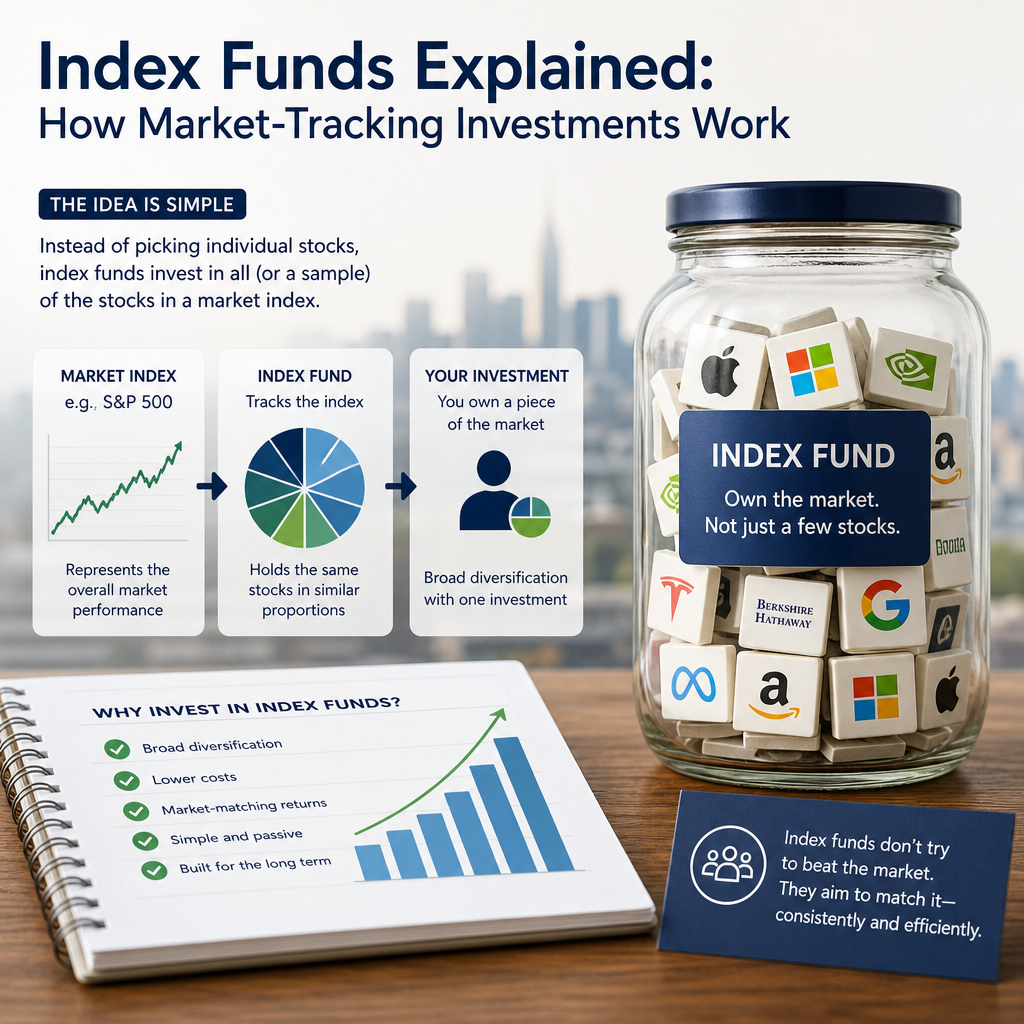
At their core, index funds are built to track a market index such as the S&P 500, the total U.S. stock market, or a bond index. Instead of relying on an active manager to pick investments, the fund aims to mirror the performance of its benchmark as closely as possible. That makes index funds a practical option for investors who want diversification, transparency, and a long-term strategy they can understand.
Anúncios
What Is an Index Fund?
An index fund is a type of mutual fund or exchange-traded fund (ETF) designed to match the performance of a specific market index. That index may represent:
Large U.S. companies
Small- and mid-cap stocks
International stocks
Bonds
Sector-specific markets, such as technology or healthcare
When people search for index funds explained, they are usually trying to understand why these funds behave differently from actively managed funds. The answer is simple: index funds do not try to beat the market. They try to be the market, or at least a defined part of it.
Anúncios
A quick example
If an index fund tracks the S&P 500, it generally owns the same stocks in roughly the same proportions as the index. If Apple, Microsoft, and Amazon are among the largest holdings in the S&P 500, the fund will also hold them in similar weightings.
That is what makes index funds market-tracking investments. They are built around replication, not prediction.
How Index Funds Work
To understand index funds explained clearly, it helps to look at the process behind them.
1. The fund chooses a benchmark index
Every index fund starts with an index. This benchmark serves as the blueprint. The fund manager does not choose investments based on personal opinions or market forecasts. Instead, the goal is to follow the index rules.
2. The fund buys the underlying assets
The fund purchases the securities that make up the index. Depending on the benchmark, that could mean stocks, bonds, or other assets.
3. The fund rebalances as the index changes
Indexes are not static. Companies are added or removed, and weightings may shift over time. The fund adjusts its holdings to stay aligned with the benchmark.
4. The fund aims to minimize tracking error
Tracking error is the difference between the index’s return and the fund’s return. A well-run index fund tries to keep that difference small.
This is where indexing stands apart from active investing. Instead of aiming for outperformance, the fund focuses on consistency and precision.
Why Index Funds Became So Popular
Index funds have gained traction because they solve several common investor problems at once.
Lower costs
Because index funds do not need large research teams or frequent trading, they often have lower expense ratios than active funds. Lower costs matter because fees reduce your net return over time.
Broad diversification
Many index funds hold hundreds or even thousands of securities. That helps reduce the impact of any single company’s poor performance.
Simplicity
You do not need to analyze individual stocks or constantly monitor the market. A few well-chosen index funds can give you exposure to broad segments of the market.
Long-term discipline
Index funds encourage a patient, buy-and-hold approach. That can help investors avoid emotional decisions during market swings.
Index Funds vs. Actively Managed Funds
A lot of confusion clears up once you compare index funds with actively managed funds.
Index funds
Track a benchmark
Aim to match market performance
Usually have lower fees
Trade less often
Offer a rules-based approach
Actively managed funds
Rely on fund managers to pick investments
Aim to beat the market
Often have higher fees
May trade more frequently
Depend on manager skill and timing
Neither option is automatically “better” in every situation. But for many investors, index funds offer a strong balance of cost, diversification, and simplicity.
The Main Types of Index Funds
Index funds are not one-size-fits-all. They come in several forms, and each serves a different role in a portfolio.
Stock index funds
These track equity markets. Common examples include:
Broad U.S. market funds
Large-cap funds
Growth or value funds
International stock funds
Bond index funds
These track fixed-income benchmarks and can help reduce portfolio volatility. They may include:
Treasury bonds
Corporate bonds
Government bond indexes
Inflation-protected securities
Sector and thematic index funds
These focus on a particular part of the market, such as technology, energy, or healthcare. They can be useful, but they are usually less diversified than broad-market funds.
International index funds
These provide exposure to companies outside the United States. Some track developed markets, while others include emerging markets.
How Index Funds Make Money for Investors
Index funds can generate returns in two main ways:
Capital appreciation — the value of the securities rises over time
Income distributions — stocks may pay dividends, and bonds may pay interest
For many investors, the real power of index funds comes from compounding. When your returns stay invested and continue earning returns themselves, growth can accelerate over the long term.
Practical example
Imagine you invest in a total market index fund and leave the money alone for years. As the market rises, your investment value may grow. If the fund also distributes dividends and you reinvest them, those payments buy more shares, which may then generate additional growth.
That is one of the simplest and most effective ways to build wealth over time.
What to Look for in an Index Fund
Not all index funds are equally efficient or suitable for every investor. When evaluating a fund, pay attention to these factors.
Expense ratio
This is the annual fee charged as a percentage of your investment. In general, lower is better, assuming the fund tracks its index well.
Tracking difference
A fund should closely follow its benchmark. A large gap between the fund and the index may indicate inefficiency.
Holdings and index methodology
Two funds may sound similar but track different indexes. Read the fund’s objective and methodology to understand what you are actually buying.
Liquidity and trading structure
ETF index funds trade like stocks during market hours, while mutual fund index funds are priced once per day. Both can work well, but the trading experience is different.
Minimum investment and accessibility
Some mutual funds require a minimum investment, while many ETFs can be purchased with the price of a single share. That may matter if you are starting small.
Common Misunderstandings About Index Funds
Despite their popularity, index funds are sometimes misunderstood.
“Index funds are risk-free”
They are not. If the market falls, index funds fall too. Diversification helps, but it does not eliminate market risk.
“Index funds guarantee average returns”
They aim to match the market, not guarantee a specific outcome. Returns depend on the underlying index and market conditions.
“All index funds are the same”
Not true. A fund tracking large U.S. stocks has a very different risk profile than one tracking emerging market bonds.
“You can set it and forget it forever”
While index funds are relatively low-maintenance, you still need to review your asset allocation, contribution plan, and time horizon periodically.
Are Index Funds Good for Beginners?
For many beginners, the answer is yes. Index funds are often a smart entry point because they make it easier to invest without becoming overwhelmed.
Why beginners like them
Easy to understand
Built-in diversification
Lower fees
Fewer decisions to make
Good fit for long-term investing
A simple starter approach
A beginner might begin with one broad U.S. stock index fund and one bond index fund, then add an international fund later if needed. The exact mix depends on age, goals, and risk tolerance.
If you are just getting started, index funds can help you build a steady investment habit before worrying about advanced strategies.
How to Use Index Funds in a Portfolio
Index funds work best when they fit into a thoughtful plan.
Build around your goals
Ask yourself:
Am I investing for retirement?
Do I need money in the next five years?
How much volatility can I tolerate?
Your answers help determine which funds make sense.
Choose a simple asset allocation
A common portfolio structure includes:
U.S. stocks for growth
International stocks for global diversification
Bonds for stability and income
Rebalance when needed
Over time, some assets grow faster than others. Rebalancing helps you return to your target mix. You can do this annually or when allocations drift significantly.
Keep investing consistently
Dollar-cost averaging, or investing a fixed amount regularly, can make it easier to stay disciplined. It does not remove risk, but it can reduce the pressure of trying to time the market.
Tax Considerations to Know
Index funds are often tax-efficient, but taxes still matter.
Why they can be tax-efficient
Because index funds trade less often than active funds, they may generate fewer taxable capital gains distributions. ETFs can also be especially tax-friendly in certain accounts.
What investors should watch
Dividends may be taxable
Selling shares in a taxable account may trigger capital gains
Tax rules vary by account type and jurisdiction
For taxable investing, it helps to understand where to place different fund types, especially if you also use retirement accounts such as a 401(k) or IRA.
Example: A Simple Index Fund Strategy
Let’s say you want a straightforward, long-term investment plan.
You might choose:
A total U.S. stock market index fund
An international stock index fund
A U.S. bond index fund
That setup gives you exposure to growth, global diversification, and some stability. You can adjust the percentages based on your age and goals.
For example:
80% stocks and 20% bonds for a more growth-focused investor
60% stocks and 40% bonds for someone seeking a steadier ride
The key is not finding the “perfect” fund. It is creating a structure you can stick with.
Frequently Asked Questions
What is the main purpose of an index fund?
The main purpose of an index fund is to track the performance of a specific market index as closely as possible. Instead of trying to beat the market, it aims to deliver the market’s return for that segment, minus low fees and small tracking differences.
Are index funds better than individual stocks?
Index funds are often better for investors who want broad diversification and less risk tied to any single company. Individual stocks can offer higher upside, but they also carry much more company-specific risk. For many people, index funds are the simpler and more reliable long-term option.
How do index funds compare to ETFs?
An ETF is a fund structure, while an index fund is an investing strategy. Many index funds are ETFs, and many are mutual funds. Both can track indexes. The biggest difference is often how they trade: ETFs trade throughout the day, while mutual funds are priced once per day.
Do index funds pay dividends?
Yes, many index funds pay dividends if the underlying companies or bonds generate income. Some investors choose to reinvest those dividends, which can help compound growth over time. Others may take the cash distributions depending on their goals.
Can index funds lose money?
Yes. Index funds are still subject to market risk. If the underlying market falls, the fund value can fall too. They are generally less risky than owning a small number of individual stocks, but they are not guaranteed investments.
Index funds offer a straightforward way to invest in the market without trying to outguess it. By tracking a benchmark, they provide broad diversification, lower costs, and a rules-based approach that many investors find easier to stick with over time. That combination makes them especially appealing for beginners, busy professionals, and anyone building a long-term portfolio.
The most important thing to remember is that index funds are not magical. They still carry market risk, and they still require a plan. But when used thoughtfully, they can help you invest with more confidence and less complexity. Whether you are saving for retirement, building wealth, or simply looking for a more efficient investing strategy, index funds can play a valuable role.
If you are new to investing, start by understanding your goals, your time horizon, and your risk tolerance. Then choose a few well-diversified index funds that fit your strategy, keep your costs low, and invest consistently. Over time, that disciplined approach can make a meaningful difference.
Mary S, CFP®, is a Certified Financial Planner with over 12 years of experience in personal finance, retirement planning, and wealth management. She writes educational content that helps readers understand financial concepts and make informed decisions based on reliable information.