Open Educational Resources: Free, Adaptable Classroom Materials
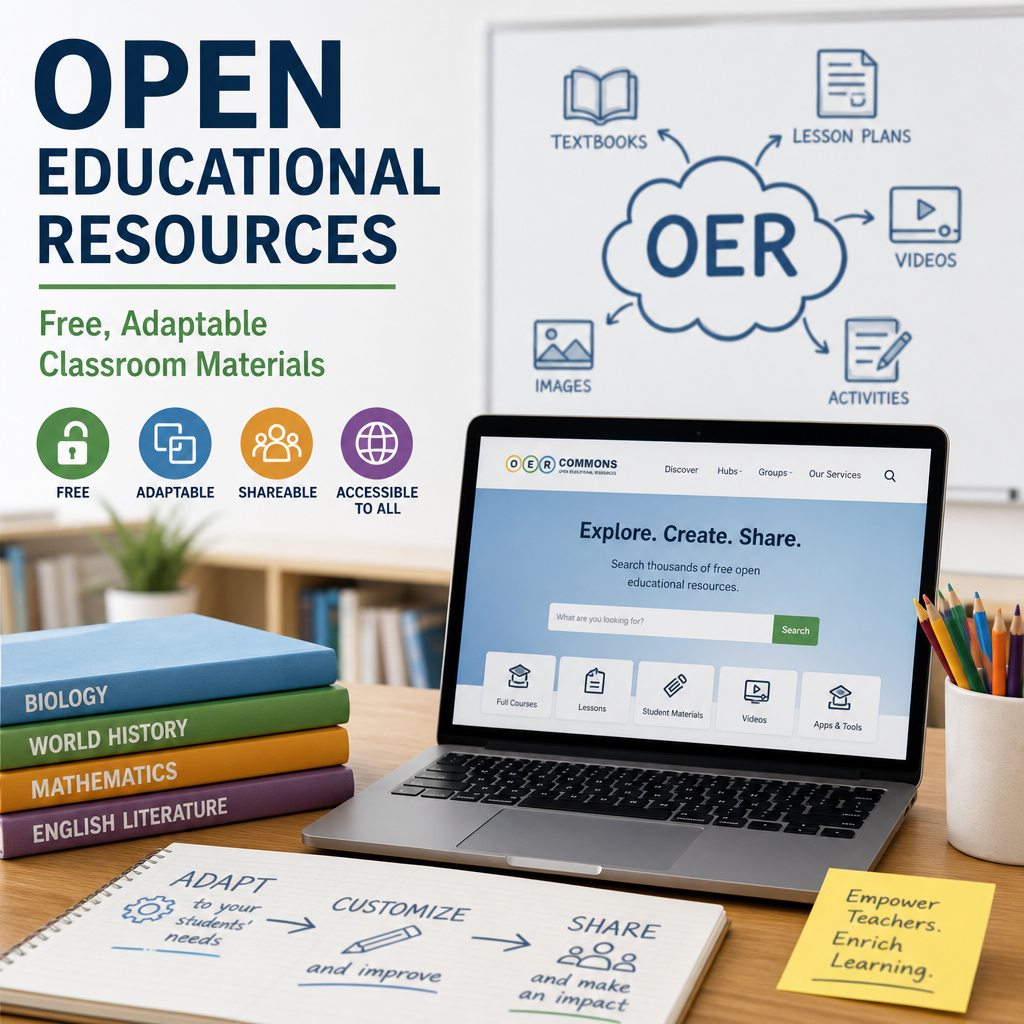
Open educational resources give teachers free, flexible materials they can adapt to meet different grade levels, learning goals, and student needs. From textbooks to videos and quizzes, OER make it easier to create engaging lessons without the cost barriers of traditional resources.
By: Jennifer Collins on August 3, 2026
Anúncios
Open Educational Resources, often called OER, are changing the way teachers find, use, and adapt classroom content. In a world where budgets are tight and student needs vary widely, Open Educational Resources offer a practical, flexible solution for educators who want high-quality materials without the usual cost barriers. From lesson plans and textbooks to videos, quizzes, and full courses, OER gives teachers more control over what they teach and how they teach it.
What makes Open Educational Resources especially valuable is not just that they are free. They are also adaptable. Teachers can revise, remix, and share these materials to fit grade level, learning goals, language needs, and local context. That flexibility makes OER a powerful tool for supporting student engagement and access.
Anúncios
What Are Open Educational Resources?
Open Educational Resources are teaching, learning, and research materials that are either in the public domain or published with licenses that allow free use and adaptation. In practical terms, that means educators can legally download, copy, modify, and redistribute them, depending on the license.
Common examples of OER include:
Anúncios
Full textbooks
Lesson plans
Worksheets and activity sheets
Slide presentations
Videos and animations
Interactive simulations
Assessments and quizzes
Entire online courses
Unlike traditional commercial resources, OER are designed for sharing and improvement. A teacher can use an existing reading passage, simplify the language, add discussion questions, and translate it for multilingual learners—all while staying within the terms of the license.
How OER differ from free resources
Not every free resource is an Open Educational Resource. A free worksheet on a website may be available for download, but if the copyright does not allow modification or redistribution, it is not truly open.
To count as OER, the material should include an open license such as Creative Commons or be in the public domain. That license is what gives educators the legal freedom to adapt it.
Why Open Educational Resources Matter in Classrooms
Open Educational Resources matter because they help solve several common classroom challenges at once: cost, access, customization, and equity.
1. They reduce cost barriers
Textbooks and digital subscriptions can strain school budgets and place pressure on families. OER can reduce or eliminate material costs, making it easier for schools to provide access on day one.
2. They support instructional flexibility
Teachers rarely use one-size-fits-all materials. OER can be adjusted for:
Different reading levels
Special education supports
English learner scaffolds
Local examples and case studies
Project-based learning units
3. They encourage collaboration
Because OER are shareable, teachers can collaborate across schools, districts, and even countries. One educator can improve a lesson and another can build on it. That kind of collaboration can lead to stronger materials over time.
4. They improve access for diverse learners
When teachers can adapt materials, they can better meet student needs. For example, a history lesson can be shortened, translated, or paired with visual supports to make it more accessible.
The 5R Framework of Open Educational Resources
A useful way to understand Open Educational Resources is through the 5R permissions model, which describes what users are allowed to do with open content.
1. Retain
You can keep, copy, and own a copy of the content.
2. Reuse
You can use the content in a wide range of ways, such as in class, online, or in handouts.
3. Revise
You can adapt, edit, or change the material.
4. Remix
You can combine the original or revised material with other open resources to create something new.
5. Redistribute
You can share the original, revised, or remixed version with others.
This framework is one reason Open Educational Resources are so valuable in education. It gives teachers room to make materials truly their own.
Types of Open Educational Resources Teachers Can Use
Teachers can find OER across nearly every subject and grade level. The key is knowing what kinds of resources work best for a particular lesson or unit.
Open textbooks
Open textbooks provide complete, standards-aligned content that can replace or supplement traditional textbooks. They are especially useful in high school and college settings, but there are also many options for K–12.
Lesson plans and unit plans
These materials help teachers save planning time while still allowing for customization. A lesson plan can be adapted for pacing, student interests, or local curriculum requirements.
Multimedia resources
Videos, audio clips, images, and simulations can help explain complex topics. For example, a science teacher might use an open simulation to demonstrate how variables affect a chemical reaction.
Practice activities and assessments
Teachers can use open quizzes, discussion prompts, and exit tickets to check for understanding and guide instruction.
Open courses and learning modules
Some OER collections include full courses that educators can borrow from or adapt for blended learning, independent study, or remediation.
How to Evaluate Open Educational Resources
Not all Open Educational Resources are equally strong. Quality matters, especially when classroom time is limited. Before using a resource, review it carefully with a clear checklist.
Check alignment
Ask whether the content matches your learning goals, state standards, and student needs.
Review accuracy and currency
Make sure the information is accurate, current, and supported by reliable sources. This matters especially in science, history, health, and technology.
Look for accessibility
Good OER should support varied learners. Consider whether the resource includes:
Clear headings
Alt text for images
Captioned videos
Readable font and layout
Translation or language supports
Assess usability
A resource can be open and accurate, but still hard to use. Check whether it is well organized, easy to download, and simple to edit in a familiar format.
Verify the license
Always confirm the open license before adapting or sharing. Look for Creative Commons labels or other clear permissions. If a resource says “free” but offers no license, treat it cautiously.
How Teachers Can Adapt OER Effectively
The real strength of Open Educational Resources is adaptation. A thoughtful adjustment can turn a decent resource into a strong classroom tool.
Start with small changes
You do not have to redesign everything at once. Many teachers begin by:
Simplifying directions
Replacing unfamiliar examples
Adding vocabulary supports
Breaking a long reading into chunks
Creating a differentiated graphic organizer
Match the resource to your students
For example, a middle school teacher using an open article on ecosystems might:
Highlight key terms
Add a word bank
Insert guided questions
Offer an audio version
Create two versions of the assignment, one scaffolded and one more advanced
Remix strategically
You can combine materials from several open sources into one stronger lesson. A teacher might pair:
An open textbook chapter
A short open video
A self-created exit ticket
A discussion protocol from another open source
This approach lets you build a cohesive learning experience without starting from scratch.
Benefits of Open Educational Resources for Schools and Districts
Open Educational Resources can benefit not just individual teachers, but entire schools and districts.
Better resource consistency
When teams work from shared OER, they can build more consistent instruction across classrooms and grade levels.
More equitable access
If all students receive the same core materials, schools can reduce gaps caused by uneven access to books or subscriptions.
Stronger local customization
Districts can adapt resources to align with local curriculum, community values, and student demographics without negotiating with publishers for every change.
Professional learning opportunities
Working with OER often encourages instructional collaboration. Teachers who revise and share resources build skills in curriculum design, digital literacy, and accessibility.
Challenges to Consider Before Adopting OER
Open Educational Resources are powerful, but they are not a perfect fix. Schools should plan carefully.
Time required for review and adaptation
Finding a resource is only the beginning. Teachers may need time to evaluate, edit, and align materials. Without support, OER can feel like extra work.
Variable quality
Because OER comes from many different creators, quality can vary widely. Strong review processes help solve this problem.
Technology and format issues
Some OER are easy to edit; others are locked into hard-to-modify formats. Schools should prioritize resources that are practical to use.
Copyright confusion
Teachers may unintentionally mix open and non-open content. Clear guidance on licensing helps prevent misuse.
Best Practices for Using Open Educational Resources
To get the most from Open Educational Resources, start with a simple, sustainable workflow.
Use a review process
Before adopting a resource, ask:
Is it accurate?
Is it aligned?
Is it accessible?
Is the license clear?
Can I realistically use and adapt it?
Keep attribution clear
Even when a resource is open, creators should be credited according to the license terms. Good attribution protects both the creator and the school.
Save editable versions
Whenever possible, store materials in editable formats so future teachers can continue improving them.
Build a shared library
A school or department can save time by creating a shared OER folder with approved materials, notes, and adapted versions.
Train staff on licensing
A short professional development session on Creative Commons licenses can help teachers feel more confident and avoid mistakes.
Practical Classroom Examples of OER in Action
Here are a few real-world ways Open Educational Resources can support teaching and learning.
Elementary reading lesson
A third-grade teacher uses an open phonics worksheet, a free illustrated story, and a shared slide deck. The teacher shortens the text for small-group intervention and adds picture supports for emerging readers.
Middle school science lab
A science teacher uses an open lab simulation to explore states of matter. Students complete a teacher-created worksheet that includes prediction questions and reflection prompts.
High school history unit
A U.S. history teacher pulls together open primary sources, an open textbook chapter, and an open discussion guide. The teacher adds local historical connections to make the content more relevant.
College composition class
An instructor uses an open textbook for writing basics, then adapts chapters to fit a semester-long theme. Students benefit from a low-cost material that still feels tailored to the course.
Frequently Asked Questions
What counts as an Open Educational Resource?
An Open Educational Resource is a learning or teaching material that is either in the public domain or licensed in a way that allows free use, sharing, and adaptation. Common examples include open textbooks, lesson plans, videos, and assessments.
Are Open Educational Resources really free?
Yes, OER are free to access and use, but some may require you to follow specific license terms, such as giving proper attribution. Also, “free” does not always mean “open,” so it is important to verify the license.
Can teachers modify Open Educational Resources?
In most cases, yes. That is one of the main advantages of OER. Depending on the license, teachers may revise, remix, and redistribute the material for classroom use.
How can I tell if a resource is truly open?
Look for a clear open license, such as a Creative Commons license, or confirmation that the material is in the public domain. If the website says the resource is free but does not explain reuse rights, it may not be OER.
What is the best way to start using OER in my classroom?
Start small. Choose one lesson, one unit, or one supplemental resource. Evaluate its quality, adapt it for your students, and test it in class. Once you are comfortable, you can expand your use of OER over time.
Open Educational Resources give educators a practical way to improve access, flexibility, and collaboration in the classroom. By using openly licensed materials, teachers can save money, adapt content for diverse learners, and build lessons that better reflect student needs. OER also supports a more sustainable approach to curriculum development, where educators do not have to choose between quality and affordability.
Still, the best results come from thoughtful use. Teachers and school leaders should take time to evaluate quality, verify licenses, and make sure resources align with learning goals. When used well, Open Educational Resources are more than a cost-saving tool. They are a pathway to more responsive, equitable, and creative teaching.
Whether you are exploring one open textbook or redesigning an entire unit, the key is to start with a resource that fits your classroom and then shape it to serve your students better. With the right approach, OER can become a lasting part of your instructional toolkit.
Jennifer, M.Ed., holds a degree in Higher Education Administration, with
a focus on U.S. college financial aid, admissions policy, and student
support systems. She researches and writes about scholarships, federal
aid programs, and the college planning process to help students and
families make informed, well-supported decisions.