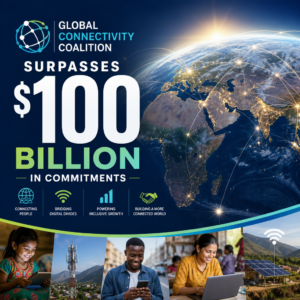
Global Connectivity Coalition Surpasses $100 Billion in Commitments
Anúncios
The Global Connectivity Coalition has become a major point of interest for governments, investors, technology companies, and development leaders because it has now surpassed $100 billion in commitments. That milestone matters for more than its size. It signals that improving digital access is no longer treated as a niche development issue—it is now widely viewed as essential infrastructure for economic growth, education, healthcare, and public services.
At a time when millions of people still lack reliable internet access, the Global Connectivity Coalition’s expanding commitments reflect a broader shift: connectivity is increasingly seen as a foundation for opportunity. From rural broadband builds to submarine cables, data centers, mobile networks, and last-mile solutions, these commitments could help close long-standing digital gaps if they are deployed effectively.
Anúncios
What the Global Connectivity Coalition Is

The Global Connectivity Coalition is a multi-stakeholder effort focused on expanding affordable, reliable internet access around the world. It brings together public agencies, private companies, financial institutions, and nonprofit organizations that share a common goal: making digital connectivity more accessible in underserved and unserved regions.
While the coalition’s structure can vary by initiative or region, its central purpose is consistent:
Anúncios
- Expand broadband infrastructure
- Support digital inclusion
- Encourage investment in connectivity projects
- Reduce barriers to access in low-income and remote communities
The coalition’s recent milestone—surpassing $100 billion in commitments—suggests that the scale of investment behind digital access is growing quickly. That matters because connectivity projects often require long timelines, significant capital, and coordination across sectors.
Why $100 Billion in Commitments Matters
Crossing the $100 billion mark is not just a symbolic achievement. It shows that the business case for global connectivity has become stronger and more widely accepted.
A sign of long-term confidence
Large commitments usually indicate that investors and institutions believe the sector has durable value. In this case, that value includes:
- Expanding digital commerce
- Supporting remote work and learning
- Enabling telehealth and e-government services
- Improving resilience in rural and developing regions
A response to real-world demand
The demand for internet access continues to grow as more essential services move online. People need connectivity for:
- School assignments and online learning
- Job applications and workforce training
- Small business operations
- Banking and mobile payments
- Access to government services and emergency alerts
When the coalition attracts this level of commitment, it suggests that stakeholders understand digital infrastructure is no longer optional. It is core infrastructure.
A potential catalyst for private and public action
One of the most important effects of a major commitment milestone is signaling. When large-scale projects gain momentum, others often follow. Governments may update policies, private investors may revisit regional markets, and telecom operators may expand into areas they once considered too risky.
What Drives Investment in Global Connectivity
Several factors have helped push the Global Connectivity Coalition beyond $100 billion in commitments. These include economic opportunity, technological advances, and growing recognition of the social value of internet access.
Growing demand for broadband infrastructure
Broadband demand continues to rise across both developed and emerging markets. Remote work, streaming, cloud services, digital payments, and connected devices all depend on fast, stable networks. As usage increases, so does the need for new infrastructure.
Projects often involve:
- Fiber-optic networks
- 4G and 5G mobile expansion
- Satellite connectivity
- Community wireless networks
- Shared infrastructure in rural areas
The rise of digital inclusion as a policy priority
Policymakers increasingly recognize that digital exclusion can deepen existing inequalities. Households without reliable connectivity face disadvantages in education, employment, healthcare, and civic participation.
That’s why connectivity investment often aligns with broader public goals such as:
- Closing the digital divide
- Supporting economic development
- Expanding access to public services
- Strengthening disaster response and communication
New financing models
Connectivity projects have become more attractive as financing structures improve. Public-private partnerships, blended finance, universal service funds, and development finance tools can reduce risk and make challenging projects more viable.
These models are especially useful in markets where:
- Population density is low
- Income levels are limited
- Terrain is difficult
- Traditional returns are slower to materialize
How the Commitments Could Be Used
A commitment is not the same as a completed project, but it can still drive real progress. If deployed strategically, the Global Connectivity Coalition’s funding commitments could support a wide range of initiatives.
1. Expanding rural broadband
Many remote communities still rely on slow or inconsistent internet service. Investment can help extend fiber and wireless networks to areas that private markets often overlook.
Practical uses include:
- Connecting schools and libraries
- Supporting local hospitals and clinics
- Enabling small businesses to reach broader markets
2. Improving affordability
Access is not only about availability. In many places, internet service exists but remains too expensive for households to use consistently. Commitments may support pricing reforms, infrastructure sharing, or public access points that reduce cost barriers.
3. Supporting local digital ecosystems
Connectivity works best when paired with local capacity. Investments can also help train technicians, support entrepreneurs, and improve digital literacy so communities can fully benefit from new infrastructure.
4. Building resilient networks
Climate events, disasters, and political instability can disrupt communications. Investments in resilient infrastructure can improve reliability and help communities stay connected during emergencies.
Challenges That Still Need Attention
Even with $100 billion in commitments, the work is far from complete. Connectivity projects are complex, and money alone does not guarantee success.
Infrastructure gaps remain large
Many regions still lack basic coverage. In some places, the challenge is not just technical—it is geographic, logistical, and financial. Mountainous terrain, islands, dense forests, and dispersed populations all raise deployment costs.
Affordability remains a major barrier
A network can exist and still fail to serve residents if monthly costs are too high or devices are out of reach. Affordable service plans and access to smartphones, computers, and public Wi-Fi matter just as much as towers and cables.
Regulatory and policy hurdles
Permitting delays, inconsistent spectrum rules, and unclear licensing frameworks can slow projects. In some markets, investors also face uncertainty about taxation, local ownership requirements, or infrastructure sharing policies.
Digital literacy and trust
Connectivity alone does not create inclusion. People also need the skills and confidence to use online tools safely and productively. That includes knowing how to:
- Search for reliable information
- Protect personal data
- Use online learning platforms
- Access e-government services
- Avoid scams and misinformation
What This Means for Businesses and Communities
The milestone reached by the Global Connectivity Coalition has implications well beyond the telecom sector. It affects how businesses operate, how communities grow, and how public services are delivered.
For businesses
Expanded connectivity can create new markets and improve efficiency. Small businesses can sell online, manage logistics, and communicate with customers more easily. Larger firms benefit from better supply chain visibility and broader talent access.
Potential business impacts include:
- Faster digital transformation
- Better remote collaboration
- Access to underserved customer segments
- Improved data sharing and automation
For communities
Reliable internet access can change everyday life in practical ways. Students can complete schoolwork, workers can apply for jobs, and families can connect with services that were once difficult to reach.
Examples of community-level benefits include:
- Online education for rural students
- Telemedicine appointments
- Mobile banking and remittances
- Real-time weather and emergency alerts
- Access to local government resources
For governments
Governments can deliver services more efficiently when more people are connected. Digital platforms can reduce paperwork, improve service delivery, and extend access to citizens in remote locations.
How to Evaluate Connectivity Commitments
Because the headline figure is so large, it helps to look beyond the total and ask practical questions about execution. If you are following the Global Connectivity Coalition or a similar initiative, these are the kinds of factors that matter most.
Key questions to ask
- Where will the money go?
Is the funding focused on infrastructure, affordability, training, or policy reform? - Who will benefit first?
Are the projects targeting the hardest-to-reach communities or only the easiest opportunities? - What type of connectivity is being built?
Fiber, mobile, satellite, and community networks each have different strengths. - How will success be measured?
Useful metrics include coverage, affordability, adoption, reliability, and usage. - Are local communities involved?
Long-term success is more likely when projects reflect local needs and conditions.
The Bigger Picture: Connectivity as a Global Development Priority
The fact that the Global Connectivity Coalition surpasses $100 billion in commitments reflects a larger global trend: digital access is now widely viewed as a development priority, not just a technology issue.
That shift matters because internet access influences nearly every part of modern life. It shapes education, work, healthcare, finance, and civic participation. It also affects how quickly communities can respond to crises and how effectively businesses can compete in a digital economy.
Still, the strongest results will come from coordinated action. Infrastructure investment must be paired with affordability, local training, supportive regulation, and long-term maintenance. Without those pieces, even large commitments can fall short of their goals.
Practical Examples of What Success Could Look Like
To understand the potential impact, it helps to think in practical terms.
A rural school gains stable internet
Teachers can assign online research, students can join virtual lessons, and administrators can access digital tools without constant interruptions.
A clinic expands telehealth services
Patients in remote areas can consult specialists without traveling long distances, saving time and potentially improving health outcomes.
A small business grows online
A local artisan or retailer can reach customers outside the immediate area, process digital payments, and market products through social platforms or e-commerce sites.
A local government improves service delivery
Residents can renew documents, pay fees, or check public notices online instead of waiting in long lines or traveling to municipal offices.
These examples show why the coalition’s commitments matter. Connectivity investments can create practical, everyday gains that compound over time.
Frequently Asked Questions
1. What does it mean that the Global Connectivity Coalition surpassed $100 billion in commitments?
It means participating organizations have pledged more than $100 billion toward connectivity-related projects and initiatives. These commitments may support broadband expansion, digital inclusion, infrastructure upgrades, and related programs. The figure reflects growing confidence in the importance of global internet access.
2. Does a commitment guarantee that all the money will be spent immediately?
No. A commitment is a pledge, not necessarily immediate spending. Funds may be deployed over several years, and some projects may depend on regulatory approval, technical planning, or matching investments. It is important to distinguish between pledged capital and completed investment.
3. Why is global connectivity such a major development priority?
Because internet access supports education, healthcare, employment, commerce, and public services. Communities without reliable connectivity often face disadvantages that affect long-term economic and social outcomes. Expanding access can help reduce those gaps.
4. What are the biggest obstacles to expanding connectivity?
Common obstacles include high infrastructure costs, remote geography, low affordability, regulatory delays, and limited digital literacy. Even when networks exist, some households still cannot use them regularly because service or device costs are too high.
5. How can communities benefit from these commitments?
If implemented well, the commitments can improve local internet access, lower costs, support schools and clinics, strengthen small businesses, and expand access to online public services. Community involvement is key to making sure investments match real local needs.
Official Resources
- World Bank: Digital Development
- International Telecommunication Union (ITU)
- Federal Communications Commission: Broadband
- UNICEF: Digital Connectivity
- National Telecommunications and Information Administration (NTIA)
Conclusion
The milestone reached by the Global Connectivity Coalition is significant because it reflects more than financial momentum—it reflects a global recognition that connectivity is essential infrastructure. Surpassing $100 billion in commitments signals strong belief in the long-term value of broadband expansion, digital inclusion, and network resilience. But the real measure of success will not be the headline number alone. It will be whether these commitments turn into reliable, affordable access for the people and communities that need it most.
That means execution matters. Projects must reach underserved regions, lower barriers to use, and support the local skills needed to make digital tools truly useful. Governments, investors, service providers, and community leaders all have a role to play in making that happen.
For businesses, policymakers, and citizens alike, this is a moment to pay attention. The next phase of global connectivity will shape how people learn, work, communicate, and participate in the digital economy for years to come.