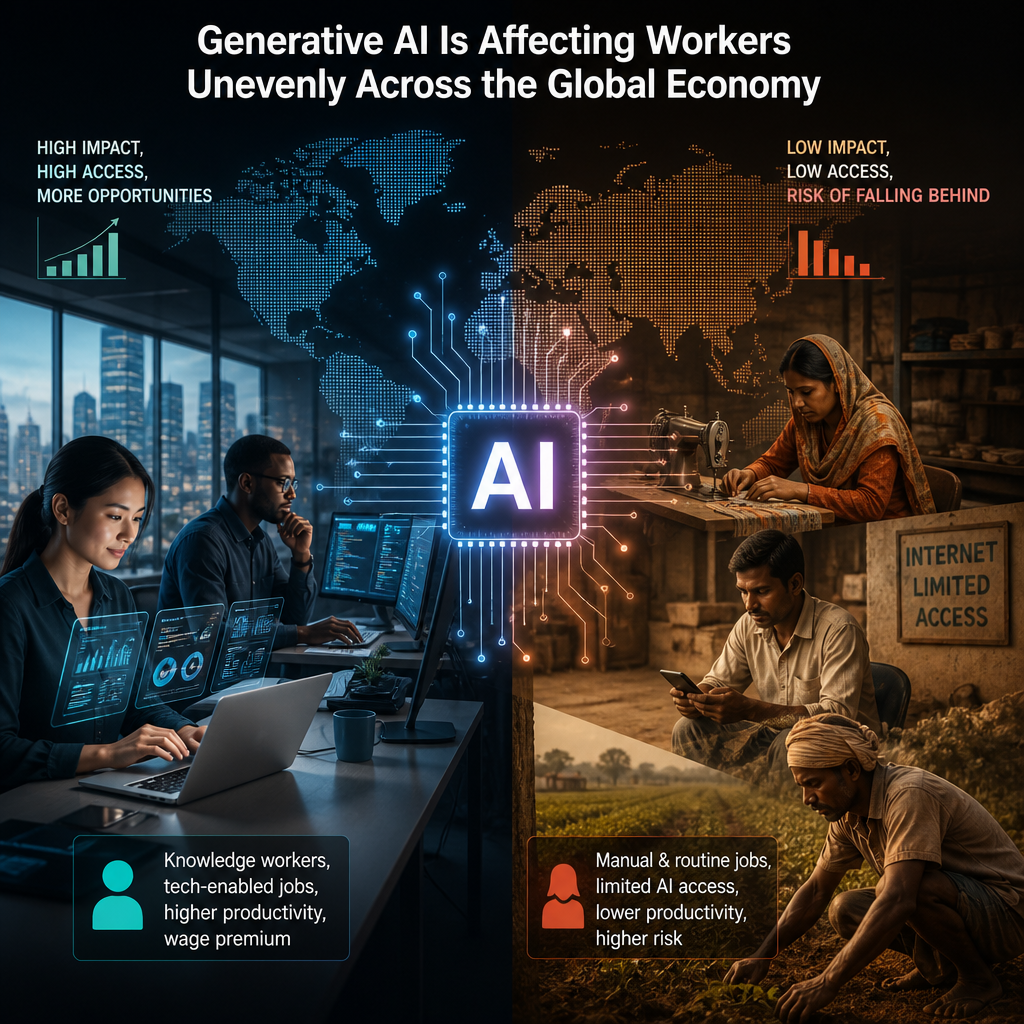
Generative AI Is Affecting Workers Unevenly Across the Global Economy
Generative AI impact is already being felt in very different ways depending on the job, industry, and region. While some workers are gaining new tools and productivity boosts, others face greater uncertainty, showing why the generative AI impact is anything but uniform.
By: Peter on August 3, 2026
Anúncios
Generative AI is changing how work gets done, but its impact is far from equal. In some industries, it is already speeding up tasks, improving customer service, and reshaping job roles. In others, workers may feel little immediate change—or may face greater pressure, uncertainty, or displacement. The reality is that generative AI is affecting workers unevenly across the global economy, and that unevenness matters for businesses, policymakers, and employees alike.
This is not just a story about automation replacing jobs. It is also about who gains access to new tools, who has the skills to use them, which tasks can be augmented, and which countries and industries have the infrastructure to adopt AI quickly. To understand the true effects of generative AI, we need to look beyond headlines and examine how it is influencing work across sectors, job types, and regions.
Anúncios
Why Generative AI Is Affecting Workers Unevenly Across the Global Economy
Generative AI tools such as chatbots, code assistants, writing platforms, and design generators are highly flexible. They can support knowledge work, customer interactions, marketing, software development, and even parts of legal, financial, and administrative work. But that flexibility does not mean the impact is uniform.
Several factors shape the uneven effects:
Anúncios
Job content: Roles built around routine digital tasks are more exposed than jobs requiring physical presence, manual labor, or complex human judgment.
Skill level: Workers with advanced digital literacy can often use AI as a productivity tool, while others may be left behind.
Industry readiness: Some sectors have the budgets, data systems, and leadership to adopt AI quickly; others do not.
Geography: Countries with stronger digital infrastructure and higher rates of broadband access tend to see faster AI adoption.
Language and data availability: AI tools often perform better in English and in well-resourced markets, which can limit usefulness elsewhere.
In other words, generative AI does not simply “affect workers.” It affects different workers in different ways, depending on the context in which they work.
Which Workers Face the Biggest Changes?
Knowledge Workers Are Feeling the Shift First
The first major wave of generative AI adoption has been concentrated in white-collar, information-based jobs. These include:
Marketing and advertising professionals
Software developers
Customer support teams
Administrative assistants
Paralegals and legal researchers
Analysts and consultants
Content creators and editors
These roles often involve producing text, summarizing information, generating ideas, or handling structured digital workflows. Generative AI can speed up these tasks, but it also changes what managers expect from workers.
For example, a marketing employee may use AI to draft campaign ideas, then spend more time on strategy and brand judgment. A customer service agent may rely on AI to suggest responses, allowing faster resolution of common issues. A software developer may use AI to write boilerplate code and focus more on architecture and debugging.
The result is not always job loss. In many cases, it is task reshaping. Workers do fewer repetitive steps and more review, editing, and decision-making. But this shift can also raise productivity expectations, create pressure to produce more output, and reduce demand for certain entry-level tasks that traditionally help workers learn the ropes.
Entry-Level and Routine White-Collar Roles May Be More Exposed
One concern is that generative AI may reduce opportunities in roles that serve as stepping stones into professional careers. Junior writers, assistants, researchers, and support staff often begin by doing simpler tasks that build expertise over time.
If AI takes over a large share of those tasks, employers may hire fewer entry-level workers or expect them to operate at a higher level immediately. That could make it harder for new graduates or career changers to gain experience.
This is one reason the conversation about generative AI should not focus only on whether a job can be automated. It should also ask:
What parts of the job are being automated?
Are workers being trained to use AI effectively?
Are employers redesigning career pathways?
Are younger workers losing opportunities to build skills?
Why the Global Impact Is So Uneven
Advanced Economies Have More Resources for Adoption
High-income countries are often first to adopt generative AI because they usually have:
Better digital infrastructure
More access to cloud services and computing power
Larger pools of highly skilled workers
More capital for experimentation and training
Stronger institutional support for digital transformation
That does not mean workers in advanced economies are protected. In fact, they may be more exposed because they work in occupations with high levels of digital task content. But these economies also tend to have more resources to retrain workers and redesign jobs.
Emerging Markets Face Different Constraints
In many lower- and middle-income countries, the impact of generative AI may unfold differently. Workers may be less exposed in some sectors because the economy relies more heavily on agriculture, manufacturing, informal labor, or face-to-face services. At the same time, these countries may have less access to the tools, training, and infrastructure needed to benefit from AI.
This creates a tough balance:
Some workers are insulated from immediate displacement because their jobs are less digitized.
Others may miss out on productivity gains because businesses cannot adopt AI easily.
Countries that rely on outsourced digital services may face competitive pressure if AI reduces demand for routine support work.
For example, a business process outsourcing center may see AI tools handle common customer inquiries more efficiently, which could reduce the need for certain roles. Meanwhile, local entrepreneurs, educators, or small firms may not have the bandwidth to adopt those same tools at scale.
Language and Localization Matter
Generative AI systems often perform best in widely represented languages, especially English. Workers in markets where local languages are underrepresented may find AI outputs less accurate, less culturally appropriate, or less useful.
That matters because productivity tools only help if they fit actual work conditions. A customer service chatbot that works well in one language may struggle in another. A writing assistant may produce polished English but weak results in a regional language. This uneven performance can widen existing gaps between global markets.
How Different Sectors Are Responding
Technology and Professional Services Are Adopting Fast
Some sectors are moving quickly because they already work in digital environments and can measure the productivity effects of AI tools. Technology companies, consulting firms, financial services, and media organizations are actively testing generative AI for:
Drafting documents
Summarizing reports
Generating code
Supporting client communication
Speeding up research
These sectors often have the right mix of data, expertise, and incentives to experiment. They can also absorb the cost of training workers and refining internal processes.
Manufacturing and Logistics Are Seeing Slower, Indirect Effects
Generative AI matters in manufacturing and logistics too, but the effects are often less immediate. These sectors may use AI to:
Improve documentation
Support maintenance planning
Assist with training materials
Analyze supply chain data
Enhance customer communication
However, because many jobs in these sectors involve physical work, the technology is less likely to replace entire roles quickly. Instead, it may change back-office functions, planning, and coordination.
Public Sector and Education Face Both Opportunity and Risk
Governments, schools, and universities are exploring generative AI for administration, teaching support, and information access. A public agency may use AI to draft routine responses. A teacher may use it to create lesson ideas. A university may use it to streamline internal workflows.
But these institutions must also manage privacy, accuracy, accountability, and fairness. If AI tools are introduced without guardrails, workers may be asked to rely on systems that produce errors or reflect hidden bias.
What Uneven AI Adoption Means for Workers
Some Workers Gain Productivity and Flexibility
For workers who have access to the right tools, generative AI can reduce repetitive work and create more time for higher-value tasks. Benefits may include:
Faster drafting and editing
Better brainstorming
Easier research and summarization
Improved customer response times
More efficient documentation
When used well, AI can support human work rather than replace it. It can help workers focus on judgment, creativity, and relationship-building.
Others Face Pressure, Monitoring, or Job Insecurity
Not everyone benefits equally. Workers may experience AI as:
A source of job anxiety
A trigger for reduced headcount
A management tool that increases output expectations
A system that monitors performance more closely
A reason to accept lower wages for “AI-assisted” work
This is especially true when organizations adopt AI primarily to cut costs rather than improve work quality. If workers are expected to do more with fewer resources, AI can become a stress multiplier.
New Skill Gaps Are Emerging
As generative AI becomes more common, a new divide is forming between workers who can:
Prompt effectively
Evaluate AI output critically
Integrate AI into workflows
Spot hallucinations and errors
Protect confidential information
and workers who cannot.
This is one of the most important labor-market shifts to watch. AI literacy is becoming a practical workplace skill, not a niche technical ability. Employers that invest in training can reduce disruption and improve performance. Those that do not may widen internal inequality.
How Businesses Can Respond Responsibly
Organizations do not have to choose between innovation and worker well-being. They can adopt generative AI in ways that improve productivity while supporting employees.
Practical steps include:
Map tasks, not just jobs
Identify which parts of work AI can assist with and which require human judgment.
Train workers early
Teach employees how to use AI safely, effectively, and critically.
Protect entry-level learning
Preserve opportunities for junior workers to develop core skills.
Set clear quality standards
Make sure AI-generated content is reviewed before use.
Monitor impact across teams
Watch for unequal effects on gender, age, education level, or location.
Use AI to augment, not just cut
Focus on better service, better decision-making, and better work design.
A thoughtful rollout can help workers adapt instead of react.
What Policymakers Should Pay Attention To
Because generative AI is affecting workers unevenly across the global economy, public policy will play a major role in shaping outcomes.
Key priorities include:
Training and reskilling programs
Digital infrastructure investment
Support for small businesses
Guidance on AI transparency and accountability
Labor market monitoring
Education reforms that build AI literacy
Governments should also pay attention to regional inequality. Rural areas, smaller cities, and underconnected communities may need targeted support to avoid being left behind.
International cooperation matters too. Countries with fewer resources may benefit from shared standards, language resources, and access to open educational materials. Without that support, the AI divide may deepen.
How Workers Can Prepare
Workers do not need to become AI experts overnight, but they do need to stay informed and adaptable.
Useful steps for individual workers:
Learn the basics of how generative AI works and where it fails
Practice using AI tools for drafting, brainstorming, and summarizing
Check outputs carefully for errors and bias
Build strengths in human-centered skills like communication, leadership, and problem-solving
Stay current on AI policies in your workplace
Ask how AI is changing your role and what training is available
The workers most likely to benefit are often those who treat AI as a tool to manage, not a force to fear.
Frequently Asked Questions
1. Which workers are most affected by generative AI?
Workers in knowledge-based roles are often affected first, especially those who handle writing, research, customer support, coding, and administrative tasks. These jobs include many digital tasks that AI can assist with or partially automate.
2. Does generative AI always replace jobs?
No. In many cases, it changes tasks rather than eliminating entire jobs. Workers may spend less time on routine work and more time on review, strategy, or communication. However, some roles may shrink if companies use AI to reduce labor costs.
3. Why is the impact of generative AI different across countries?
The effects differ because countries have different levels of digital infrastructure, language support, worker training, and industry mix. High-income economies often adopt AI faster, while emerging markets may face more barriers to implementation.
4. How can workers protect their careers as AI grows?
Workers can build AI literacy, practice using tools responsibly, and strengthen skills that AI cannot easily replace, such as critical thinking, collaboration, and relationship management. Staying adaptable is one of the best ways to remain competitive.
5. What should employers do to manage AI fairly?
Employers should train workers, review which tasks AI should handle, protect entry-level learning opportunities, and monitor whether AI is creating uneven outcomes across teams. Responsible adoption should improve work, not just cut costs.
Generative AI is not reshaping the global workforce in a single, uniform way. It is moving fastest in digital, white-collar, and high-income environments, while other workers face slower change, fewer benefits, or new forms of pressure. That uneven impact reflects differences in skills, infrastructure, language support, industry structure, and policy readiness.
For businesses, the lesson is clear: AI should be introduced with a plan for training, job redesign, and worker support. For policymakers, the challenge is to expand access, reduce inequality, and prepare labor markets for ongoing change. For workers, the goal is to build AI literacy, stay adaptable, and focus on the human skills that technology cannot easily replace.
The future of work will not be shaped by generative AI alone. It will be shaped by how institutions choose to deploy it, regulate it, and teach people to use it well. The sooner organizations and workers approach AI thoughtfully, the better their chances of turning disruption into opportunity.
Peter B holds a degree in Journalism and has 5 years of experience covering U.S. economic policy, labor markets, and financial news. He writes data-driven news content on topics like inflation, interest rates, and employment trends.