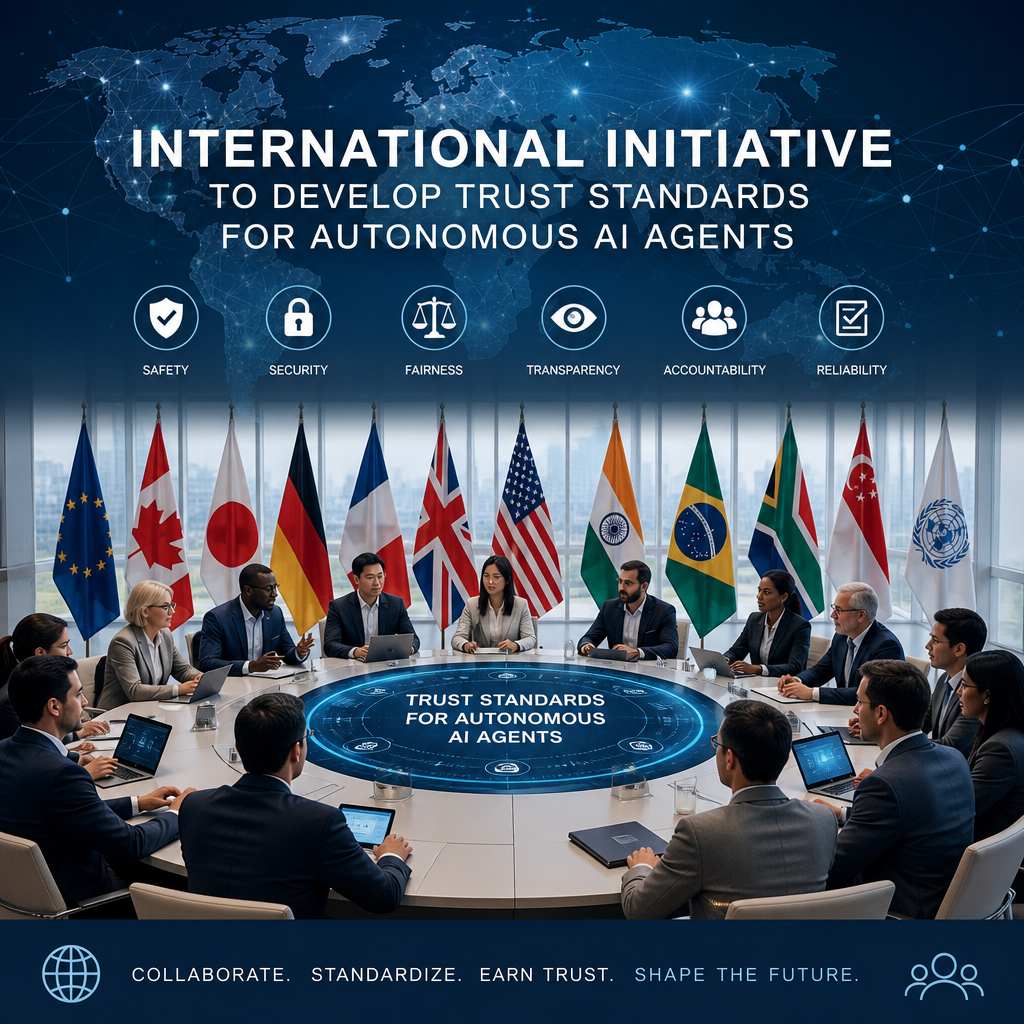
International Initiative to Develop Trust Standards for Autonomous AI Agents
A new international initiative is stepping in to develop trust standards for autonomous AI agents, helping define what safety, accountability, and transparency should look like as these systems take on more independent tasks. The goal is to give organizations clearer guidance so they can adopt agentic AI with greater confidence and less risk.
By: Peter on August 3, 2026
Anúncios
Autonomous AI agents are moving from experimental tools to practical systems that can plan tasks, make decisions, and act with increasing independence. As these systems spread across industries, one issue keeps rising to the top: trust. That is why a new international initiative will develop trust standards for autonomous AI agents, aiming to create clearer expectations for safety, accountability, transparency, and responsible deployment.
Anúncios
This matters because autonomous agents are not just chatbots. They can connect to software, make choices across multiple steps, and carry out actions with limited human oversight. When they work well, they can save time, reduce repetitive work, and improve efficiency. When they fail, the consequences can include security risks, faulty decisions, privacy concerns, and serious operational problems.
The push for trust standards for autonomous AI agents is an important step toward helping organizations adopt these systems more confidently. It also reflects a broader reality: the more capable AI becomes, the more important it is to define what “safe,” “reliable,” and “accountable” actually mean.
Why Trust Standards for Autonomous AI Agents Matter
Autonomous AI agents differ from traditional software because they can adapt their behavior based on goals, context, and incoming data. That flexibility is powerful, but it also creates new risks that older technology frameworks do not fully address.
Anúncios
The growing need for shared rules
Organizations across the world are exploring agentic AI in customer service, software development, logistics, healthcare, finance, and research. But each company often defines safeguards differently. One vendor may prioritize human approval before any action. Another may allow agents to operate with broader access. Without common trust standards for autonomous AI agents, it becomes harder to compare systems, test them consistently, or determine whether they are suitable for high-stakes use.
Shared standards can help answer questions such as:
How much autonomy is appropriate in a given setting?
What logs should an AI agent keep?
When must a human review a decision?
How should agent failures be reported?
What security controls are required before deployment?
Trust is more than performance
A system can be accurate in many cases and still not be trustworthy. For autonomous AI agents, trust includes:
Transparency: Can users understand what the agent is doing and why?
Reliability: Does the agent perform consistently across scenarios?
Safety: Can the agent avoid harmful or unintended actions?
Security: Can the agent resist misuse, manipulation, or unauthorized access?
Accountability: Is it clear who is responsible when something goes wrong?
These concerns are especially important when an agent can take actions on behalf of a person or organization, such as sending emails, changing records, creating code, or initiating transactions.
What the International Initiative Is Likely to Address
The announcement of a new international initiative signals a coordinated effort to bring structure to a fast-moving field. While specific frameworks may evolve over time, trust standards for autonomous AI agents will likely focus on several core areas.
1. Safety and bounded autonomy
One of the biggest questions is how much independence an agent should have. Standards may define levels of autonomy, similar to how other industries classify risk. For example, an agent handling a low-risk scheduling task may need fewer controls than one supporting legal, financial, or medical decisions.
Possible safeguards include:
Restricting the types of actions an agent can take
Requiring human approval for sensitive steps
Setting spending, access, or operational limits
Testing agents in controlled environments before live use
2. Transparency and explainability
People need to understand what an autonomous AI agent is doing, especially when it acts in ways that are not obvious. Trust standards may encourage documentation of:
The agent’s goals
The data it can access
The decision logic or workflow it follows
The conditions that trigger escalation to a human
This does not mean every internal model decision must be fully interpretable in a technical sense. It does mean users and auditors should have enough information to evaluate behavior and spot problems.
3. Security and misuse prevention
Because autonomous agents can interact with tools and systems, they may be exposed to prompt injection, credential theft, manipulation, or unauthorized instructions. International standards will likely address secure design practices such as:
Strong access controls
Identity verification
Input validation
Audit logging
Segregation of duties
Monitoring for abnormal actions
Security is not a one-time checklist. For agentic systems, it is an ongoing process that must evolve alongside the threat landscape.
4. Accountability and governance
A common concern with AI is the “responsibility gap.” If a machine makes a harmful decision, who is accountable? Trust standards for autonomous AI agents will likely push organizations to define clear ownership before deployment.
That may include:
Naming the system owner
Assigning oversight responsibility
Documenting escalation procedures
Recording who can approve, modify, or shut down the agent
Maintaining records for audits and incident review
Clear governance does not eliminate risk, but it makes risk easier to manage.
5. Testing, benchmarking, and certification
Standards often become valuable when they can be measured. The initiative may create testing criteria that help developers and buyers evaluate whether an autonomous AI agent meets baseline trust requirements.
That could involve testing for:
Task completion accuracy
Error recovery
Resistance to malicious prompts
Consistency across environments
Compliance with access and action limits
If certification programs emerge, businesses may be able to compare systems more confidently before adoption.
How These Standards Could Affect Businesses
For companies considering autonomous AI agents, trust standards could become a practical roadmap rather than just a policy discussion. They may influence procurement, compliance, product design, and customer confidence.
Better vendor evaluation
When standards exist, buyers can ask more precise questions. Instead of relying on vague claims about “safe AI,” organizations can compare products using common criteria.
That might help decision-makers evaluate:
Data handling practices
Human oversight options
Audit capabilities
Incident response procedures
Third-party testing or certification
Faster internal adoption
Many organizations hesitate to deploy autonomous AI because they do not know how to control it. Clear standards can reduce that uncertainty. With defined guardrails, internal teams can move from pilots to production with more confidence.
Stronger compliance planning
Businesses in regulated industries often need to show that they understand and manage technology risks. Trust standards for autonomous AI agents could support policy development, risk assessments, and documentation practices that align with broader compliance goals.
More responsible product development
For companies building agentic AI products, the initiative may shape design decisions early. That can be a major advantage. It is far easier to build trust features into a system from the start than to retrofit them after release.
Challenges the Initiative Must Solve
Creating trust standards for autonomous AI agents will not be simple. The field is moving quickly, and the technology is still evolving. Any international effort will need to balance flexibility with real-world usefulness.
Different use cases need different standards
A customer support agent, a coding assistant, and an AI system managing industrial workflows do not present the same level of risk. Standards must be specific enough to be meaningful while still broad enough to apply across sectors.
Global alignment is difficult
Countries may approach AI governance differently based on legal systems, business priorities, and public expectations. An international initiative will need to bridge those differences without becoming too vague.
Standards must keep up with innovation
AI agents are changing quickly. A useful standard today could become outdated if it does not evolve. That means the initiative will likely need regular review cycles, public input, and technical updates.
Trust must be measurable
The word “trust” is easy to use and hard to define. Standards will only be useful if they translate into concrete requirements that engineers, auditors, and users can verify.
What Organizations Can Do Right Now
Even before international trust standards for autonomous AI agents are finalized, businesses can start preparing.
Build governance early
Create a cross-functional team that includes legal, security, IT, compliance, and business stakeholders. Decide who can approve deployments, review incidents, and set usage policies.
Limit autonomy by default
Start with narrow tasks and gradually expand only after testing. Keep human review in place for high-impact decisions.
Document system behavior
Track what the agent can access, what actions it can take, and how it behaves under different conditions. Good documentation makes audits and troubleshooting much easier.
Test for failure, not just success
Many teams test AI systems only for normal workflows. That is not enough. Also test:
Edge cases
Malicious prompts
Bad data inputs
Unexpected tool interactions
Recovery after errors
Train employees
Users need to understand what autonomous AI agents can and cannot do. Training reduces misuse and helps people recognize warning signs when systems behave unexpectedly.
The Bigger Picture for AI Governance
The new international initiative will develop trust standards for autonomous AI agents at a time when public interest in AI governance is growing fast. That is a good sign. It suggests the conversation is moving beyond hype and into practical accountability.
In the long run, trust standards may help create a healthier AI ecosystem in several ways:
Developers will know what to build for
Buyers will know what to expect
Regulators will have a clearer reference point
Users will have more confidence in the systems they rely on
The most successful technologies are rarely the ones that are just powerful. They are the ones people can understand, control, and rely on. For autonomous AI agents, trust will be the difference between wide adoption and widespread hesitation.
Frequently Asked Questions
What are autonomous AI agents?
Autonomous AI agents are AI systems that can pursue goals, make decisions, and take actions with limited human supervision. They often connect to tools, software, or data sources and can complete multi-step tasks on behalf of a user or organization.
Why do autonomous AI agents need trust standards?
They need trust standards because they can affect real-world systems and decisions. Standards help define expectations for safety, security, transparency, accountability, and reliability, making it easier to deploy these systems responsibly.
What industries may be most affected by these standards?
Industries that use high-impact or sensitive workflows may be affected the most, including healthcare, finance, customer service, software development, logistics, and enterprise operations. Any sector using AI agents with access to data or tools will likely pay attention.
Will trust standards make autonomous AI agents safer?
Trust standards can improve safety by encouraging better testing, clearer governance, and stronger controls. They do not eliminate all risk, but they can reduce the chances of harmful errors, misuse, and unchecked behavior.
How can businesses prepare for new AI trust standards?
Businesses can prepare by tightening governance, documenting agent behavior, limiting autonomy in sensitive tasks, improving testing procedures, and training employees on responsible use. It also helps to monitor updates from official standards bodies and regulators.
The move to develop trust standards for autonomous AI agents is a meaningful sign that the world is taking agentic AI seriously. As these systems become more capable and more widely deployed, organizations need clearer ways to assess safety, reliability, transparency, and accountability. A well-designed standard can help bridge the gap between innovation and responsible use.
For businesses, this is not just a policy issue. It is a practical planning issue. Companies that start building governance, security, and testing practices now will be better prepared when standards mature and expectations become more formalized. For developers, the message is equally clear: trust is not an extra feature. It is part of the product.
If autonomous AI agents are going to earn a lasting role in everyday operations, they will need more than impressive performance. They will need systems, rules, and oversight that people can rely on. That is exactly why this international initiative matters, and why the conversation around trust standards should continue to grow.
Peter B holds a degree in Journalism and has 5 years of experience covering U.S. economic policy, labor markets, and financial news. He writes data-driven news content on topics like inflation, interest rates, and employment trends.