Qualified Charitable Distributions: Donate Directly From Your IRA
Qualified charitable distributions let eligible IRA owners give directly to charity while potentially lowering taxable income. For retirees who want to support causes they care about, a QCD can be a simple, tax-efficient way to make an impact.
By: Mary Mitchell on August 3, 2026
Anúncios
Many retirees want to support causes they care about while also making smart tax decisions. That is where qualified charitable distributions come in. A qualified charitable distribution, often called a QCD, lets eligible IRA owners send money directly from an IRA to a qualified charity. For many people, this strategy can be a clean, tax-efficient way to give.
If you are age 70½ or older and own a traditional IRA, a qualified charitable distribution may help you reduce taxable income while supporting organizations you value. The rules matter, though, and the details can affect whether the gift counts as a QCD or as a regular withdrawal. Understanding how qualified charitable distributions work can help you avoid costly mistakes and make the most of this giving strategy.
Anúncios
What Are Qualified Charitable Distributions?
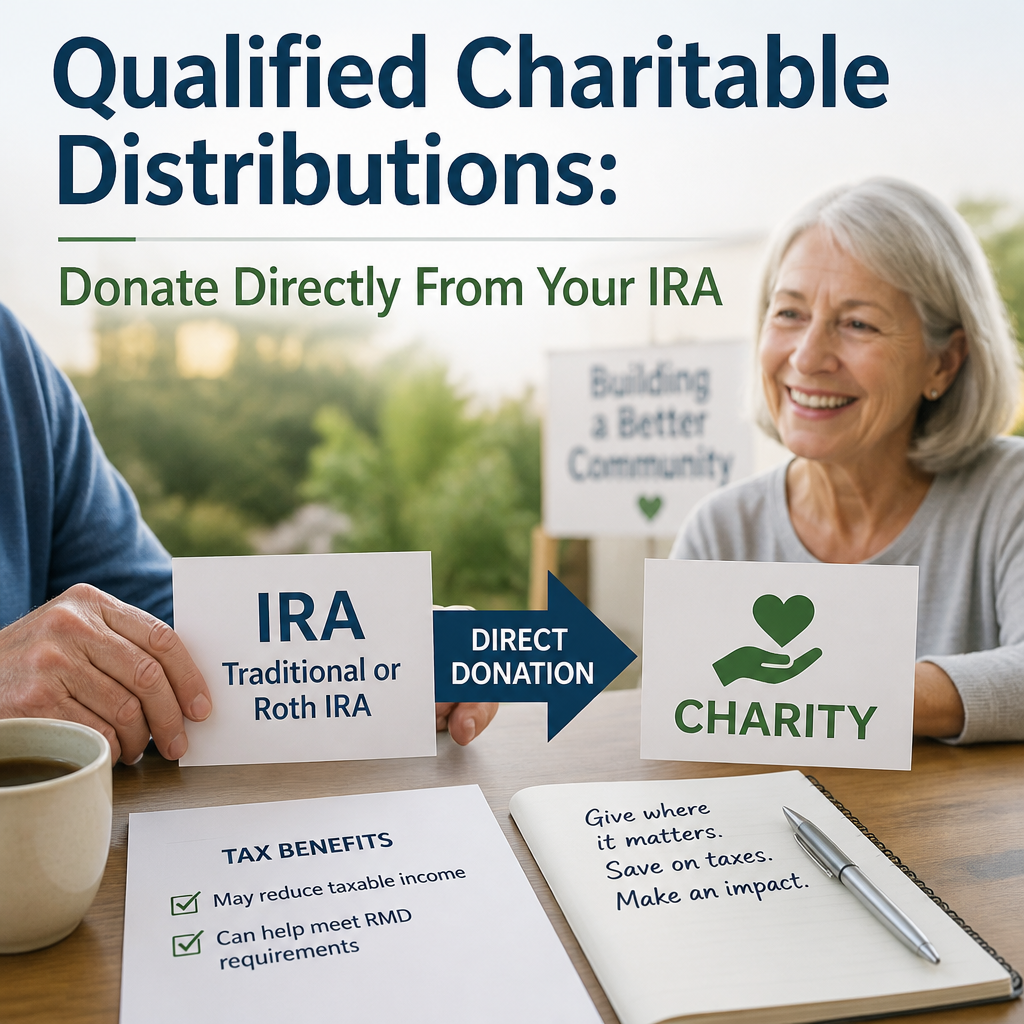
A qualified charitable distribution is a transfer of funds from an individual retirement account directly to an eligible charity. Instead of taking the money out of your IRA, paying income tax on the withdrawal, and then donating cash separately, the IRA custodian sends the money straight to the charity.
That direct transfer is the key difference. When done correctly, the distribution may count toward your required minimum distribution, or RMD, if you are subject to one. It also may be excluded from your taxable income, which can make it more valuable than a regular charitable donation for some retirees.
Anúncios
QCDs are available only from certain types of IRAs and only to qualified charities. They are not the same as a donor-advised fund contribution, and they are not available from every retirement account.
Why QCDs Matter
Qualified charitable distributions can be especially helpful because they may:
Reduce taxable income
Satisfy part or all of an RMD
Support charitable goals without itemizing deductions
Lower the chance of higher income-based taxes on Medicare premiums or Social Security benefits, depending on your situation
That last point can matter more than people expect. Even if you do not take an itemized charitable deduction, a QCD may still provide tax benefits by keeping your adjusted gross income lower.
How Qualified Charitable Distributions Work
The mechanics are simple, but the process has to be handled correctly.
Basic Steps
Confirm you are eligible.
Generally, you must be at least age 70½ at the time of the distribution.
Use a qualifying IRA.
QCDs are usually made from traditional IRAs, inherited IRAs, and some other eligible IRA accounts.
Request a direct transfer.
The money must go directly from your IRA custodian to the charity.
Keep documentation.
Save records from both the custodian and the charity for tax reporting and proof.
Direct Transfer Is Essential
A QCD only works if the funds move directly from the IRA to the charity. If the money is paid to you first, the IRS generally treats it as a taxable distribution, even if you later donate it.
For example:
Correct: Your IRA custodian sends $5,000 directly to your local food bank.
Incorrect: The custodian sends $5,000 to you, and you write a check to the food bank later.
The first example may qualify as a QCD. The second usually does not.
Who Can Make Qualified Charitable Distributions?
Not every IRA owner qualifies automatically. The main requirements are tied to age, account type, and the charity receiving the gift.
Age Requirement
You must be 70½ or older when the distribution is made. This age rule is specific to QCDs and is different from the age for beginning RMDs, which currently is based on federal law and can differ depending on your birth year.
Eligible Accounts
Qualified charitable distributions generally can be made from:
Traditional IRAs
Inherited IRAs
IRA rollover accounts
In many cases, QCDs can also be made from Roth IRAs, but because Roth IRA withdrawals are often already tax-free for qualified owners, the tax benefit may be limited. It is still important to check the rules carefully.
Ineligible Accounts
QCDs generally cannot be made from:
Employer-sponsored retirement plans such as 401(k)s
403(b) plans
SEP IRAs and SIMPLE IRAs if they are receiving employer contributions, unless specific conditions are met and the plan has been rolled into an IRA
If you want to use a charitable distribution strategy, confirm the account type before submitting any request.
Qualified Charitable Distributions and Required Minimum Distributions
One of the biggest advantages of qualified charitable distributions is their connection to RMDs.
If you are required to take minimum distributions from a traditional IRA, a QCD can often count toward all or part of that annual requirement. This can be useful if you do not need the full RMD for living expenses and prefer to give some or all of it to charity.
Why This Can Be Better Than Taking the RMD First
If you withdraw the RMD personally and then donate it:
The withdrawal is taxable income
The charitable gift may only help if you itemize deductions
The deduction may be limited by tax rules
If you use a QCD instead:
The amount may be excluded from income
The distribution can satisfy the RMD requirement
You may not need to itemize to get a tax benefit
For many retirees, this creates a more efficient giving strategy than a standard cash donation.
Limits on Qualified Charitable Distributions
QCDs are powerful, but they are not unlimited. The IRS sets annual limits on the amount you can give through qualified charitable distributions.
Annual Maximum
There is an annual cap on QCDs per individual. That limit is indexed and can change over time, so it is important to verify the current amount before making a transfer.
Per-Person Rule
The limit applies per IRA owner, not per charity. You can divide your QCD among multiple qualified charities if you wish, as long as you stay within the annual cap.
RMD Coordination
If your required minimum distribution is smaller than the annual QCD limit, you can still only exclude the amount transferred. If your RMD is larger than the QCD limit, you can use a QCD to cover part of it and take the rest as a taxable distribution.
Which Charities Qualify?
Not every nonprofit is eligible to receive a qualified charitable distribution.
Certain government entities for public purposes, if permitted
Generally Not Eligible Recipients
QCDs usually cannot go to:
Donor-advised funds
Private foundations
Supporting organizations in many cases
Most charitable trusts
This is an important distinction. A donor-advised fund may be a useful charitable tool, but it is typically not a valid recipient for a qualified charitable distribution.
Before sending money, verify that the charity is eligible. Many charities know how to receive QCDs and can tell you exactly how to title the check or transfer instructions.
Tax Benefits of Qualified Charitable Distributions
The main tax advantage of a qualified charitable distribution is that the amount transferred may be excluded from your taxable income.
What That Means in Practice
Suppose you would normally owe tax on an IRA withdrawal. If you instead use a QCD:
The income may not show up in your adjusted gross income
You may lower your taxable income without needing an itemized deduction
You may preserve other tax breaks that phase out at higher income levels
That can be especially valuable for retirees who do not itemize because of the higher standard deduction. In that case, a traditional charitable deduction may not provide any tax benefit, but a QCD still could.
Possible Secondary Benefits
Lowering adjusted gross income may also help with:
Medicare premium planning
Social Security taxation
Capital gain tax planning
Income-related phaseouts for other deductions or credits
These effects depend on your full tax picture, but they are one reason QCDs are often discussed in retirement tax planning.
Common Mistakes to Avoid
Qualified charitable distributions are straightforward once you know the rules, but small errors can disqualify the transfer or reduce the tax benefit.
1. Taking the Money Yourself First
This is the most common mistake. The money must go directly from the IRA custodian to the charity.
2. Donating to an Ineligible Organization
A charity that seems legitimate may still not qualify for QCD treatment. Always verify the recipient.
3. Missing the Deadline
The transfer must be completed by the end of the tax year if you want it to count for that year. Waiting until late December can be risky if the custodian needs processing time.
4. Forgetting to Report It Properly
The IRA distribution will still appear on your tax forms. You may need to report the QCD correctly on your tax return so it is not taxed as ordinary income.
5. Ignoring State Tax Rules
Federal treatment of qualified charitable distributions is one thing; state tax treatment may differ. Check how your state handles IRA distributions and charitable giving.
How to Set Up a Qualified Charitable Distribution
If you are thinking about using a QCD, a simple plan can help you avoid mistakes.
Practical Checklist
Confirm you are age 70½ or older
Review your IRA type
Choose a qualified charity
Contact your IRA custodian
Ask for a direct charitable transfer or trustee-to-charity distribution
Make sure the check is payable to the charity, not to you
Keep written confirmation from the charity
Save your tax forms and any related statements
Example
Let’s say Maria is 76 and wants to support her church and a local shelter. She does not need her full IRA distribution for living expenses. Instead of taking a taxable withdrawal and donating later, she asks her IRA custodian to send $3,000 directly to the church and $2,000 to the shelter.
If both organizations qualify, Maria may be able to exclude the $5,000 from income and count it toward her RMD, depending on her situation. She also simplifies her tax filing because the money never enters her personal checking account.
When a QCD Makes the Most Sense
Qualified charitable distributions tend to work best for people who:
Are age 70½ or older
Have traditional IRA assets
Want to support charity regularly
Do not need every IRA dollar for spending
Prefer to lower taxable income rather than claim a deduction
Already take or are approaching RMDs
They may be less helpful if you:
Need the full IRA withdrawal for expenses
Want to give to a donor-advised fund
Hold most retirement money in an employer plan
Are not yet eligible by age
That said, the strategy can still be worth reviewing with a tax professional if you are close to eligibility or have multiple retirement accounts.
Working With a Tax Professional or Custodian
Because retirement and tax rules can change, it is wise to coordinate with both your IRA custodian and a qualified tax advisor before making a large QCD.
A tax professional can help you:
Confirm eligibility
Avoid reporting errors
Coordinate QCDs with RMDs
Understand the impact on adjusted gross income
Compare QCDs with other giving strategies
Your custodian can help you:
Process the transfer correctly
Prepare the proper paperwork
Make sure the charity receives the funds in a compliant way
A little planning can prevent the most common QCD mistakes and help make the gift count the way you intended.
Frequently Asked Questions
What is a qualified charitable distribution?
A qualified charitable distribution is a direct transfer of money from an eligible IRA to a qualified charity. When the rules are followed, the amount may be excluded from taxable income and can count toward a required minimum distribution.
Can I make a qualified charitable distribution from a 401(k)?
Generally, no. QCDs usually come from IRAs, not employer-sponsored retirement plans like 401(k)s or 403(b)s. If your money is still in a workplace plan, you may need to roll it into an IRA first, and even then you should review the rules carefully with a tax professional.
Do qualified charitable distributions need to go to one charity?
No. You can split a QCD among multiple qualified charities, as long as each recipient is eligible and the total stays within the annual limit. Many retirees use this approach to support several organizations in one tax year.
Can a QCD go to a donor-advised fund or private foundation?
Usually not. Donor-advised funds and private foundations are generally not eligible recipients for qualified charitable distributions. The transfer must go to a qualified public charity or another eligible organization under the rules.
Will a QCD lower my taxes even if I do not itemize?
Often, yes. That is one of the biggest advantages of a QCD. Because the distribution may be excluded from income, you may receive a tax benefit even if you take the standard deduction and do not itemize charitable gifts.
Qualified charitable distributions offer a practical way to combine retirement income planning with meaningful philanthropy. For eligible IRA owners, a QCD can do more than support a favorite charity. It can also help reduce taxable income, manage required minimum distributions, and simplify year-end tax planning. The strategy works best when you understand the rules, choose an eligible charity, and arrange the transfer correctly through your IRA custodian.
If you are age 70½ or older and do not need every dollar from your IRA, a qualified charitable distribution may be one of the most effective ways to give. It is especially useful for retirees who want tax-efficient charitable giving without relying on itemized deductions. Before making your first QCD, review your account type, confirm the charity is eligible, and keep careful records for tax filing. A small amount of planning can turn a simple gift into a smarter financial move.
Mary S, CFP®, is a Certified Financial Planner with over 12 years of experience in personal finance, retirement planning, and wealth management. She writes educational content that helps readers understand financial concepts and make informed decisions based on reliable information.