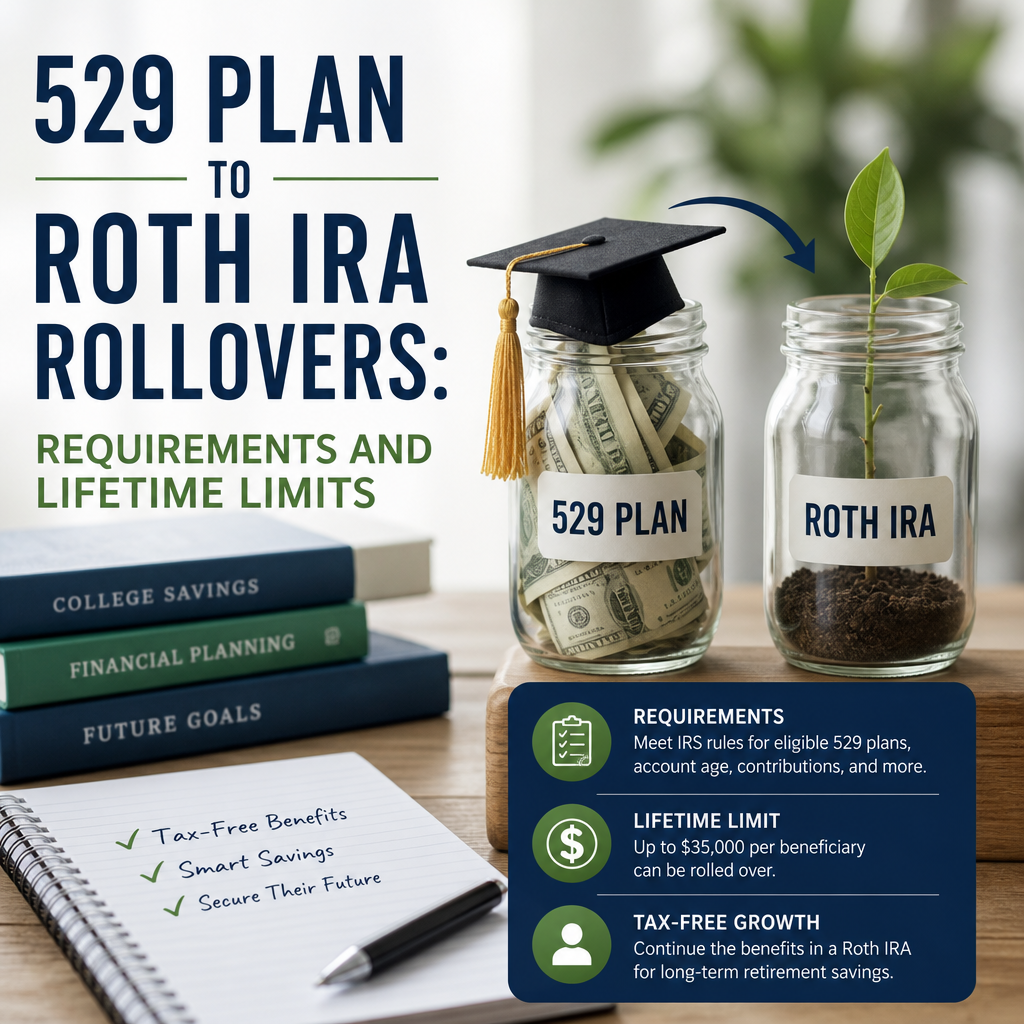
529 Plan to Roth IRA Rollovers: Requirements and Lifetime Limits
Leftover education savings don’t have to go to waste—there’s now a tax-smart way to move eligible funds with a 529 to Roth IRA rollover. Learn the key requirements, annual caps, and lifetime limits before you transfer money from education savings to retirement savings.
By: Mary Mitchell on August 3, 2026
Anúncios
Saving for education is one of the smartest ways to plan ahead, but sometimes a 529 plan ends up with money left over. In the past, that often created a tax problem or a difficult decision about what to do with unused funds. Today, 529 plan to Roth IRA rollovers give families a more flexible option for turning leftover education savings into retirement savings.
This change matters because it can help account owners avoid wasting unused 529 assets while giving the beneficiary a head start on long-term investing. Still, the rules are specific. There are eligibility requirements, annual rollover limits, and lifetime limits you need to understand before moving money from a 529 plan to a Roth IRA.
Anúncios
What Is a 529 Plan to Roth IRA Rollover?
A 529 plan to Roth IRA rollover allows certain unused funds from a qualified education savings plan to be transferred into a Roth IRA for the same beneficiary. The goal is simple: if the money is no longer needed for education, it may still help the beneficiary build tax-advantaged retirement savings.
A Roth IRA is attractive because:
Anúncios
Contributions are made with after-tax dollars
Investments may grow tax-free
Qualified withdrawals in retirement are generally tax-free
For families with leftover 529 money, this rollover can be a useful backup plan. But it is not an open-ended transfer. The IRS sets conditions on who qualifies, how much can be rolled over, and when the rollover is allowed.
Why This Option Matters
Many families fund 529 plans with the best intentions, but not every child uses the full balance for college or trade school. Common reasons for leftover money include:
Scholarships
Lower-than-expected tuition costs
Community college attendance
Graduation with savings still in the account
Changing education plans
Without a rollover option, families might have to change beneficiaries, keep the account open for future education expenses, or face taxes and penalties on nonqualified withdrawals. 529 plan to Roth IRA rollovers create a more forgiving outcome and help preserve the account’s tax benefits.
Key Requirements for 529 Plan to Roth IRA Rollovers
The IRS has several rules that must be met before a rollover can happen. These requirements are designed to prevent abuse and ensure the transfer is used for the same beneficiary.
1. The 529 Account Must Have Been Open for at Least 15 Years
One of the most important rules is that the 529 plan must have been open for at least 15 years before the rollover can occur.
That means the clock starts from the date the account was established, not from the date the money was deposited. If you opened the plan recently, you generally cannot use this rollover option yet.
2. The Roth IRA Must Be in the Beneficiary’s Name
The rollover must go into a Roth IRA owned by the same beneficiary listed on the 529 plan. You cannot roll 529 funds into:
A parent’s Roth IRA
A sibling’s Roth IRA
A grandparent’s retirement account
This rule keeps the benefit tied to the original student beneficiary.
3. The Beneficiary Must Have Earned Income
Like any Roth IRA contribution, the beneficiary must have earned income at least equal to the rollover amount. This is a critical point.
Examples of earned income include:
Wages from a job
Self-employment income
Tips reported as income
Things that do not count as earned income include:
Investment income
Gifts
Allowances
Unemployment benefits
If the beneficiary does not have enough earned income for the year, the rollover amount is limited accordingly.
4. The Beneficiary Must Be Within Roth IRA Contribution Eligibility Rules
The rollover must fit within general Roth IRA rules, including annual contribution limits and income-related requirements. While the 529 rollover is treated differently from a normal contribution in some respects, the beneficiary still needs to have a valid Roth IRA and meet the basic framework for contributions.
5. The Rollover Must Stay Within Lifetime Limits
There is also a lifetime limit on how much can be rolled over from a 529 plan to a Roth IRA. This is a major part of the rule set and one of the most important numbers to understand before planning a transfer.
Understanding the Lifetime Limit
The lifetime rollover limit is designed to prevent someone from moving a large 529 balance into a Roth IRA all at once. Instead, the IRS allows the transfer in smaller amounts over time, subject to the law’s cap.
While the exact amount is subject to statutory rules and may be updated by future legislation or IRS guidance, the current framework places a lifetime ceiling on total 529-to-Roth IRA rollovers per beneficiary. This means:
The total amount rolled over cannot exceed the lifetime cap
Prior rollovers count against that cap
The beneficiary must still have earned income to support the rollover
Annual Roth IRA contribution rules still matter
Because these limits are tied to federal tax law, it is smart to confirm current guidance before making a transfer. The rollover is useful, but it is not designed to move an entire 529 balance into retirement savings.
Annual Rollover Rules You Need to Know
In addition to the lifetime limit, there is also an annual cap on how much can be rolled over in a given year. This helps prevent large transfers and spreads the tax advantage over time.
How the Annual Limit Works
The annual amount that can move from a 529 plan to a Roth IRA is generally limited by:
The beneficiary’s earned income for the year
The Roth IRA contribution limit for that tax year
The remaining lifetime rollover balance
In practice, the rollover amount is often the lowest of those applicable limits.
Example
Suppose a beneficiary:
Earns $5,000 from a part-time job
Has a valid Roth IRA
Has enough remaining lifetime rollover room
Even if the 529 account has much more than $5,000, the rollover may be capped at $5,000 for that year because the beneficiary’s earned income is only $5,000.
This is why careful planning matters. A family may need to spread rollovers across several years to use the option effectively.
What Happens to the 529 Account After a Rollover?
The 529 account does not disappear after one rollover. It can remain open if there is still money left in it. Families may choose to:
Make additional rollovers in future years, if eligible
Keep the funds for future education expenses
Change the beneficiary to another qualifying family member
Use the account for apprenticeship or certain other qualified expenses, depending on the plan and rules
Withdraw the funds and pay any applicable taxes and penalties on nonqualified distributions
For many families, the rollover is just one piece of a broader strategy. The best choice depends on the account balance, the beneficiary’s earnings, and whether more education costs are likely.
Common Mistakes to Avoid
The rules around 529 plan to Roth IRA rollovers are useful, but small errors can create unnecessary tax issues or block the transfer.
1. Assuming Any 529 Can Be Rolled Over
The account must meet the 15-year rule. If the 529 is too new, the rollover is not available.
2. Forgetting About Earned Income
No earned income usually means no rollover, or at least no rollover beyond the income limit. This is one of the most common stumbling blocks.
3. Missing the Beneficiary Match
The beneficiary on the 529 must be the same person who owns the Roth IRA receiving the money.
4. Overlooking the Lifetime Cap
Some families think they can move the full leftover balance over time. The lifetime limit prevents that.
5. Waiting Too Long to Plan
Because rollovers depend on annual earned income and contribution limits, timing matters. A year with low earnings may reduce the available rollover amount.
Practical Ways to Use This Rule Wisely
A 529-to-Roth rollover can be especially helpful if the beneficiary is starting adulthood and beginning to work. Here are a few practical scenarios.
Scenario 1: Student Graduates With Leftover Funds
A student finishes college with $10,000 remaining in a 529 plan. The account has been open long enough, and the student begins a full-time job. Instead of withdrawing the money and paying tax on earnings, the family may be able to roll over part of the balance into the student’s Roth IRA over several years.
Scenario 2: A Part-Time Worker with Modest Earnings
A recent graduate earns $3,000 in one year through part-time work. If eligible, that year may allow only a $3,000 rollover amount, even if more funds remain in the 529 plan.
Scenario 3: A Long-Term Strategy for Excess Savings
Parents who overfunded a 529 plan may use the rollover opportunity as a retirement boost for the child. This can be a meaningful way to repurpose unused education dollars without losing tax advantages.
How to Think About Taxes and Paperwork
A 529 plan to Roth IRA rollover is not something to rush. The process can involve coordination between the 529 plan administrator and the Roth IRA provider.
Before moving money, confirm:
The 529 account meets the 15-year requirement
The beneficiary has earned income
The rollover amount is within annual and lifetime limits
The Roth IRA provider can accept the transfer
You understand how the transaction will be reported for tax purposes
If you are unsure, a qualified tax professional or financial advisor can help you evaluate whether the rollover makes sense for your family.
When a Rollover May Not Be the Best Choice
Even though this option is valuable, it is not always the best move. You may want to consider alternatives if:
The beneficiary still has future education plans
The 529 account is needed for graduate school or professional training
The beneficiary has little or no earned income
The account has not been open long enough
The remaining balance is larger than the rollover limits allow
In some cases, preserving the 529 for future qualified education expenses may provide more value than using the rollover feature right away.
Frequently Asked Questions
1. Can any 529 plan be rolled over to a Roth IRA?
No. The 529 account must have been open for at least 15 years, and the rollover must meet IRS eligibility requirements. The beneficiary also needs earned income, and the transfer must stay within annual and lifetime limits.
2. Does the beneficiary need a Roth IRA already open?
Yes, the rollover goes into a Roth IRA for the same beneficiary. In most cases, the receiving Roth IRA must be established before the transfer can happen.
3. What counts as earned income for a 529-to-Roth rollover?
Earned income usually includes wages, salary, tips, and self-employment income. Investment earnings, gifts, and allowances generally do not count.
4. Can I roll over all of the leftover 529 money at once?
Usually not. The rollover is limited by annual rules, earned income, Roth IRA contribution limits, and the lifetime cap. Many families need to spread rollovers across several years.
5. What if my child does not have enough income in a given year?
If the beneficiary’s earned income is low, the rollover amount is generally limited to that income amount. If there is no earned income, the rollover may not be possible for that year.
529 plan to Roth IRA rollovers offer a valuable way to preserve the tax advantages of education savings even when a beneficiary no longer needs all of the money for school. For families with leftover 529 funds, this rule can turn an unused education account into a meaningful retirement head start. But the opportunity comes with important conditions: the account must be old enough, the beneficiary must have earned income, and both annual and lifetime limits apply.
The best results usually come from planning ahead. If you think your 529 balance may not be fully needed for education, it helps to track the account’s age, the beneficiary’s income, and any future education goals. That way, you can decide whether to use the rollover, keep the account open, or consider another qualified option.
Understanding the rules now can help you avoid mistakes later and make a smarter choice with money you’ve already set aside. If you want to get the most value from your education savings, this is a strategy worth learning carefully and using intentionally.
Mary S, CFP®, is a Certified Financial Planner with over 12 years of experience in personal finance, retirement planning, and wealth management. She writes educational content that helps readers understand financial concepts and make informed decisions based on reliable information.