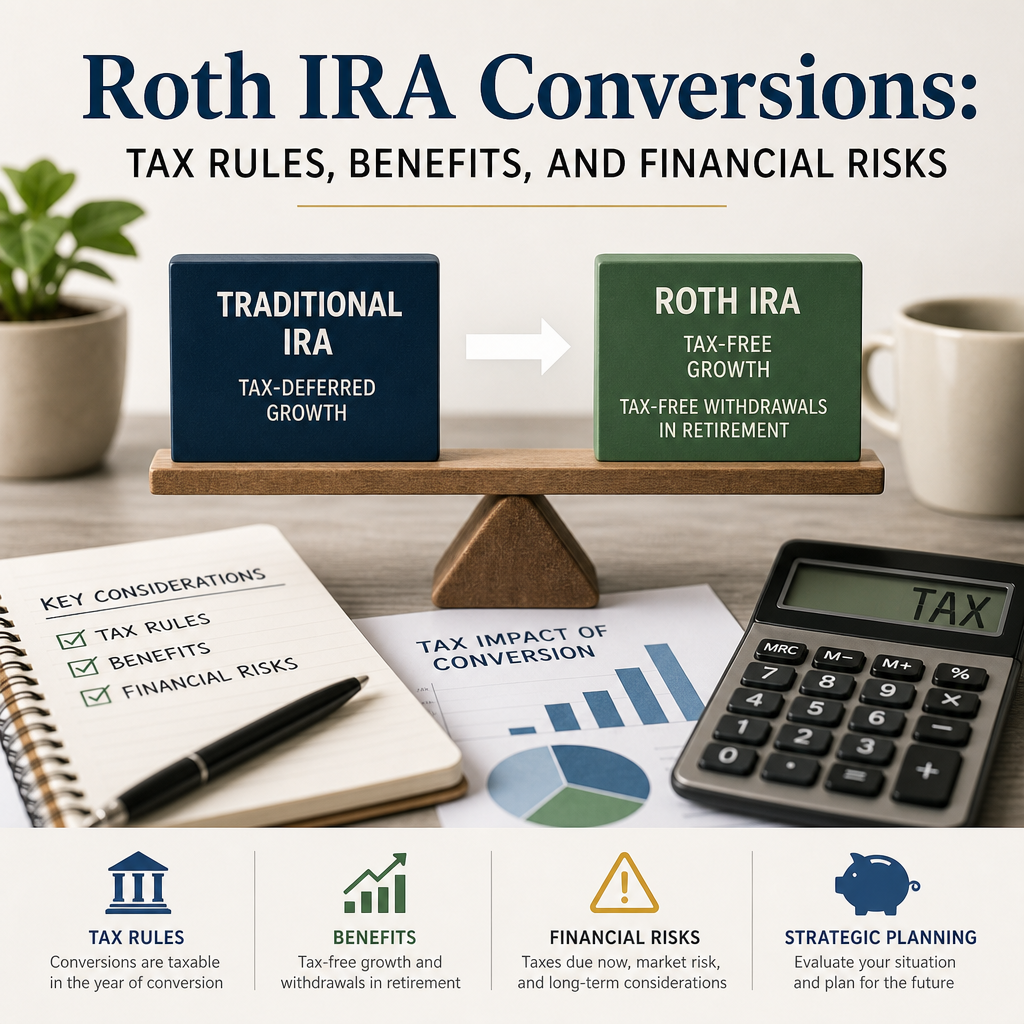
Roth IRA Conversions: Tax Rules, Benefits, and Financial Risks
A Roth IRA conversion can help you build tax-free retirement income, but it also creates an immediate tax bill that can change the timing and value of the move. Before converting, it’s important to weigh the tax rules, long-term benefits, and potential risks to your overall financial plan.
By: Mary Mitchell on August 3, 2026
Anúncios
A Roth IRA conversion can be a powerful move for long-term retirement planning, but it is not a decision to make lightly. Converting money from a traditional IRA, SEP IRA, or SIMPLE IRA into a Roth IRA can create valuable tax-free growth later, yet it also triggers immediate tax consequences and may affect your financial plan in ways that are easy to overlook.
If you’re considering a Roth IRA conversion, the key is understanding how the tax rules work, what benefits you may gain, and what risks could make the move less attractive. Done strategically, a conversion can support tax diversification, estate planning, and future retirement flexibility. Done hastily, it can create an unnecessary tax bill or disrupt your cash flow.
Anúncios
What Is a Roth IRA Conversion?
A Roth IRA conversion is the process of moving money from a pre-tax retirement account into a Roth IRA. Most people convert from:
Traditional IRA
SEP IRA
SIMPLE IRA, if the account meets IRS conversion rules
Rollover IRA
The money you convert is generally treated as taxable income in the year of the conversion, but future qualified withdrawals from the Roth IRA are tax-free.
Anúncios
Why people consider a conversion
A Roth IRA conversion may appeal to people who want:
Tax-free withdrawals in retirement
No required minimum distributions during their lifetime
More control over taxable income later
A way to pass tax-advantaged assets to heirs
That said, the “right” strategy depends on your current tax bracket, expected retirement income, time horizon, and whether you can pay the conversion tax without tapping retirement funds.
How Roth IRA Conversion Tax Rules Work
The most important feature of a Roth IRA conversion is that it is usually a taxable event. When you move pre-tax money into a Roth account, the converted amount is added to your ordinary income for the year.
Ordinary income tax treatment
Converted funds are taxed at your marginal ordinary income tax rate, not the lower long-term capital gains rate. That means the size of the conversion matters.
For example:
If you convert $20,000 and your tax bracket is 22%, the conversion could add roughly $4,400 in federal income tax, before considering state taxes.
If the conversion pushes you into a higher bracket, part of the amount may be taxed at a higher rate.
Pro-rata rule for nondeductible IRA contributions
If you have both pre-tax and after-tax money in traditional IRAs, the IRS applies the pro-rata rule. You cannot choose to convert only the after-tax portion. Instead, the tax treatment is based on the ratio of your total pre-tax and after-tax IRA balances.
This rule surprises many investors who made nondeductible IRA contributions over the years. Before converting, it’s important to calculate the taxable portion carefully.
Five-year rules to know
Roth IRAs come with two common five-year considerations:
Five-year rule for earnings
To withdraw earnings tax-free, the account must meet the five-year holding period and you generally must be age 59½ or meet another qualifying exception.
Five-year rule for conversions
Each conversion has its own five-year clock for penalty purposes if you withdraw converted principal early and are under 59½.
These rules matter if you expect to access the funds soon after conversion.
State income tax considerations
Federal taxes are only part of the picture. Depending on where you live, a Roth IRA conversion may also trigger state income tax. Some states have no income tax; others may treat retirement income differently. It’s smart to check your local rules before making a move.
Benefits of a Roth IRA Conversion
A Roth IRA conversion can offer several meaningful advantages, especially for people with a long time horizon.
Tax-free growth and withdrawals
Once in a Roth IRA, investments can grow tax-free. If you follow the rules for qualified withdrawals, you won’t owe tax on earnings later. That can be especially valuable if you expect tax rates to rise or you believe your taxable income will be higher in retirement than it is now.
No required minimum distributions during the owner’s lifetime
Traditional IRAs generally require required minimum distributions (RMDs) starting at a certain age. Roth IRAs, by contrast, do not require lifetime RMDs for the original owner. This gives you more control over when and how you use the money.
That flexibility can help you:
Manage taxable income in retirement
Avoid unnecessary withdrawals
Keep more assets invested longer
Tax diversification
Many retirees benefit from having a mix of taxable, tax-deferred, and tax-free accounts. A Roth IRA conversion can help create tax diversification, which gives you more options when planning withdrawals.
For example, if you have:
A traditional IRA
A Roth IRA
A taxable brokerage account
you can choose which account to draw from based on your tax situation each year.
Potential estate planning advantages
Roth IRAs can also be useful in estate planning. Heirs who inherit a Roth IRA may still face distribution rules, but the withdrawals are generally tax-free if the account has met the requirements. That can preserve more of the account’s value for your beneficiaries.
Financial Risks of a Roth IRA Conversion
Despite the advantages, a Roth IRA conversion comes with real risks. The biggest one is that you pay taxes now in exchange for potential benefits later. If the timing is wrong, the tradeoff may not work in your favor.
Immediate tax bill
The conversion tax can be substantial, especially if you move a large balance at once. If you don’t have enough cash outside the retirement account to pay the tax, you may be forced to use converted funds or other savings, which reduces the long-term benefit.
Using retirement money to pay the tax can also be problematic because:
It reduces the amount that stays invested in the Roth
If you are under 59½, you may owe an early withdrawal penalty on the amount used for taxes
It can weaken your overall retirement plan
Moving into a higher tax bracket
A large conversion can push part of your income into a higher bracket, increasing the total tax cost. This is why many people prefer partial Roth conversions spread across multiple years.
Market risk after conversion
If you convert when markets are high and then the account drops in value, you may have paid tax on a larger balance than what the account is later worth. While no one can predict markets perfectly, timing still matters.
Loss of tax-deferral on converted dollars
Traditional IRAs allow tax-deferred growth. Once you convert, you give up that deferral and pay tax upfront. If you expect to be in a much lower tax bracket later, the conversion may not be beneficial.
Impact on income-based programs
Because a Roth IRA conversion increases taxable income in the conversion year, it can affect things like:
Medicare premiums
Tax credits
Income-related deductions
Social Security taxation, depending on the rest of your income
These indirect costs are easy to miss but can materially affect the decision.
When a Roth IRA Conversion May Make Sense
A Roth IRA conversion tends to be more attractive in certain situations. While everyone’s numbers are different, these are common scenarios where a conversion may fit well.
You expect higher taxes later
If you believe your tax rate will be higher in retirement or in future years, paying tax now may make sense. This is especially relevant for:
Younger investors with decades until retirement
People early in their careers with temporarily low income
Individuals expecting pension income, rental income, or large retirement withdrawals later
You have cash outside the IRA to pay the tax
The best conversions are often paid with money from a taxable account or savings, not from the IRA itself. That allows the full converted amount to keep compounding inside the Roth.
You’re in a low-income year
A lower-income year can be a strategic time for a Roth IRA conversion, such as when you:
Change jobs
Start a business
Retire before RMDs or Social Security begin
Take a sabbatical
Have unusually high deductions or losses that reduce taxable income
You want to reduce future RMDs
If your traditional retirement balances are large, future required distributions could create tax headaches. Converting some assets now may reduce those future distributions and give you more flexibility later.
When a Roth IRA Conversion May Not Be the Best Move
A Roth IRA conversion is not automatically a smart choice. In some cases, it can create more tax cost than benefit.
You need the money soon
If you plan to withdraw the funds within a few years, the tax-free growth may not have time to overcome the conversion tax.
You’re already in a high tax bracket
If your income is already high, the added taxable income may push you into an even more expensive bracket. In that case, the tax cost may outweigh the future benefits.
You don’t have cash to cover the tax
If you need to use retirement money to pay the taxes, the conversion may be less efficient and potentially reduce your long-term retirement security.
You may have large deductions in the future
If you expect your income to fall significantly later, converting now may be less appealing. Paying tax at a lower future rate could be better than paying it today.
Strategies to Make a Roth IRA Conversion More Efficient
A well-timed Roth IRA conversion often depends on careful planning. These strategies can help improve the outcome.
Convert in smaller amounts
Instead of converting everything at once, consider converting just enough to fill up a lower tax bracket. This can smooth out the tax cost over several years.
Coordinate with your tax return
Before converting, estimate how the added income will affect:
Your tax bracket
Credits and deductions
Medicare premiums
State taxes
A tax professional or financial planner can help you model the impact.
Watch the pro-rata rule
If you have multiple IRAs with pre-tax and after-tax money, review your total IRA balances before converting. In some cases, people consolidate accounts or use other planning tools to reduce unwanted tax complications.
Consider a multi-year conversion plan
Large retirement account balances may work better with a phased approach. Converting a portion each year can help control taxes and make the plan more manageable.
Make sure the investment mix still fits your goals
After a conversion, the Roth IRA should still match your asset allocation. A conversion changes the account type, not the need for diversification. Review stocks, bonds, and cash positions just as you would in any other account.
Practical Example of a Roth IRA Conversion
Imagine you have a traditional IRA worth $100,000 and you expect to retire in a lower tax bracket than you’re in now. You also have $20,000 in cash outside the IRA.
You decide to convert $25,000 this year.
Here’s what happens:
The $25,000 is added to your taxable income.
You owe tax on the converted amount based on your income and bracket.
You pay the tax using your cash savings.
The full $25,000 continues growing inside the Roth IRA.
If you follow the rules, future qualified withdrawals may be tax-free.
If instead you converted the full $100,000 at once, the added income could cause a much bigger tax bill and possibly push you into a higher bracket. That’s why many investors prefer measured, year-by-year planning.
Roth IRA Conversion Checklist
Before making a Roth IRA conversion, review these key questions:
What is my current marginal tax rate?
Will the conversion push me into a higher bracket?
Can I pay the tax from non-retirement funds?
Do I have pre-tax and after-tax IRA money that triggers the pro-rata rule?
How will this affect Medicare, credits, and state taxes?
How long do I expect the money to stay in the Roth IRA?
Do I need this money in the near future?
Would partial conversions over several years work better?
Frequently Asked Questions
1. What is the main tax cost of a Roth IRA conversion?
The main tax cost is that the converted amount is generally treated as ordinary income in the year of the conversion. That means you owe income tax at your marginal tax rate, and possibly state income tax as well. The exact cost depends on the amount converted and your total taxable income for the year.
2. Can I undo a Roth IRA conversion if I change my mind?
In some cases, recharacterization was allowed in the past, but current IRS rules do not generally allow you to undo a Roth IRA conversion the way people once could. Because of this, it’s important to plan carefully before converting. Mistakes can be costly, so many investors run the numbers with a tax professional first.
3. Do I need earned income to do a Roth IRA conversion?
No. A Roth IRA conversion does not require earned income. However, you do need to have eligible retirement funds in a traditional IRA, SEP IRA, SIMPLE IRA, or similar account that can be converted under IRS rules.
4. Is a Roth IRA conversion better than making direct Roth contributions?
It depends on your situation. Direct Roth contributions are usually simpler and do not trigger a taxable event, but income limits may reduce or eliminate eligibility. A Roth IRA conversion can help people with higher incomes access Roth benefits indirectly, but it comes with tax costs. The better choice depends on your eligibility, current tax bracket, and long-term plan.
5. How do I know if a Roth IRA conversion will save me money?
You need to compare the tax you pay now with the tax you might pay later. Consider your current bracket, expected future tax rate, how long the money will stay invested, and whether you can pay the tax from outside funds. If the Roth money has many years to grow and you expect higher taxes later, conversion may be attractive. If you need the funds soon or expect lower taxes later, it may not be worth it.
A Roth IRA conversion can be a smart long-term strategy, but only when it fits your broader financial picture. The appeal is clear: tax-free growth, no lifetime RMDs for the original owner, and greater flexibility in retirement. At the same time, the tax rules are unforgiving if you rush the decision. A conversion can raise your taxable income, affect credits and Medicare costs, and create a tax bill that feels much bigger than expected.
The most effective approach is usually thoughtful and gradual. Compare your current tax rate with the rate you expect later, review the pro-rata rule if you have multiple IRA balances, and make sure you have cash available to cover the tax. For many investors, partial conversions over several years offer a balanced way to build Roth assets without creating unnecessary strain.
If you’re planning for retirement, now is a good time to evaluate whether a Roth conversion supports your goals. With careful timing and a clear tax strategy, it can become a valuable part of a resilient retirement plan.
Mary S, CFP®, is a Certified Financial Planner with over 12 years of experience in personal finance, retirement planning, and wealth management. She writes educational content that helps readers understand financial concepts and make informed decisions based on reliable information.