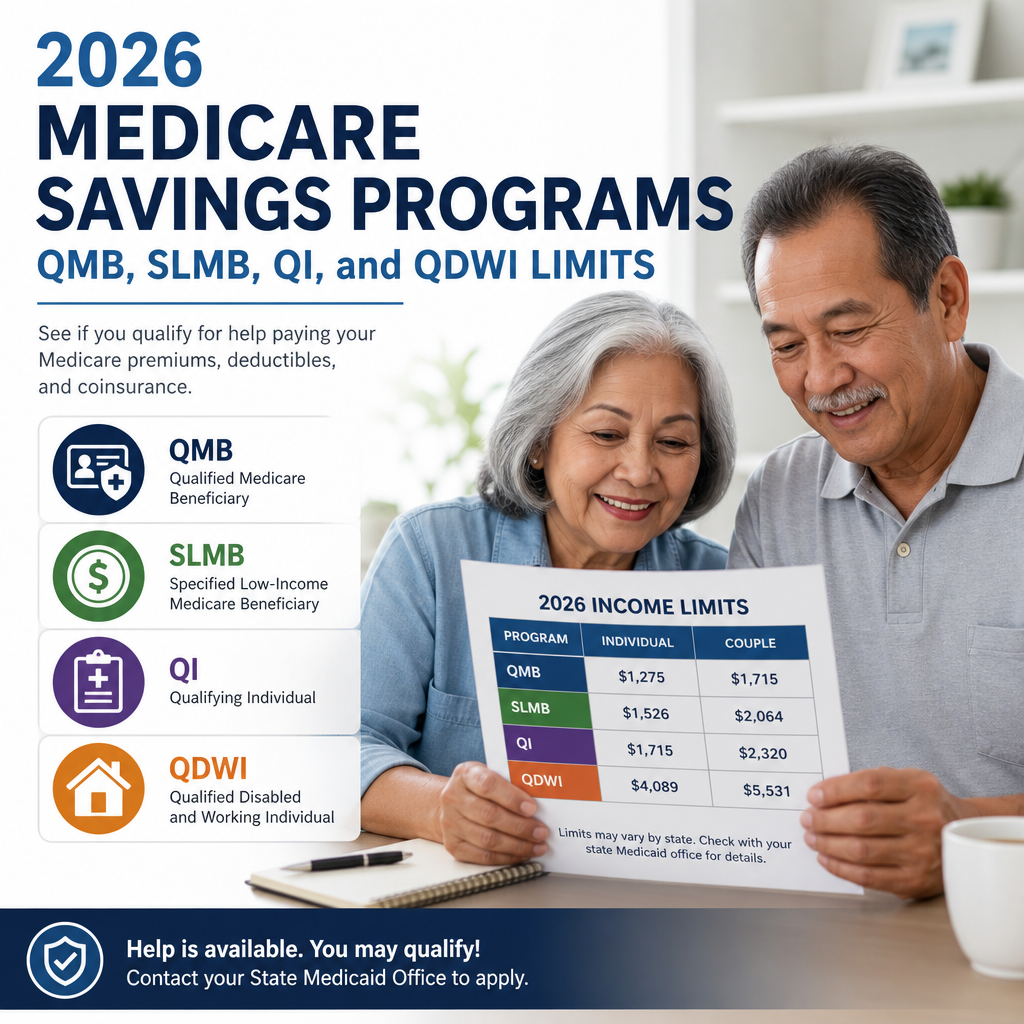
2026 Medicare Savings Programs: QMB, SLMB, QI, and QDWI Limits
The 2026 Medicare Savings Programs can help lower your Medicare costs if you meet the income and resource limits for QMB, SLMB, QI, or QDWI. Here’s a clear guide to what each program covers and how to tell whether you may qualify.
By: Emily Adams on August 3, 2026
Anúncios
Medicare can be expensive, especially when monthly premiums, deductibles, copays, and coinsurance start adding up. That’s where the 2026 Medicare Savings Programs: QMB, SLMB, QI, and QDWI limits matter. These programs can help eligible people with limited income and resources pay some of their Medicare costs, making coverage more affordable and easier to manage.
If you’re trying to understand whether you qualify in 2026, you’re not alone. The rules can feel confusing because each program has different income and resource limits, plus different rules about which Medicare costs they help cover. In this guide, we’ll break down each program in plain English, explain what the limits mean, and show you how to think through eligibility.
Anúncios
What Are Medicare Savings Programs?
Medicare Savings Programs, often called MSPs, are state-run assistance programs that help people with low income and limited assets pay Medicare-related expenses. Even though the federal government sets the framework, your state Medicaid agency usually handles eligibility and enrollment.
The four main Medicare Savings Programs are:
Anúncios
QMB — Qualified Medicare Beneficiary
SLMB — Specified Low-Income Medicare Beneficiary
QI — Qualifying Individual
QDWI — Qualified Disabled and Working Individual
Each program has its own purpose:
QMB helps pay Part A and Part B premiums, plus Medicare cost sharing
SLMB helps pay Part B premiums
QI also helps pay Part B premiums
QDWI helps certain disabled workers pay the Part A premium
The 2026 Medicare Savings Programs: QMB, SLMB, QI, and QDWI limits are especially important because eligibility depends on countable income and, for some programs, countable resources.
Why the 2026 Limits Matter
Medicare Savings Program limits change over time, usually because they are tied to federal poverty guidelines and other federal rules. That means the income thresholds for 2026 may be different from prior years.
Understanding the 2026 Medicare Savings Programs: QMB, SLMB, QI, and QDWI limits can help you:
See whether you qualify before applying
Avoid missing out on premium assistance
Better plan your monthly Medicare expenses
Understand why your state may ask about income and assets
If you’ve recently retired, lost income, or are managing a disability, these programs may be worth checking even if you assumed you made too much to qualify.
Because states can use different methods to count income and resources, the exact figures can vary slightly depending on where you live. Still, the federal guidelines provide a clear framework for most applicants.
QMB Income and Resource Limits
The Qualified Medicare Beneficiary (QMB) program is the most generous of the four. It may help pay:
Medicare Part A premiums, if you owe them
Medicare Part B premiums
Deductibles
Copayments
Coinsurance
To qualify, your income and resources must fall within the QMB limits set for 2026. In many cases, states use a monthly income test based on a percentage of the federal poverty level and a resource test for countable assets.
Important note: Some assets do not count, such as:
Your primary home
One vehicle
Certain personal belongings
Burial expenses, depending on state rules
QMB can be especially valuable because it may protect you from Medicare cost sharing at the point of care. In many cases, providers should not bill you for Medicare-covered services beyond allowed amounts.
SLMB Income and Resource Limits
The Specified Low-Income Medicare Beneficiary (SLMB) program helps pay Medicare Part B premiums only. It does not usually cover deductibles or coinsurance.
SLMB has a higher income limit than QMB, which means more people may qualify. However, applicants still need to meet the program’s resource requirements if their state uses them.
SLMB can be useful for people who:
Have Medicare Part A
Pay a monthly Part B premium
Have income just above the QMB threshold
Even though SLMB helps with just one premium, that monthly savings can make a meaningful difference over the course of a year.
QI Income and Resource Limits
The Qualifying Individual (QI) program also helps pay Part B premiums. Like SLMB, it does not cover cost sharing, but it can still reduce monthly Medicare expenses.
QI is often viewed as a slightly less restrictive program than SLMB in terms of income. However, there is one major difference: QI funds are limited, and states approve applications on a first-come, first-served basis until available funding runs out.
That means:
You should apply as early as possible
Approval may depend on funding availability
Renewal may require reapplying each year
If you miss QI enrollment one year, you may qualify the next year, so it is worth checking again during annual renewals.
QDWI Income and Resource Limits
The Qualified Disabled and Working Individual (QDWI) program is different from the others. It is designed for certain people under 65 who have a disability, returned to work, and lost premium-free Part A because of that work activity.
QDWI helps pay:
Medicare Part A premiums
This program is often important for disabled workers who want to stay insured but are now responsible for Part A premiums due to their work status.
To qualify for QDWI, you generally must:
Be under age 65
Have a disability
Be working
Not be receiving Medicaid
Meet the income and resource limits
QDWI is a narrower program, but for those who qualify, it can be a critical support.
How Income and Resources Are Counted
Knowing the 2026 Medicare Savings Programs: QMB, SLMB, QI, and QDWI limits is only part of the picture. You also need to understand how states count income and resources.
Countable Income
Income may include:
Social Security benefits
Pension income
Wages
Self-employment income
Unemployment compensation
Interest or dividends
Some income may be excluded depending on the program and state rules. For example, certain small amounts or specific benefits may not count the same way taxable income does.
Countable Resources
Resources usually refer to assets you own, such as:
Checking and savings accounts
Stocks and bonds
Additional real estate
Cash value of some life insurance policies
However, not all assets count. Common exclusions include:
Your home, if it is your primary residence
One vehicle
Household goods
Personal items
Some burial funds or burial plots, depending on rules
Because states may use different methodologies, it helps to confirm how your local Medicaid office counts assets before applying.
QMB vs. SLMB vs. QI vs. QDWI: Key Differences
It’s easy to mix up the four programs, so here’s a simple comparison.
QMB
Helps with Part A premiums, Part B premiums, deductibles, copays, and coinsurance
Has the strictest income/resource limits
Offers the broadest Medicare cost protection
SLMB
Helps with Part B premiums only
Has higher income limits than QMB
Good for people who need help with monthly premiums but not full cost sharing
QI
Helps with Part B premiums only
Usually has income limits similar to or slightly higher than SLMB, depending on year and state rules
Enrollment depends on available funding
QDWI
Helps with Part A premiums only
Designed for disabled individuals who are working
Applies to a specific group and has different eligibility rules
If you’re trying to decide where you fit, start with the most comprehensive program you may qualify for, then move down the list.
How to Check Whether You Qualify in 2026
Here’s a practical way to approach the 2026 Medicare Savings Programs: QMB, SLMB, QI, and QDWI limits.
Step 1: Gather your documents
Collect:
Social Security award letter
Pay stubs or pension statements
Bank statements
Proof of Medicare enrollment
Information about any property or investments
Step 2: Estimate your countable income
Compare your monthly income to your state’s current MSP thresholds for 2026. Be sure to use the right figures for your household size and program type.
Step 3: Review your resources
Add up countable assets, but leave out excluded items like your primary home or one vehicle.
Step 4: Contact your state Medicaid office
State Medicaid agencies handle MSP applications. They can explain:
Which programs are available in your state
What counts as income or resources
Whether your state uses any special rules
Step 5: Apply even if you are unsure
Many people assume they earn too much, but they may still qualify for SLMB or QI. It’s often worth applying and letting the state determine eligibility.
Practical Examples
Example 1: A retiree with limited income
Maria receives Social Security and a small pension. Her income is too high for QMB, but she is below the limit for SLMB. She qualifies for help with her Part B premium, which lowers her monthly Medicare bill.
Example 2: A beneficiary with higher medical expenses
James has a modest income and limited savings. He qualifies for QMB. That means Medicare helps cover not just his premium costs, but also much of his cost sharing for covered services.
Example 3: A disabled worker who returned to employment
Tanya is under 65, has a disability, and returned to work. Because she no longer receives premium-free Part A, she checks whether QDWI can help pay that premium. This keeps her Medicare coverage more affordable while she continues working.
These examples show why the 2026 Medicare Savings Programs: QMB, SLMB, QI, and QDWI limits are worth reviewing carefully. A small difference in income can move someone from one program to another.
Tips for Applying Successfully
A few simple strategies can make the process smoother:
Apply through your state Medicaid agency, not Medicare directly
Double-check household income and resource information
Ask how your state treats burial funds, vehicles, and bank accounts
Reapply if your situation changes
Don’t wait if you may qualify for QI, since funding can run out
If you are denied, ask for the reason in writing. Sometimes an application is denied because of missing documents rather than actual ineligibility.
Frequently Asked Questions
1. What is the difference between Medicare Savings Programs and Extra Help?
Medicare Savings Programs help pay Medicare premiums and, in some cases, cost sharing. Extra Help is a separate program that helps with Medicare prescription drug costs under Part D. Some people qualify for both.
2. Can I qualify for a Medicare Savings Program if I own a home?
Yes, in many cases your primary home is not counted as a resource. Other assets, like bank accounts or investments, may still count depending on the program and your state’s rules.
3. Do Medicare Savings Programs cover prescription drugs?
No, MSPs do not directly pay for prescription drugs. If you need help with drug costs, you may want to look into Extra Help or a Part D plan with low premiums and copays.
4. How often do I need to renew my Medicare Savings Program?
Most states require periodic renewal, often annually. If your income or assets change, you may need to report the change sooner. Keep copies of all notices and renewal forms.
5. What should I do if I think I qualify but was denied?
Review the denial letter carefully and contact your state Medicaid office. You may be able to correct missing information, appeal the decision, or reapply if your circumstances change.
The 2026 Medicare Savings Programs: QMB, SLMB, QI, and QDWI limits can make a real difference for people trying to manage Medicare costs on a fixed or limited income. Whether you need help with premiums, cost sharing, or both, these programs exist to reduce financial pressure and improve access to care.
The key is understanding which program fits your situation. QMB offers the most comprehensive help, SLMB and QI can lower Part B premium costs, and QDWI supports certain disabled workers who need help with Part A premiums. Since eligibility depends on income, resources, and state-specific rules, the safest next step is to review your numbers and contact your state Medicaid office.
If you think you may qualify, don’t assume you’re over the limit. Many people are surprised to learn they meet the requirements for at least one Medicare Savings Program. Taking a few minutes to check can lead to meaningful savings all year long.
Emily A, holds a Master's degree in Public Administration (MPA) and has over 7 years of experience researching federal and state assistance programs. She writes educational content focused on government benefits, public policy, and community resources, using information from official agencies to help readers understand available programs and eligibility requirements.