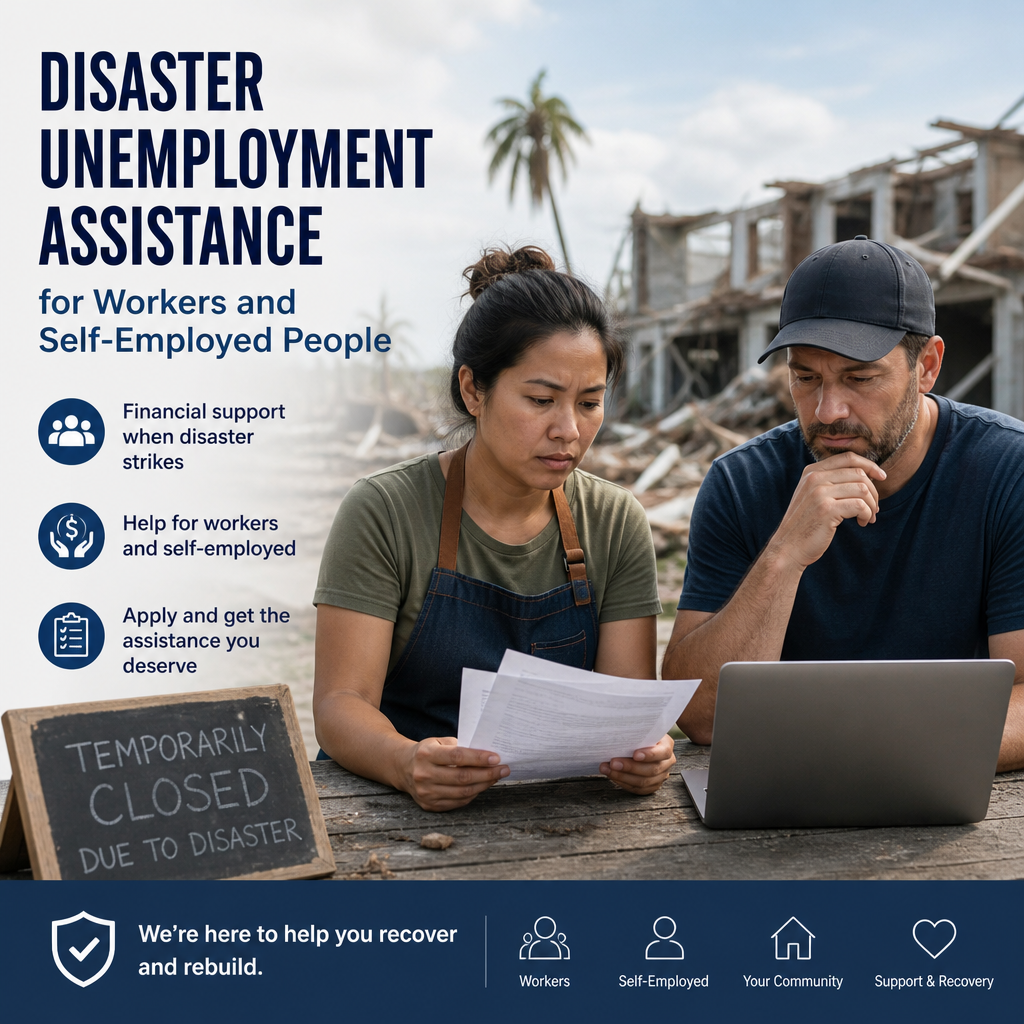
Disaster Unemployment Assistance for Workers and Self-Employed People
Disaster Unemployment Assistance can be a vital lifeline when a federally declared disaster leaves you unable to work and regular unemployment benefits don’t apply. This guide explains who may qualify, how to apply, and what to do next so workers, freelancers, and self-employed people can access help quickly.
By: Emily Adams on August 3, 2026
Anúncios
When a disaster shuts down a business, destroys equipment, or makes a job site unusable, income can disappear overnight. For workers and self-employed people, Disaster Unemployment Assistance can provide a critical financial bridge when regular unemployment benefits are not available. If you have been affected by a federally declared disaster, understanding how Disaster Unemployment Assistance works can help you take the right next steps quickly.
This guide explains who may qualify, what counts as a disaster-related loss of work, how to apply, and what documents you may need. It also covers practical tips for workers, gig workers, freelancers, and independent contractors navigating an already stressful situation.
Anúncios
What Is Disaster Unemployment Assistance?
Disaster Unemployment Assistance (DUA) is a federal program that helps people who lost work because of a major disaster and are not eligible for regular state unemployment benefits. It is especially important for:
Self-employed workers
Independent contractors
Freelancers
Gig workers
Farmers and fishers in some situations
People who were injured in the disaster and cannot work
DUA is different from standard unemployment insurance. Regular unemployment programs typically cover employees who paid into state systems through payroll taxes. By contrast, Disaster Unemployment Assistance is designed to fill gaps after a disaster when many workers lose income but do not qualify for traditional unemployment benefits.
Anúncios
When DUA May Become Available
Disaster Unemployment Assistance is only available after a disaster has been federally declared and the program is activated for affected areas. That means you cannot usually apply unless the disaster qualifies under federal rules.
Common qualifying events may include:
Hurricanes
Floods
Tornadoes
Wildfires
Severe storms
Earthquakes
Other major disasters declared by the federal government
If you live or work in the affected area, your loss of income may qualify even if your home was not damaged, as long as the disaster caused your unemployment or self-employment interruption.
Who Can Qualify for Disaster Unemployment Assistance?
Many people assume DUA is only for employees who lost their jobs, but that is not true. The program is broader and can cover several types of workers.
Self-Employed People
If you run your own business, work as a sole proprietor, or earn income independently, you may qualify if the disaster directly affected your ability to work. This can include:
Freelancers
Consultants
Uber or Lyft drivers
Delivery drivers
Hairstylists renting chairs or working independently
Home-based business owners
Sole proprietors with a physical business location
You may need to show proof that your self-employment was active before the disaster and that the disaster caused the loss of income.
Workers Who Cannot Reach Their Job
You may qualify if the disaster prevented you from getting to your workplace and your employer could not provide work remotely or at another location. Examples include:
Roads washed out by flooding
Bridges or transit lines closed
Mandatory evacuation orders
Unsafe conditions at the workplace
People Injured in the Disaster
If you were injured in the disaster and cannot work, you may qualify even if your job still exists. The key issue is whether the disaster directly caused your inability to work.
People Who Became the Main Caregiver
Disaster Unemployment Assistance may also help if you became the primary caregiver for a family member who was injured in the disaster and therefore cannot work.
Disaster Unemployment Assistance vs. Regular Unemployment
It helps to understand the difference between these two programs.
Regular Unemployment Insurance
Regular unemployment insurance usually applies when:
You worked as an employee
Your employer paid unemployment taxes
You lost your job through no fault of your own
You meet your state’s earnings and work-history requirements
Disaster Unemployment Assistance
DUA applies when:
A federally declared disaster caused your unemployment
You are not eligible for regular unemployment benefits
You are self-employed, a gig worker, or an independent contractor
You were injured, displaced, or unable to reach work because of the disaster
Why This Matters
Many people should apply for regular unemployment first if they are unsure. In some states, the system will automatically determine whether you qualify for regular unemployment or DUA. Since eligibility rules can vary, it is important to file promptly and let the state agency review your situation.
What Counts as Disaster-Related Unemployment?
To qualify for Disaster Unemployment Assistance, your job loss must be directly tied to the disaster. That connection matters.
Here are common examples:
A contractor cannot work because a storm destroyed the job site
A rideshare driver loses access to a flooded city
A freelance photographer cannot operate because equipment was destroyed
A self-employed landscaper cannot work because the disaster damaged tools, trucks, or client properties
A restaurant worker cannot reach work because the area remains closed
Not every hardship qualifies. For example, a slowdown in business unrelated to the disaster may not be enough. The loss must be caused by the disaster itself.
How to Apply for Disaster Unemployment Assistance
The application process usually starts with your state unemployment agency, even though the benefits are federally funded. Each state administers the program in the disaster area.
Step 1: Check Whether the Disaster Was Declared
Before applying, confirm that:
The disaster has been federally declared
Your county or area is included
DUA has been made available for that disaster
State labor agencies and FEMA usually publish updates about eligible locations and deadlines.
Step 2: File a Claim Promptly
Timing is important. DUA claims usually have strict deadlines, and waiting too long can affect your benefits. File as soon as possible after the disaster if you think you may qualify.
Step 3: Provide Your Work History
Be prepared to report your employment or self-employment information. Depending on your situation, you may need:
Employer names and addresses
Dates worked
Type of work performed
Proof of self-employment income
Tax forms or business records
Step 4: Explain How the Disaster Affected Your Ability to Work
The agency will want to know exactly how the disaster caused your unemployment. Be specific. For example:
“My business equipment was destroyed in the flood.”
“I could not reach my job because the highway was closed.”
“My home office was damaged by the wildfire.”
Step 5: Respond to Requests for More Information
The state agency may ask for additional documents or clarification. Respond quickly to avoid delays.
Documents You May Need
Keeping records organized can make a big difference. Even if you lost some paperwork in the disaster, gather as much as you can.
Helpful Documents for Employees
Recent pay stubs
W-2 forms
Employer contact information
Work schedules
Letters showing the workplace closure
Helpful Documents for Self-Employed Workers
Tax returns, especially Schedule C
1099 forms
Bank statements showing business deposits
Invoices and receipts
Business licenses
Appointment books or client records
Photos of damaged equipment or business property
Insurance claims or repair estimates
If Records Were Destroyed
If the disaster damaged your documents, do not assume you are out of options. Agencies may accept alternative proof, such as:
Bank statements
Email correspondence with clients
Digital invoices
Screenshots of payment apps
Statements from customers or business partners
The more evidence you can provide, the easier it is to show that you were working before the disaster and lost income because of it.
How Benefits Are Calculated
Disaster Unemployment Assistance benefits are generally based on what you earned before the disaster. State agencies use federal rules and local procedures to determine the amount.
Your weekly benefit amount may depend on:
Prior earnings
Employment or self-employment history
State calculation methods
Any income you continue to earn after the disaster
If you receive part-time income or temporary work, you may still qualify for reduced benefits, depending on your state rules.
How Long DUA Lasts
DUA is temporary assistance. It is not meant to replace income indefinitely. Benefits usually run for a limited period following the disaster declaration, subject to federal rules and state administration.
If your work remains unavailable after the initial period, you may need to explore other forms of support, such as:
State or local relief programs
Small business disaster loans
FEMA assistance, if eligible
Food, housing, or utility aid from nonprofit organizations
Common Mistakes to Avoid
When applying for Disaster Unemployment Assistance, small mistakes can slow your claim or cause a denial.
1. Waiting Too Long to Apply
Many people delay because they are focused on basic recovery. Unfortunately, missing the deadline can jeopardize benefits.
2. Assuming You Are Not Eligible
Self-employed people often assume unemployment programs do not apply to them. DUA was specifically created to help in these situations.
3. Failing to Document the Disaster Impact
You need to show a clear link between the disaster and your loss of work. Keep records of closures, damage, evacuation notices, or destroyed equipment.
4. Mixing Up DUA and FEMA Help
DUA is income support, while FEMA often helps with disaster recovery needs such as housing or repairs. They are separate programs.
5. Not Following Up
If the agency asks for more information, answer quickly. Unanswered requests can delay or stop benefits.
Practical Examples of DUA Eligibility
Real-world examples can make the rules easier to understand.
Example 1: Freelance Designer After a Hurricane
A freelance graphic designer works from a home office. A hurricane damages the home, destroys the computer, and cuts off internet access for several weeks. Because the disaster caused the loss of work, the designer may qualify for Disaster Unemployment Assistance.
Example 2: Rideshare Driver After Flooding
A rideshare driver cannot operate for days because roads are closed and the city is under emergency restrictions. If the driver is otherwise eligible, DUA may help replace some lost income.
Example 3: Restaurant Employee During a Wildfire
A server cannot reach the restaurant because evacuation orders and road closures keep the area inaccessible. If the employee does not qualify for regular unemployment but the disaster caused the work stoppage, DUA may be available.
Example 4: Independent Contractor With Damaged Equipment
An HVAC contractor loses tools and a work van in a tornado. Without equipment, the contractor cannot accept jobs. This type of disaster-related interruption may support a DUA claim.
Tips for Self-Employed Workers Applying for DUA
Self-employed applicants often face extra documentation challenges, but a strong claim is still possible.
Keep Your Business Records Updated
Maintain digital copies of:
Tax returns
Invoices
Business bank statements
Client contracts
Mileage logs
Payment records
Document Your Normal Work Activity
It helps to show that your self-employment was ongoing before the disaster. That may include:
A client calendar
Marketing materials
A website or online profile
Business registration records
Regular deposits into a business account
Track Disaster-Related Losses
Write down how the disaster affected your work, such as:
Lost clients
Cancelled appointments
Destroyed tools
Office closure
Inability to travel
This kind of documentation can strengthen your claim.
Where to Get Help
If you are unsure about your eligibility, contact your state unemployment agency as soon as possible. Local disaster recovery centers, legal aid organizations, and small business support groups may also help explain your options.
You may also want to reach out to:
State labor department offices
FEMA disaster assistance resources
Small Business Administration disaster recovery programs
Local chambers of commerce or nonprofit aid groups
Legal aid clinics that handle disaster-related benefits
Frequently Asked Questions
1. Can self-employed people get Disaster Unemployment Assistance?
Yes. Self-employed workers, freelancers, independent contractors, and gig workers may qualify if a federally declared disaster caused them to lose work and they are not eligible for regular unemployment insurance. You will usually need to show proof of your self-employment and how the disaster interrupted your income.
2. Do I need to live where the disaster happened to qualify?
Not always. In many cases, eligibility depends on whether you worked in the disaster area or were affected by the disaster in a way that prevented you from working. For example, if you commute into the impacted area or your business serves that market, you may still qualify depending on the circumstances and state rules.
3. What if I am already receiving regular unemployment benefits?
If you already qualify for regular unemployment, you generally receive those benefits first. DUA is mainly for people who are not eligible for regular unemployment or who need disaster-specific assistance. If your work situation changes because of the disaster, your state agency can help determine the correct program.
4. What proof do I need for self-employment?
Proof may include tax returns, 1099 forms, invoices, business bank statements, client records, licenses, or digital payment history. If the disaster destroyed your paperwork, provide alternate evidence such as email records, photos, or statements from customers.
5. How long does it take to receive DUA payments?
Processing times vary by state and by how quickly you submit required documents. Claims with complete paperwork usually move faster. If the agency needs more information, payment may take longer. Responding quickly to all requests can help avoid delays.
Disaster Unemployment Assistance can be a lifeline when a disaster disrupts work, destroys equipment, or makes a job impossible to reach. For self-employed people, freelancers, independent contractors, and workers who do not qualify for regular unemployment, this program can provide essential short-term support during an already difficult recovery period.
The most important step is to act quickly. Confirm whether your area is covered by a federal disaster declaration, gather whatever records you can, and file your claim as soon as possible. If your documents were lost, do not give up—alternative proof may still support your application. By understanding the rules and staying organized, you can improve your chances of receiving the help you need while you rebuild your income and get back to work.
Emily A, holds a Master's degree in Public Administration (MPA) and has over 7 years of experience researching federal and state assistance programs. She writes educational content focused on government benefits, public policy, and community resources, using information from official agencies to help readers understand available programs and eligibility requirements.