Required Minimum Distributions: Retirement Withdrawal Rules Explained
Anúncios
If you’ve saved in tax-deferred retirement accounts for years, required minimum distributions can feel like the point where the rules suddenly get more complicated. But these mandatory withdrawals don’t have to be confusing. Once you understand when they start, how they’re calculated, and which accounts are affected, it becomes much easier to plan ahead and avoid costly mistakes.
Required minimum distributions, often called RMDs, are the minimum amounts the IRS requires you to withdraw from certain retirement accounts once you reach a specific age. The goal is simple: retirement accounts received tax advantages while you were saving, so the IRS eventually collects income tax on that money.
Anúncios
This guide explains required minimum distributions in plain English, including the current rules, who must take them, how they work, and what strategies can help you manage them more effectively.
What Are Required Minimum Distributions?
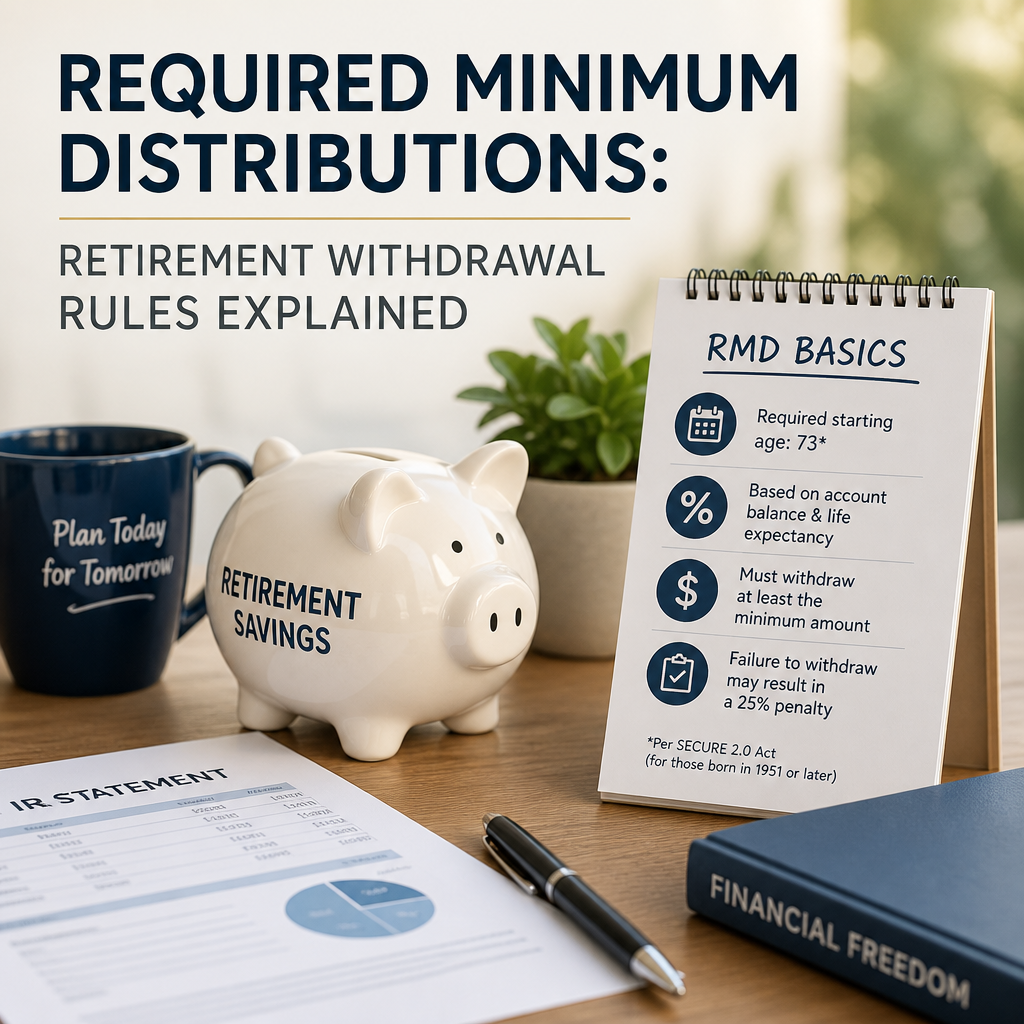
Required minimum distributions are annual withdrawals you must take from most tax-deferred retirement accounts after reaching the IRS starting age. These withdrawals are taxable as ordinary income in most cases.
Anúncios
The idea behind required minimum distributions is to ensure retirement savings don’t grow tax-deferred forever. Since contributions to traditional retirement accounts were often made with pre-tax dollars, the government eventually wants its share.
Common accounts subject to RMDs
Required minimum distributions usually apply to:
- Traditional IRAs
- SEP IRAs
- SIMPLE IRAs
- 401(k) plans
- 403(b) plans
- 457(b) plans, in many cases
Roth accounts work differently. Roth IRA owners are not required to take lifetime RMDs, though Roth 401(k) rules changed recently and may still require withdrawals unless the account is rolled into a Roth IRA.
When Do Required Minimum Distributions Begin?
The starting age for required minimum distributions has changed over time, so it’s important to use the current rules rather than old advice.
Under current law, many people must begin taking RMDs at age 73. For those who reach the applicable age later under future rule changes, that age may increase again according to the law in effect at the time.
The key rule to remember
Your first required minimum distribution is generally due by April 1 of the year after you reach the required beginning age.
That sounds straightforward, but there’s a catch: if you wait until April 1 to take your first RMD, you may also need to take your second RMD by December 31 of the same year. That can create two taxable withdrawals in one calendar year.
Example
Suppose you reach the RMD age in 2025.
- Your first RMD is due by April 1, 2026
- Your second RMD is due by December 31, 2026
This timing can raise your taxable income for that year, so many retirees choose to take their first distribution in the year they first become eligible instead of delaying it.
Which Retirement Accounts Require RMDs?
Not all retirement accounts follow the same withdrawal rules. Knowing which accounts require distributions can help you avoid unnecessary tax surprises.
Accounts that usually require RMDs
- Traditional IRA: Yes, RMDs apply
- SEP IRA: Yes, RMDs apply even if you’re still self-employed
- SIMPLE IRA: Yes, RMDs apply
- Traditional 401(k): Yes, RMDs apply
- 403(b): Yes, RMDs apply
- Most inherited retirement accounts: Usually yes, though rules vary depending on the beneficiary
Accounts that usually do not require RMDs during your lifetime
- Roth IRA: No lifetime RMDs for the original owner
- Health Savings Accounts (HSAs): Not subject to RMDs
- Taxable brokerage accounts: No RMDs
If you’re not sure whether a specific account is subject to required minimum distributions, check the plan documents or speak with the plan administrator.
How Required Minimum Distributions Are Calculated
The IRS calculates required minimum distributions using your account balance and a life expectancy factor from official tables.
Basic formula
The general formula is:
Account balance as of December 31 of the previous year ÷ distribution period = RMD
For example, if your IRA balance on December 31 was $500,000 and your distribution factor is 25.5, your required minimum distribution would be about $19,608.
Why the number changes each year
The distribution period changes as you age, which means your RMD usually increases over time if your account balance remains stable. However, market performance, additional contributions, and withdrawals can also affect the amount.
Multiple accounts can complicate things
For IRAs, you generally calculate the RMD for each IRA separately but may withdraw the total amount from one or more of your IRAs. Employer plans, such as 401(k)s, are different and often require distributions from each plan separately unless you qualify for consolidation or rollover options.
What Happens If You Miss an RMD?
Missing a required minimum distribution can be expensive.
The IRS can impose an excise tax on the amount you should have withdrawn but didn’t. While the penalty rules have become more forgiving in recent years, you should still treat RMD deadlines seriously.
If you miss one
If you realize you missed an RMD, act quickly:
- Take the missed distribution as soon as possible
- File the appropriate IRS form if required
- Consult a tax professional if the situation is complex
The IRS may waive or reduce penalties in certain cases if you correct the error promptly and show reasonable cause.
Strategies to Manage Required Minimum Distributions
You can’t avoid required minimum distributions forever on tax-deferred accounts, but you can plan around them. Smart planning can help reduce taxes, preserve flexibility, and support your retirement goals.
1. Start planning before RMD age
Don’t wait until the year your withdrawals begin. Review your retirement income sources, tax bracket, and spending needs several years in advance.
This gives you time to consider:
- Roth conversions
- Withdrawal sequencing
- Tax bracket management
- Charitable giving strategies
2. Use qualified charitable distributions if eligible
If you’re age 70½ or older, you may be able to make a qualified charitable distribution directly from an IRA to a qualified charity. A QCD can count toward your RMD and may help reduce taxable income.
This strategy can be especially useful if you already give to charity and don’t need every dollar of your RMD for living expenses.
3. Consider Roth conversions earlier in retirement
Roth conversions move money from a traditional IRA or similar account into a Roth IRA, where future growth and qualified withdrawals may be tax-free. Because Roth IRAs do not require lifetime RMDs for the original owner, conversions can reduce future mandatory withdrawals.
This strategy works best when:
- Your current tax rate is relatively low
- You expect higher income later
- You want to reduce future RMDs
- You have cash outside the IRA to pay the taxes
4. Coordinate RMDs with Social Security and other income
Required minimum distributions can affect the taxes on Social Security benefits and Medicare premiums. Even if the RMD itself seems modest, the additional income may push you into a higher tax bracket or increase related costs.
A retirement income plan should look at all sources together, including:
- Pension income
- Social Security
- Taxable investment income
- Part-time work
- RMDs
5. Review beneficiary designations
Beneficiary designations affect how inherited retirement accounts are handled. Some beneficiaries may face their own distribution rules after inheriting an account, and those rules can differ depending on the account type and the relationship to the original owner.
Keeping these designations current helps avoid confusion and potential tax problems.
Required Minimum Distributions and Inherited Accounts
Inherited retirement accounts often have separate distribution rules, and these rules can be more complicated than standard RMDs.
Spouse beneficiaries
A surviving spouse may have more flexibility than other beneficiaries. In some cases, the spouse can:
- Treat the account as their own
- Roll it into their own IRA
- Remain as beneficiary and follow inherited IRA rules
The best choice depends on age, income needs, and tax planning goals.
Non-spouse beneficiaries
Many non-spouse beneficiaries must follow specific withdrawal timelines. In some situations, the account must be emptied within a certain number of years. Because these rules have changed and continue to evolve, inherited account planning is one area where professional advice can be especially valuable.
If you inherit a retirement account, don’t assume the rules are the same as your own RMD schedule.
Common Mistakes to Avoid
Even well-prepared retirees make mistakes with required minimum distributions. A little awareness can help you stay ahead of the curve.
Watch for these issues
- Waiting too long to take the first RMD
- Forgetting that multiple accounts may have separate requirements
- Assuming Roth 401(k)s work exactly like Roth IRAs
- Missing the December 31 deadline for annual withdrawals
- Taking only the amount needed for spending instead of the full required amount
- Ignoring tax withholding and estimated taxes
Tax withholding matters
RMDs are taxable income, so it’s wise to plan for withholding. If you don’t withhold enough, you may owe taxes later and possibly face underpayment penalties. Some retirees prefer to have taxes withheld directly from the distribution.
How to Build RMDs Into Your Retirement Plan
A good retirement plan doesn’t just ask how much you’ve saved. It also asks how you’ll draw income in the most efficient way.
A practical approach
- Estimate your future RMDs several years ahead
- Compare them with your expected spending needs
- Review whether Roth conversions make sense
- Decide whether charitable giving could offset taxable income
- Update the plan each year as account balances and tax laws change
Why this matters
Required minimum distributions can influence:
- Your federal tax bill
- State income taxes
- Medicare-related income adjustments
- Eligibility for certain deductions and credits
- The pace at which your retirement assets are depleted
Planning ahead can make RMDs feel less like a surprise and more like a predictable part of your financial strategy.
Frequently Asked Questions
1. What age do required minimum distributions start?
For many retirees, required minimum distributions begin at age 73 under current law. Your first distribution is generally due by April 1 of the following year. Because tax law can change, it’s smart to confirm the current starting age when you approach retirement.
2. Do Roth IRAs have required minimum distributions?
No. Roth IRAs do not require lifetime RMDs for the original owner. That makes them a valuable estate planning and tax planning tool. However, inherited Roth IRAs may still have distribution rules for beneficiaries.
3. Can I take my RMD from just one IRA?
Yes, for traditional IRAs you can generally calculate the RMD for each IRA and withdraw the total amount from one or more IRAs. Employer-sponsored plans such as 401(k)s usually require separate RMDs from each plan unless you roll assets into an IRA or qualify under specific plan rules.
4. Are required minimum distributions taxable?
Yes, in most cases required minimum distributions from tax-deferred retirement accounts are taxed as ordinary income. The exact impact depends on your overall tax situation, including other income, deductions, and state taxes.
5. What should I do if I missed my RMD?
Take the missed distribution as soon as possible and correct the issue quickly. You may also need to file IRS paperwork explaining the error. In some cases, the IRS may reduce or waive penalties if you have a reasonable cause and act promptly.
Official Resources
- IRS: Retirement Plan and IRA Required Minimum Distributions FAQs
- IRS Publication 590-B: Distributions from Individual Retirement Arrangements (IRAs)
- IRS Topic No. 451: Individual Retirement Arrangements (IRAs)
- U.S. Department of Labor: Retirement Plans
- Consumer Financial Protection Bureau: Planning for retirement
Conclusion
Required minimum distributions are a normal part of retirement planning, but they don’t have to be intimidating. Once you understand when RMDs begin, which accounts are covered, and how the withdrawals are calculated, you can make better decisions about taxes, income timing, and long-term retirement strategy.
The biggest mistake many retirees make is waiting too long to plan. By reviewing your accounts early, understanding how required minimum distributions affect your tax picture, and considering options like Roth conversions or qualified charitable distributions, you can reduce stress and keep more control over your retirement income.
Whether you’re approaching RMD age soon or helping a parent manage inherited accounts, the key is to stay informed and organized. The rules may change over time, but a thoughtful plan gives you the flexibility to adapt. If you’re nearing the point where withdrawals are required, now is the right time to review your accounts, confirm deadlines, and build a strategy that fits your goals.